
US President Signs Order Withdrawing US from 66 International Organisations
International
In News
- The US has withdrawn from 66 international organizations, including 31 UN entities and 35 non-UN bodies.
- The entities include climate/energy/science forums such as the UN Framework Convention on Climate Change (UNFCCC), the Intergovernmental Panel on Climate Change (IPCC), the International Renewable Energy Agency (IRENA), and the International Solar Alliance (ISA).
US Withdrawing
- Sovereignty Concerns: Resistance to binding international rules perceived to constrain domestic policy autonomy.
- Perceived Institutional Bias: Allegations of politicisation, inefficiency, and bias against US or allied interests.
- Domestic Political Pressures: Multilateral commitments viewed as costly with limited direct electoral benefits.
- Burden-Sharing Argument: Claim that the US contributes disproportionately to global institutions.
- Strategic Reorientation: Preference for bilateral or minilateral arrangements over universal institutions.
- Strategic Competition: Desire to limit platforms where rival powers gain influence.
Potential Impacts
- Climate Change Setback: Weakens global efforts to curb greenhouse gas emissions and provides other countries an excuse to delay climate commitments and finance pledges.
- Fragmentation of Multilateralism: Further erodes international governance, intensifies power rivalries, and accelerates a shift towards protectionism and smaller ad-hoc regional blocs.
- Development & Humanitarian Slowdown: US funding cuts worsen already declining international development and humanitarian aid, affecting health, education, food security, and SDG progress.
- Global Peace & Security Risks: Reduced US support to bodies like the UN Peacebuilding Commission hampers peacebuilding and post-conflict recovery, especially in conflict-prone regions such as Africa and the Caribbean.
- Weakening of Global Norms: Encourages selective compliance with international law and treaty obligations by other states.
- Leadership Vacuum: Creates space for other major powers to shape global rules and institutions.
Doomsday Glacier
Geography & Environment
Context
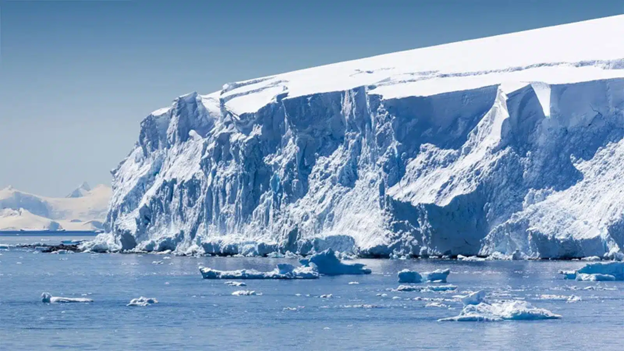
- A new study published in the Journal of Geophysical Research: Earth Surface explains recent structural changes in the Thwaites Glacier region and shows how other Antarctic ice shelves may collapse in the future.
Doomsday Glacier (Thwaites Glacier)
- It is an outflow glacier of the West Antarctic Ice Sheet (WAIS), flowing into the Amundsen Sea.
- It is nicknamed ‘Doomsday Glacier’ due to its potential to cause major sea-level rise.
- The complete destruction of the Doomsday Glacier could lead to a global sea level rise of 3 meters.
Additional Information – Conservation efforts of Antarctic Treaty
- The Treaty covers the area south of 60°S latitude.
- It was signed at Washington D.C. in 1959 with the objective of the Demilitarisation of Antarctica.
- The signatories are supposed to bring laws so that no activity in contravention of the treaty takes place.
- India signed the treaty in 1983.
Convention on the Conservation of Antarctic Marine Living Resources (CCAMLR)
- Signed in – Canberra in 1980
- Objective – To protect and preserve the Antarctic environment and, particularly, for the preservation and conservation of marine living resources in Antarctica.
- India ratified the CCAMLR in 1985.
The Protocol on the Environmental Protection to the Antarctic Treaty (Madrid Protocol)
- Signed in – Madrid in 1991.
- Objective – It aims to strengthen the Antarctic Treaty system and develop a comprehensive regime for the protection of the Antarctic environment and dependent and associated ecosystems.
- India ratified the Madrid Protocol in 1998.
Council of Managers of the National Antarctic Programme (COMNAP)
- India is also a member of the COMNAP which shows the significant position that India holds among the nations involved in Antarctic research.
Madhav Gadgil
Geography & Environment
Context
- Noted ecologist Madhav Gadgil, known for his work on the conservation of Western Ghats, has passed away.
Major Contributions
- In 2010, the Ministry of Environment and Forests appointed Madhav Gadgil to chair the Western Ghats Ecology Expert Panel (WGEEP), known as the Gadgil Commission.
- His 2011 report recommended classifying 64% of the 1,40,000 sq km Ghats, spanning six states, as Ecologically Sensitive Areas (ESAs)
- It led to debate and discussion on the significance of the Western Ghats as an ecological hotspot and the efforts to conserve them.
- He played a key role in declaring the Nilgiris as India’s first biosphere reserve in 1986.
- He later helped shape the Biological Diversity Act, 2002, and Forest Rights Act 2006.
- He served on the Prime Minister’s Scientific Advisory Council and the National Tiger Authority, successfully bridging academic research with grassroots environmental activism.
- His contributions were widely recognised with major honours, including the Padma Shri (1992), Padma Bhushan (2006), the Tyler Prize for Environmental Achievement (2015) and the UNEP Champions of the Earth award (2024).
- Note – The annual Champions of the Earth award is the U.N.’s highest environmental honour awarded for his seminal work in the Western Ghats.


Leave a Reply