
US-Israel-Iran War
International Relations
Context
- Following the launch of Operation Epic Fury (U.S.) and Operation Roaring Lion (Israel), the geopolitical landscape has shifted fundamentally with the confirmed death of Iran’s Supreme Leader, Ayatollah Ali Khamenei.
- Iran retaliated through Operation True Promise 4, launching missile attacks against Israel and nearby Gulf states.
- Iran retaliated with missile and drone attacks on U.S. facilities in Bahrain, Qatar, UAE, Kuwait, and Jordan.
- Iran has effectively closed the Strait of Hormuz through threats and strikes on tankers, reducing shipping traffic by 70% and risking global oil supply disruptions.
US-Israel-Iran war
Background of the Current Escalation
- Long-standing Hostility & Ideological Rivalry: Since the 1979 Islamic Revolution, the S. and Iran have been locked in a “Cold War” posture. This relationship has been defined by severe economic sanctions, the labeling of Iran as a state sponsor of terrorism.
- Collapse of the Nuclear Deal (JCPOA): The withdrawal of the U.S. from the 2015 Nuclear Deal in 2018 triggered a “maximum pressure” campaign.
- Iran responded by gradually breaching enrichment limits, leading the U.S. and Israel to view a nuclear-armed Iran as an imminent existential threat that could no longer be contained by diplomacy alone.
- The “Gray Zone” and Proxy Warfare: For years, the conflict was fought in the shadows via proxies. Iran’s support for the “Axis of Resistance” (Hamas, Hezbollah, and the Houthis) expanded its influence across Lebanon, Syria, Iraq, and Yemen.
Global Implications
- Energy Shock & Inflation: Oil prices likely to surge beyond sustainable levels. Higher transportation and insurance premiums.
- Risk of global stagflation (slow growth + high inflation).
- Global Supply Chain Disruption: Oil, LNG, fertilizers, petrochemicals affected. Shipping rerouted via longer routes which led to increased freight costs.
- China & Russia Factor: China is the largest buyer of Iranian oil. Russia may benefit from high oil prices.
Impact on India
- Energy Inflation: As India imports 85% of its crude, the “war surcharge” on shipping and rising oil prices are putting immense pressure on the rupee.
- Diaspora Safety: With 8–9 million Indians in the Gulf, the Cabinet Committee on Security (CCS) has met to discuss potential large-scale evacuations as commercial flights to the region are being suspended.
- Trade Disruptions: Exports of agricultural goods and imports of essential fertilizers are currently at risk due to maritime insecurity.
- Strategic Connectivity: Chabahar Port (Iran) for Central Asia access; I2U2 (India-Israel-UAE-USA grouping); IMEC (India-Middle East-Europe Corridor); Gulf partnerships (UAE, Saudi Arabia), and Israel relations.
Additional Information – West Asia (Middle East)
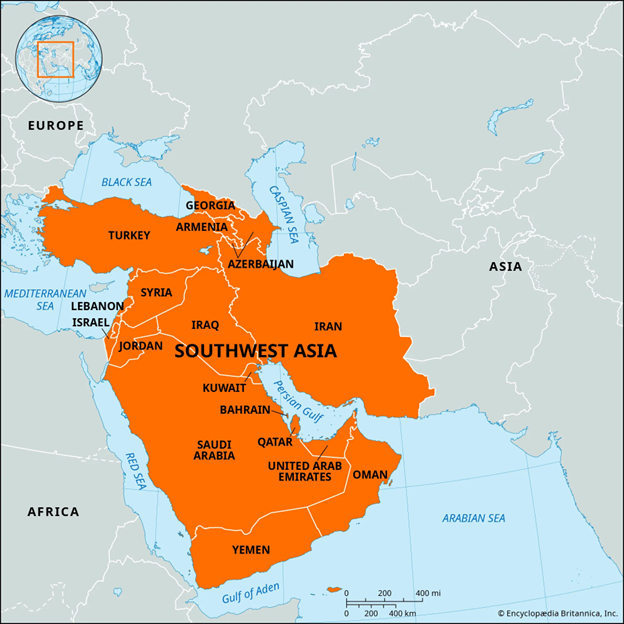
- It is a subregion of Asia that is bordered by Europe to the west, Central Asia to the north, South Asia to the east, and Africa and the Arabian sea to the south.
- The region of West Asia roughly includes Armenia, Azerbaijan, Bahrain, Cyprus, Georgia, Iraq, Israel, Jordan, Kuwait, Lebanon, Iran, Oman, Palestine, Qatar, Saudi Arabia, Syria, Turkey, United Arab Emirates, and Yemen.
It is strategically vital due to:
- Energy resources (oil & gas reserves);
- Chokepoints: Strait of Hormuz, Bab-el-Mandeb, Suez Canal;
- Religious significance (Jerusalem, Mecca, Medina);
- Geo-strategic location linking Asia, Africa, and Europe;
- Major external power involvement (US, Russia, China);
- The region is currently undergoing structural transformation marked by power realignments, proxy wars, and strategic competition.
Important maps –
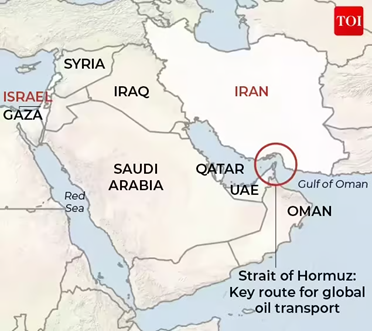
Strait of Hormuz
- Location – The Strait of Hormuz lies between Iran to the north and Oman and the United Arab Emirates to the south, linking the Persian Gulf with the Gulf of Oman and the Arabian Sea.
- At its narrowest point it is about 33 kilometres wide, with shipping lanes just a few kilometres across in either direction.
- Significance- Nearly half of India’s crude oil and around 60 per cent of its natural gas imports pass through the strait.
Securities and Exchange Board of India (SEBI)
Context
- The Securities and Exchange Board of India (SEBI) will enhance surveillance and enforcement on market manipulators and cyber fraudsters through technology and use Artificial Intelligence (AI).
Securities and Exchange Board of India (SEBI)
- It is the regulatory authority for the securities and capital markets in India.
- It was established in 1988 and given statutory powers through the SEBI Act of 1992.
- It falls under the administrative control of the Ministry of Finance.
Objective:
- Protect the interests of investors in securities.
- Promote the development of the securities market.
- Regulate the securities market in India.
Composition: SEBI consists of:
- A Chairperson (appointed by the Central Government).
- Two members from the Ministry of Finance.
- One member from the Reserve Bank of India (RBI).
- Five other members (at least three whole-time members).
Missile Defence Systems
Defence
Context
- The renewed hostilities between the United States-led coalition (including Israel and United Arab Emirates) and Iran have tested a newly integrated regional air and missile defence network in West Asia.
Missile defence system –
- It is a sophisticated, multi-layered architecture designed to detect, track, and destroy incoming ballistic and cruise missiles.
India’s Missile Defence Architecture
Multi-layered Ballistic Missile Defence (BMD) system under DRDO:
- The Prithvi Air Defence (PAD) interceptor is designed for exo-atmospheric interception to intercept incoming missiles at altitudes of 50 km to 180 km.
- The Advanced Air Defence (AAD) interceptor is intended for endo-atmospheric interception during the terminal phase to neutralise threats within the Earth’s atmosphere at altitudes up to 30 km.
Layered Air Defence Shield:
- The S-400 Triumf is a highly advanced, mobile, Russian-developed surface-to-air missile (SAM) system inducted by India to enhance long-range air defence capability.
- Medium-Range (70–100 km): The Barak-8 (MRSAM/LRSAM), co-developed with Israel, provides 360-degree protection for both land and naval assets.
- Short-Range (25–50 km): The indigenous Akash system and Israel’s SPYDER protect strategic points and mobile army units.
- Mission Sudarshan Chakra: Announced as a comprehensive vision for 2035, Mission Sudarshan Chakra aims to create an all-encompassing, AI-enabled national shield.
Key Air-Defence Systems of other countries
|
Country/Region |
Key Systems |
|
Russia |
S-400 Triumph, S-300VM, S-350 Vityaz, S-500 Prometheus |
|
USA |
THAAD, Patriot (PAC-3 MSE), Golden Dome (in development) |
|
Israel |
Iron Dome, David’s Sling, Iron Beam |
|
China |
HQ-9, HQ-22, HQ-16 |
|
European Sky Shield Initiative (ESSI) |
Skyranger, IRIS-T SLM |
PM Inaugurates India’s First Semiconductor Plant
Economy
Context
- Prime Minister Narendra Modi inaugurated India’s first semiconductor facility at Sanand in Gujarat.
- The semiconductor plant has been set up by Micron Technology (an American chipmaker) as an Assembly, Testing, Marking and Packaging (ATMP) facility, with an investment of ₹22,516 crore at Sanand, Gujarat.
Semiconductor Chips
- These are materials which have a conductivity between conductors and insulators.
- Example – They can be pure elements, silicon or germanium or compounds; gallium, arsenide or cadmium selenide.
- Significance of Semiconductor Chips – They are the basic building blocks that serve as the heart and brain of all modern electronics and information and communication technology products.
- Applications – These chips are now an integral part of contemporary automobiles, household gadgets and essential medical devices such as ECG machines.
India Semiconductor Mission (ISM)
- Launched by – Ministry of Electronics and Information Technology.
- Aim – To build a vibrant semiconductor manufacturing ecosystem to enable India’s emergence as a global hub for electronics manufacturing and design.
Leave a Reply