
Online National Drugs Licensing System
Syllabus: GS2/ Health, GS3/ Governance
Context
- The Drugs Controller General of India (DCGI) has directed digital monitoring on the Online National Drugs Licensing System (ONDLS) for tracking the supply chain of high-risk solvents.
Online National Drugs Licensing System
- It is a Drugs Controller General of India (DCGI) in India for processing drug- and cosmetic-related applications for manufacturing and sales licences, and various certificates.
- It is developed by the Centre for Development of Advanced Computing (CDAC) in coordination with the Central Drugs Standard Control Organisation (CDSCO).
Additional Information – Central Drugs Standard Control Organization (CDSCO)
- Established under – It is the Central Drug Authority and is responsible for carrying out duties entrusted by the Drugs and Cosmetics Act,1940.
- Responsibilities:
- Adoption of drugs.
- clinical trials, please.
- establishing the criteria for drugs.
- control over the country’s imported drugs’ quality.
- Coordination of state drug control organizations’ effort
Other Drug Regulatory Bodies in India
- Drugs Controller General of India (DCGI): It is in charge of approving licenses for specific kinds of medications. He or she also serves as the head of the CDSCO department of the Indian government.
- Drug Price Control Order (DPCO): To keep certain necessary medications in India accessible for the general people, the DPCO controls their prices.
- Drugs and Cosmetics Act, 1940: This act regulates domestic drug use.
Cassava/Tapioca crops
Syllabus: GS3/Agriculture
Context
- A tiny parasitic wasp, Anagyrus lopezi, has been successfully used for biological control of the invasive cassava mealybug in tapioca plantations.
Cassava (Also called ‘Bread of the Tropics’)
- Known as – ‘Yuca’ or ‘Manioc’.
- It is a root vegetable grown through stem cuttings.
- It is a tall semi-woody perennial shrub or tree native to South America and was introduced in Africa & Asia by Portuguese sailors.
- Nigeria is the world’s largest producer of Cassava.
- It has numerous health benefits as it is rich in energy & vitamins.
- Significance – Under India’s National Policy on Biofuels (2018), cassava is recognized as a raw material for ethanol production, enhancing its significance beyond food security.
5th Edition of “An Eye on Methane: From Measurement to Momentum”
Syllabus: GS3/ Environment
In News
- The UN Environment Programme (UNEP) has released the fifth edition of its flagship publication — “An Eye on Methane: From Measurement to Momentum” report.
Key Highlights of the 2025 Report
- Methane emissions from energy, agriculture, and waste sectors remain high, despite available cost-effective mitigation technologies.
- Methane has 80 times more warming potential than CO₂ over 20 years.
- Approximately 60% of current methane emissions originate from human activities, with the largest contributors being agriculture, fossil fuel extraction and use, and landfill waste.
- The report highlights India’s effective role in the Global Methane Pledge (GMP) and its efforts through SATAT, National Biogas Mission, and waste-to-energy projects.
International Day of the Snow Leopard 2025
Syllabus: GS3/ Environment
Context
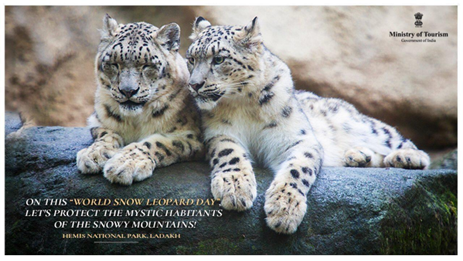
- India celebrated International Snow Leopard Day on October 23, with a nationwide campaign “#23for23”.
International Day of the Snow Leopard 2025
- In 2024, the United Nations General Assembly proclaimed October 23 as the International Day of the Snow Leopard.
- Objective – to enhance international and regional cooperation for Snow Leopard
- The ‘#23for23’ campaign is an initiative of the Global Snow Leopard and Ecosystem Protection Programme (GSLEP) and the Snow Leopard Trust Worldwide.
Snow Leopard
- Scientific name – Panthera uncia
- Habitats – The Snow Leopard lives at high altitudes in the steep mountains of Central and Southern Asia, and in an extremely cold climate.
- Range states – Jammu and Kashmir, Himachal Pradesh, Uttarakhand, Sikkim .
- Ghost of the mountains – The Snow Leopard is also known as Ghost of the mountains
- Bio indicator – It acts as an indicator of the health of the mountain ecosystem
- Snow Leopard capital of the world – Hemis, Ladakh.
- International Snow Leopard Day – It is observed on 23rd October.
Conservation status
- IUCN Red List- Vulnerable
- CITES convention – Appendix I
- Indian Wildlife (Protection) Act 1972– Schedule I
Conservation Efforts Launched by India
- Project Snow Leopard (PSL)
- Launched in – 2009
- Objective – To promote an inclusive and participatory approach to conserve snow leopards and their habitat.
- Species recovery programme – Snow Leopard is in the list of 21 critically endangered species for the recovery programme of the Ministry of Environment Forest & Climate Change.
- Snow Leopard conservation breeding programme – It is undertaken at Padmaja Naidu Himalayan Zoological Park, Darjeeling, West Bengal.
- HimalSanrakshak – It is a community volunteer programme, to protect snow leopards, launched on 23rd October 2020.
- First National Protocol – was also launched In 2019.
- SECURE Himalaya – Global Environment Facility (GEF) , United Nations Development Programme (UNDP) funded the project on conservation of high altitude biodiversity and reducing the dependency of local communities on the natural ecosystem.
International Conservation Efforts
- SNOW LEOPARD ECOSYSTEM PROTECTION PROGRAM – It seeks to address high-mountain development issues using the conservation of the endangered snow leopard as a flagship program.
- Bishkek Declaration – In 2013, the 12 snow leopard range countries signed and agreed to secure at least 20 snow leopard landscapes across by 2020
- International Year of the Snow Leopard – Year ‘2015’ was designated as International Year of the Snow Leopard
Recent Census –
- The exercise reported 718 snow leopards in India
- It was conducted from 2019 to 2023.
- Conducted by – The program was conducted by the Wildlife Institute of India (WII) with the help of all snow leopard range states and two conservation partners – the Nature Conservation Foundation, Mysuru (Karnataka), and WWF (World Wildlife Fund)-India.
- Based on data analysis, the estimated population of 718 snow leopards in different states/UTs are as follows – Ladakh (477), Uttarakhand (124), Himachal Pradesh (51), Arunachal Pradesh (36), Sikkim (21), and J & K (9).


Leave a Reply