
Tariff Threat Over Greenland May Imperil EU Trade Deal
International
In News
- EU lawmakers are moving to delay or block approval of the EU–US trade deal after US President Donald Trump threatened tariffs on countries supporting Greenland’s sovereignty.
Greenland
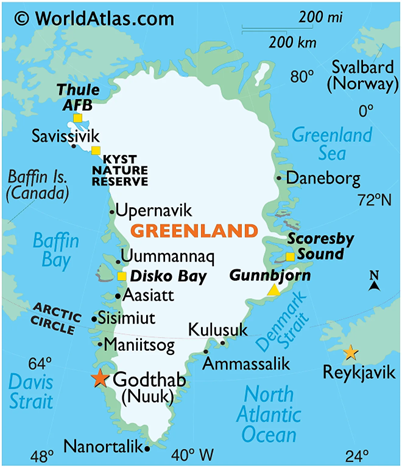
- It is located in the Northern Hemisphere and is surrounded by the Arctic Ocean in the north, the North Atlantic Ocean in the south, Baffin Bay in the west and the Greenland Sea in the east.
- It lies closer to North America, but culturally and politically it is tied to Denmark.
- Resources: It is mineral-rich with large deposits of gold, nickel, and cobalt.
- It also has some of the biggest reserves of rare earth minerals such as dysprosium, praseodymium, neodymium, and terbium.
- Governance : Greenland gained home rule in 1979 and expanded self-government in 2009, giving it authority over domestic affairs like healthcare and education.
- Denmark retains control over defense, foreign policy and monetary policy.
Major powers are eyeing Greenland
- Greenland, part of North Atlantic Treaty Organization (NATO) through the membership of Denmark, has strategic significance for the US military and for its ballistic missile early-warning system since the shortest route from Europe to North America runs via the Arctic island.
- China has shown strong interest in Greenland’s rare mineral resources, and infrastructural projects.
Green Aluminium
Geography & Environment
In News
- NALCO CMD said India’s aluminium sector is not yet ready for green aluminium under the EU’s CBAM due to high power costs and dependence on thermal energy.
Do you know?
- India is the 2nd largest Aluminium producer after China, and top-10 producer in refined copper.
- Applications of Aluminium – It is widely used across power, transport, construction, packaging, machinery, aerospace and consumer goods, and demand is rising, especially in automobiles, housing, solar energy and power transmission.
Green Aluminium
- It refers to aluminium produced using methods that minimize greenhouse gas emissions and environmental impact.
- Traditional aluminium production is energy-intensive and relies heavily on fossil fuels, contributing to carbon emissions.
- Green aluminium is manufactured using renewable energy sources, recycled materials, and innovative technologies to reduce its environmental footprint.
Importance
- Green aluminium significantly cuts carbon emissions, saves energy through recycling, and supports a circular economy by reducing waste.
- It enhances corporate sustainability credentials while retaining aluminium’s key qualities—lightweight, durable, corrosion-resistant, and versatile—without compromising performance.
IMEC’s Relevance to India and its Chokepoints
International
Context
- The current reciprocal tariff policies and protectionism by the US is a bad sign for the development of a multi-state, multimodal transport and trade corridor like the India–Middle East–Europe Economic Corridor (IMEC).
India-Middle East EU Economic Corridor (IMEC)
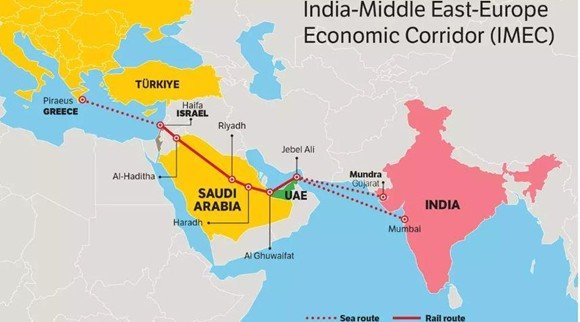
- Background: The IMEC is a proposed 4,800 km long route that was announced in 2023 on the sidelines of the G20 Summit.
- Members: India, European Union, France, Germany, Italy, Saudi Arabia, UAE and US.
- Aim: Integration of Asia, Europe and the Middle East.
The IMEC will comprise of two separate corridors:
- The east corridor connecting India to the West Asia/Middle East and
- The northern corridor connecting West Asia/Middle East to Europe.
IMEC’s Relevance To India and Its Chokepoints
- Suez Canal Blockage (2021): It was blocked by the massive container ship, leaving several vessels stranded.
- This disruption impacted nearly 12 percent of global trade until a major salvage operation successfully freed it.
- Red Sea Crisis (2023-24): It was caused by the Houthis’ attacks on commercial shipping, exposing the fragility of over-concentrated trade routes.
- Nearly a quarter of India’s cargo transiting the Red Sea faced delays.
Significance of IMEC for India
- Economic Development: By linking Asia, West Asia, the Middle East and Europe through enhanced connectivity and economic integration, the corridor aims to give a boost to economic development in the regions.
- Enhances India’s Connectivity and Trade Access: IMEC provides India with a direct, faster, and safer trade route connecting Indian ports to Europe via the Arabian Peninsula and the Mediterranean.
- Reduces dependence on the Suez Canal route, cutting shipping time by up to 40% and costs by 20–30%.
Child Trafficking in India
Polity and Governance
Context
- Child trafficking continues to be a grave human rights challenge in India, despite a robust constitutional framework and multiple statutory protections.
Child Trafficking
- Section 143 of Bhartiya Nyaya Sanhita (BNS) 2023 defines trafficking as; recruitment, transportation, harbouring, transfer or receipt of persons for exploitation.
- The means include threats, force, coercion, abduction, fraud, deception, abuse of power, or inducement.
- Scope of exploitation includes, physical and sexual exploitation, slavery, servitude and forced labour, forced removal of organs.
Constitutional Safeguards in India
- Article 21: Ensures the right to life and personal liberty, which has been interpreted to include the right to live with dignity.
- Article 23: Prohibits trafficking in human beings and forced labor.
- Article 24: Prohibits employment of children below 14 years in hazardous industries.
- Article 39(e): The state should ensure that the health and strength of workers and children are not abused, and that citizens are not forced to take jobs that are not suitable for their age or strength.
- Article 39(f): Mandates opportunities for children to develop in conditions of freedom, dignity, and protection from moral and material abandonment.
Judicial Intervention against child trafficking
- In Vishal Jeet versus Union of India, 1990 the court held that trafficking and child prostitution are serious socio-economic problems and hence a preventive and humanistic approach is essential to deal with them.
- In C. Mehta versus State of Tamil Nadu, 1996, the Court issued guidelines with a view to prohibiting employment of children in hazardous industries.
- In Bachpan Bachao Andolan versus Union of India, 2011, the Supreme court issued directions to address widespread exploitation and trafficking of children.
- The Supreme Court in P. Kiran Kumar versus State has given strict guidelines to prevent such offences, and held that trafficking grossly violates children’s fundamental right to life as guaranteed by the Constitution.
Laws governing anti-trafficking crimes
- The Immoral Traffic (Prevention) Act, 1956 is targeted at stopping immoral trafficking and sex work. It went through two amendments, in 1978 and 1986.
- The Child Labour (Prohibition and Regulation) Act, 1986, prevents children from partaking in certain employments and regulates the conditions of work for children in other fields.
- The Bonded Labour System (Abolition) Act, 1976, prohibits systems of labour where people, including children, work under conditions of servitude to pay off debt, and also provides a framework for rehabilitating released labourers.
- The Juvenile Justice (Care and Protection of Children) Act 2015, which governs laws relating to children alleged and found to be in conflict with law.
- Protection of Children from Sexual Offences (POCSO) Act, 2012, which seeks to prevent commercial sexual exploitation of children.
Leave a Reply