
Synthetic Cattle Breeds
Economy
Context
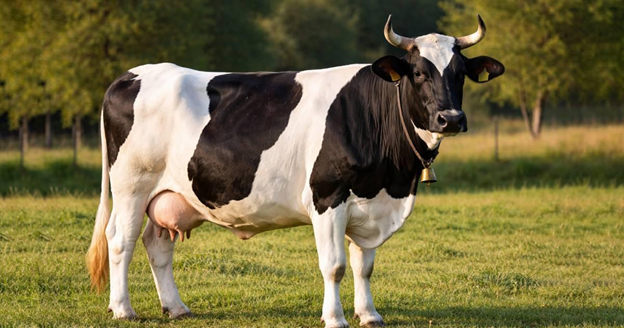
- India registers two new synthetic cattle breeds Karan Fries and Vrindavani developed by the National Dairy Research Institute (NDRI).
Karan Fries
- It is a synthetic cow breed developed through crossbreeding Holstein Friesian, a globally recognised high-yielding breed with India’s indigenous Tharparkar zebu cattle, known for their hardiness and resilience.
- The synthetic Karan Fries cow breed combines high productivity with resilience, delivering peak daily milk yields of up to 46.5 kg.
- Synthetic cattle breeds are those developed through planned cross-breeding of two or more breeds usually indigenous (Bos indicus) with exotic (Bos taurus) followed by stabilisation of desired traits over generations.
- Once stabilised, they breed true and are recognised as distinct breeds.
Significance:
- Higher productivity than indigenous cattle.
- Better climate resilience than pure exotic breeds.
- Improved economic returns for dairy farmers.
- Lower mortality and better reproductive efficiency.
18th Japan-India Foreign Ministers’ Strategic Dialogue
International
In News/Context
- At the 18th India–Japan Strategic Dialogue, India and Japan reaffirmed the upward trajectory of their Special Strategic and Global Partnership.
Key Highlights
- Announced the launch of Japan–India Private-Sector Dialogue on Economic Security (B2B) in early 2026.
- It will help in identification of five priority areas: semiconductors, critical minerals, ICT, clean energy, and pharmaceuticals.
- Establishment of the Japan–India AI Strategic Dialogue under the Japan–India AI Cooperation Initiative (JAI).
- Japan will invite 500 highly skilled Indian AI professionals by 2030 for joint research.
Additional Information – India & Japan relations
Defence and Security
- Military Exercises: Malabar, Dharma Guardian, and JIMEX exercises enhance interoperability and Indo-Pacific security.
- Trade: Bilateral trade reached approximately $23 billion in 2023-24.
- FDI: Japan is India’s fifth-largest source of FDI
- Bullet Train: The Mumbai-Ahmedabad High Speed Rail exemplifies flagship India-Japan transport cooperation.
- Energy: Clean Energy Partnership (2022) expands hydrogen, renewables, and climate cooperation.
- Quad: Quad coordination ensures Indo-Pacific stability through collective maritime commitments.
- SCRI: Supply Chain Resilience Initiative (SCRI) reduces dependency on China for the supply of critical goods.
- Forums: India and Japan cooperate in G20, International Solar Alliance (ISA), CDRI, and IPEF, strengthening multilateral governance.
- Space: ISRO–JAXA LUPEX mission exemplifies frontier collaboration in space exploration.
UN High Seas Treaty Comes Into Effect
Geography & Environment
Context
- A UN-backed treaty on biodiversity in international waters, formally known as the Biodiversity Beyond National Jurisdiction (BBNJ) Treaty, has entered into force, creating the first legally binding global framework to conserve and sustainably use the high seas.
What are the High Seas
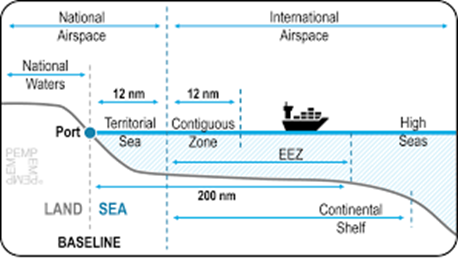
- High seas refer to ocean areas beyond national jurisdiction, i.e., beyond 200 nautical miles (Exclusive Economic Zones – EEZs).
- They cover nearly two-thirds of the global ocean and about half of the Earth’s surface.
- Earlier governed mainly by general principles under UNCLOS, with limited biodiversity-specific regulation.
Biodiversity Beyond National Jurisdiction (BBNJ) Treaty
- Adoption & Background: The Biodiversity Beyond National Jurisdiction (BBNJ) Agreement was adopted in 2023 by an Intergovernmental Conference on Marine Biodiversity of Areas Beyond National Jurisdiction, convened under the auspices of the United Nations.
- Legal Status under UNCLOS: It is agreement under the United Nations Convention on the Law of the Sea (UNCLOS), after:
- Objective: To ensure the conservation and sustainable use of marine biological diversity in Areas Beyond National Jurisdiction (ABNJ), commonly known as the high seas.
- Membership Status: 83 countries have ratified the treaty so far & India has signed but not yet ratified the BBNJ Agreement.
Seed Act 2026 and Its Impact on Farmers
Economy
Context
- Recently, the Union Minister for Agriculture and Farmers’ Welfare (MoA&FW) briefed in detail about the features of the Seed Act 2026 and its impact on farmers.
- The Seed Act 2026 is expected to be introduced in the Upcoming Budget Session of Parliament.
Key Features of the Seed Act 2026
- Nationwide Seed Traceability: Every packet of commercial seed sold will carry a QR code that farmers can scan.
- Scanning reveals key information: who produced the seed, where it was sourced, and which dealer sold it.
- It aims to eliminate anonymous seed sales and quickly detect fake or substandard seeds, enabling faster remedies for aggrieved farmers.
- Mandatory Registration of Seed Companies and Dealers: The Act proposes compulsory registration of commercial seed producers, traders, and dealers.
- Strong Penalties for Substandard and Fake Seeds: The new Act proposes fines up to ₹30 lakh and possible imprisonment for deliberate violations.
- Protection of Traditional Seed Practices: Government officials have emphasised that traditional farmer practices like saving, sharing, and exchanging seeds within the community will not be restricted.
- The new act focuses on commercial seed quality, not on traditional, non-branded seed systems.
- Scientific Evaluation of Imported Seeds: Imported seeds will undergo rigorous scientific assessment before entering the Indian market, ensuring they meet ecological, agronomic, and quality criteria.
- It protects local farmers from inferior foreign seeds that may not be suited to Indian growing conditions.
- Institutional Mechanisms and Federal Cooperation: The Act may create oversight committees at the Central and State level to improve coordination in seed testing, registration, and enforcement across regions.
- Agriculture remains a State Subject (Schedule VII of Indian Constitution), meaning states will play a key role in implementing and enforcing the Act alongside the Centre.
Thiruvalluvar Day
Culture
In News
- Prime Minister Narendra Modi paid tribute to Thiruvalluvar, acknowledging the enduring influence of his timeless works and ideals across generations.
About
- Thiruvalluvar Day was first celebrated on May 17 and 18 in 1935.
- In the present time, it is usually observed either on January 15 or 16 in Tamil Nadu and is a part of Pongal celebrations.
Thiruvalluvar
- Great Tamil poet – Thiruvalluvar, commonly known as Valluvar, was a celebrated Tamil poet and philosopher.
- Thirukkural – He is best known as the author of Thirukkural, a collection of couplets on ethics, politics, economy and love.
Jallikattu
Culture
Context
- Tamil Nadu Chief Minister M.K. Stalin attended the jallikattu in Alanganallur.
Jallikattu
- It is also known as Eruthazhuvuthal.
- It is a bull-taming sport traditionally played in Tamil Nadu as part of the Pongal harvest
- The history of this bullfight dates back to 400-100 BCE when it was played by the Ayars, an ethnic group in India.
- The name is coined from two words, Jalli (silver and gold coins) and Kattu (tied).
- In this festival, a bull is let loose among a crowd of people, and whoever tames it will get the coins tied to its horn.
- The people who participate in the sport try to hold on to the animal’s hump to stop it. Sometimes, they run along with the bull.
- Pulikulam or Kangayam is the breed of bulls used for the sport. This festival has been part of cultural tourism in the state.
- Vadi manjuviraṭṭu, Vēli viraṭṭu, and Vaṭam manjuviraṭṭu are the variants of this sport
Key Concerns:
- Animal Cruelty & Suffering: Bulls are often provoked with alcohol, sticks, knives, and chili powder in their eyes; tail-bending and physical abuse during training and the event cause extreme stress, pain, and severe injuries.
- Human Injuries & Fatalities: The event poses significant risks, with numerous injuries and deaths reported for both participants and bulls over the years.
- Ethical Considerations: Animal rights groups argue that using bulls for entertainment is unethical, regardless of cultural significance, and that the practice exploits and traumatizes the animals.
- However, in 2023, A five-judge Bench of the Supreme Court upheld the amendments made by the legislatures of Tamil Nadu, Maharashtra, and Karnataka to The Prevention of Cruelty to Animals (PCA) Act, 1960, allowing bull-taming sports like jallikattu, kambala, and bullock-cart races.


Leave a Reply