
Swahid Diwas
Syllabus: GS1/History; GS2/Governance
In News
- Prime Minister Narendra Modi honoured the courage of those who participated in the historic Assam Movement on Swahid Diwas.
Swahid Diwas
- It is observed annually on December 10
- Objective – to honour those who sacrificed their lives during the Assam Movement
Assam Movement
- It was a mass agitation launched in 1979 by the Assam Students’ Union (ASU) and the All Assam Gana Sangram Parishad (AAGSP) against large-scale infiltration from Bangladesh.
- The movement culminated in 1985 with the signing of the historic Assam Accord.
- The accord ensures detection and deportation of illegal foreigners and guarantees constitutional, legislative, and administrative safeguards to protect Assamese identity, culture, and heritage.
Asian Development Bank (ADB)
Syllabus: GS3/ Economy
In News
- The Asian Development Bank (ADB) has raised India’s growth forecast for FY26 to 7.2%, from 6.5%.
- About ADB
- ADB was established in 1966 as a regional development bank to promote social and economic development in Asia and the Pacific.
- Its headquarters is in Mandaluyong, Manila, Philippines.
- Its membership includes both regional (Asia-Pacific) and non-regional countries, with around two-thirds of UNESCAP members plus developed donor countries participating.
- India joined ADB in 1966 as a founding member.
- Major shareholders include Japan and the United States (15.6% each), followed by China (6.4%), India (6.3%) and Australia (5.8%), reflecting both regional and non‑regional stake.
GlowCas9
Syllabus: GS3/ Science & Technology

In News
- GlowCas9 is a newly engineered variant of the CRISPR Cas9 enzyme that emits light while editing DNA.
GlowCas9
- It is a bioluminescent Cas9 created at the Bose Institute, Kolkata, by fusing Cas9 with a split nano‑luciferase enzyme derived from deep‑sea shrimp proteins.
Connect with the basics – Gene Editing Technology
- It refers to technology that permits the change of an organism’s DNA by allowing genetic material to be added, removed, or altered at particular locations in the genome.
CRISPR Cas9 Technology
- Acronym – Clustered Regularly Interspaced Short Palindromic Repeats.
- Significance – With the use of the gene editing technique CRISPR, researchers can modify the DNA of living things.
- An enzyme called Cas9 functions as molecular scissors, guided by RNA molecules created to precisely match a certain DNA sequence.
- GE (Genome Editing): Involves precise modification of specific genes within an organism’s genome without introducing foreign genes, resulting in targeted genetic changes.
- GM (Genetically Modified): Involves the insertion of foreign genes from unrelated organisms into an organism’s genome to confer specific traits or characteristics.
Regulatory Bodies
- GEAC (Genetic Engineering Appraisal Committee): It is a regulatory body under the Ministry of Environment, Forest and Climate Change (MoEFCC).GEAC is responsible for evaluating and approving genetically modified organisms (GMOs)
- Cartagena Protocol on Biosafety (CPB): Ensures safe handling of GMOs that may impact biodiversity under the Convention on Biological Diversity. Nagoya-Kuala Lumpur.
CITES Conference of the Parties (CoP20)
Syllabus: GS3/ Environment
Context
- The 20th meeting of the Conference of the Parties (CoP20) to the Convention on International Trade in Endangered Species of Wild Flora and Fauna (CITES) has concluded in Samarkand, Uzbekistan, marking the 50th anniversary of the Convention.
CITES
- Abbreviation – Convention on International Trade in Endangered Species of Wild Flora & Fauna
- CITES was conceptualized in 1963 at a meeting of the (IUCN) International Union For Conservation of Nature.
- Establishment – It came into force in 1975 and consists of 183 member-countries
- Headquarter – Geneva, Switzerland,
- Administered by – United Nations under its UNEP (United Nations Environment Programme) Wing.
- CITES is legally binding on the Parties; it does not take the place of national laws.
Appendices
- Appendix 1 – It lists species that are threatened with extinction and are or may be affected by trade.
- Appendix 2 – This list includes species not necessarily threatened with extinction, but in which trade must be controlled in order to avoid utilization incompatible with their survival.
- Appendix 3 – It contains species that are protected in at least one country, which has asked other CITES Parties for assistance in controlling the trade.
Great Barrier Reef
Syllabus: GS3/ Environment
In News
- A combination of extreme heat stress and a rare coral disease has wiped out 75 per cent of Goniopora colonies at a site on the Great Barrier Reef.
CORAL REEFS
- Coral reefs are the most biologically diverse ecosystems of the planet.
Formation & Symbiotic relationship – (Coral polyps + zooxanthellae)
- They are formed when Coral polyps, the animals primarily responsible for building reefs, develop a symbiotic relationship with photosynthetic algae called zooxanthellae, which live in its tissues.
- Formation – Coral reefs begin to form when free-swimming coral larvae attach to submerged rocks or other hard surfaces along the edges of islands or continents.
- The coral provides a protected environment and the compounds zooxanthellae need for photosynthesis.
- In return, the algae produce carbohydrates that the coral uses for food, as well as oxygen. The algae also helps the coral remove waste.
FAVOURABLE CONDITIONS FOR FORMATION
- Warm tropical oceans with minimum temperature of 20 degree (30 degree north and 25 degree south latitudes)
- Oceanic water free of sedimentation
- Transparent parts of ocean bodies
- Relatively low salinity ocean bodies
TYPES OF REEF FORMATIONS
- Fringing reefs – They are the most common, projecting seaward directly from the shore, forming borders along the shoreline and surrounding islands.
- Barrier reefs – Grow at border shorelines, but at a greater distance. They are separated from their adjacent land mass by a lagoon of open, often deep water.
- Atoll – If a fringing reef forms around a volcanic island that subsides completely below sea level while the coral continues to grow upward, an atoll forms. Atolls are usually circular or oval, with a central lagoon.
DISTRIBUTION IN INDIA
- The Gulf of Kutch
- The West Coast of India
- The Lakshadweep Islands
- The Gulf of Mannar
- Palk Bay
- Andaman and Nicobar Group of Islands
THREATS
- Destructive fishing practices, Overfishing, Careless tourism, Pollution, Sedimentation, Coral mining, Climate change.
CORAL BLEACHING
- When corals face stress by changes in conditions such as temperature, light, or nutrients, they expel the symbiotic algae zooxanthellae living in their tissues, causing them to turn completely white. This phenomenon is called coral bleaching.
Causes of Coral Bleaching
|
● Rise in Sea Temperature ● Ocean Acidification ● Solar radiation & ultraviolet radiation ● Infectious Diseases |
● Chemical Pollution ● Increased Sedimentation ● Reducing light availability (Turbidity) ● Human Induced Threats |
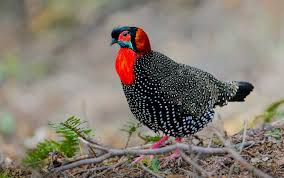
Western Tragopan
Syllabus: GS3/Species
In News
- Recent studies show that suitable habitats of western tragopan exist in Jammu & Kashmir but human disturbance and fragmentation still threaten the bird’s survival.
Western Tragopan
- It is one of India’s rarest pheasants and Himachal Pradesh’s state bird.
- It now survives only in small fragmented pockets across the western Himalayas.
- The IUCN estimates only 3,000–9,500 mature individuals remain
- Threats: It faces threats due to habitat loss, hunting, and other anthropogenic factors.
- The IUCN Red List of Threatened species classified it as
- Conservation efforts – The Sarahan pheasantry in Shimla has over the years seen successful captive breeding of western tragopan.


Leave a Reply