
Strengthening and Safeguarding Dams in India
Syllabus: GS3/Infrastructure; Disaster Management
Context
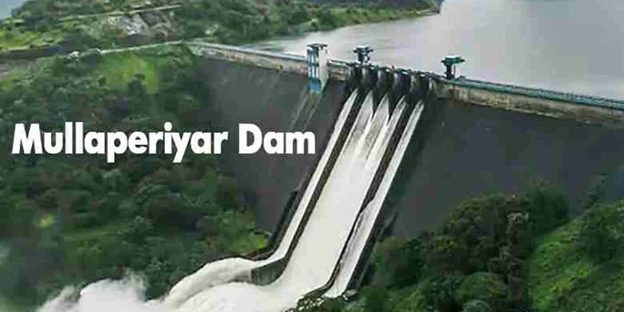
- Recently, the Supreme Court of India issued notices to various stakeholders calling for urgent directions to reinforce the aging structure of the 130-year-old Mullaperiyar dam.
Mullaperiyar Dam
- It is a gravity dam built on the Periyar River in the Idukki district of Kerala that was constructed between 1887 and 1895.
- The dam is operated and maintained by Tamil Nadu, under a 999-year lease agreement signed in 1886 between the Maharaja of Travancore and the British government.
- It diverts water to the Vaigai basin in Tamil Nadu for irrigation across 68,558 hectares.
India’s Dam Landscape – According to the National Register of Large Dams (NRLD) maintained by the Central Water Commission (CWC)
- India ranks third globally — after China and the United States — in the number of large dams, with over 6,000 operational dams.
- Functions of Dams – irrigation (supporting agriculture across vast regions); hydropower generation; flood control; and drinking water supply.
- There are concrete gravity dams (e.g., Bhakra Dam), earthen dams (e.g., Banasura Sagar Dam), rock-fill dams, and arch dams (rare in India), based on topography, geology, and hydrological needs.
Legal and Institutional Framework
- Dam Safety Act, 2021: Enacted to ensure surveillance, inspection, operation, and maintenance of dams. It mandates:
- National Dam Safety Authority (NDSA): It coordinates dam safety efforts across states.
- Dam Rehabilitation and Improvement Project (DRIP): It was launched by the CWC with World Bank support. It focuses on rehabilitation of aging dams; improved safety monitoring; and capacity building for dam operators and engineers;
PM Surya Ghar Muft Bijli Yojana
Syllabus: GS3/Environment
Context
- A report on the performance of PM Surya Ghar Yojana has been jointly published by the Institute for Energy Economics and Financial Analysis (IEEFA) and JMK Research & Analytics.
PM Surya Ghar Muft Bijli Yojana
- Launched in – 2024
- Ministry: Ministry of New and Renewable Energy.
- Objective: Installing rooftop solar (RTS) & providing free electricity for up to 300 monthly units for 1 Crore households.
- Uniqueness – It is the world’s largest domestic rooftop solar initiative, transforming India’s energy landscape
- Subsidy: The scheme offers a subsidy of up to 40% to households.
PM-Surya-Ghar-Muft-Bijli-Yojana-eligibility– Model Solar Village:
- An allocation of ₹800 crore has been designated for this component, with ₹1 crore provided to each selected Model Solar Village.
- To qualify as a candidate village, it must be a revenue village with a population of over 5,000 (or 2,000 in special category states).
- This initiative aims to promote solar energy adoption and empower village communities to achieve energy self-reliance.
UNESCO’s new Virtual Museum of Stolen Cultural Objects
Syllabus: GS1/Culture

News
- UNESCO officially launched the Virtual Museum of Stolen Cultural Objects at MONDIACULT 2025.
UNESCO’s new Virtual Museum of Stolen Cultural Objects
- It offers a globally accessible digital platform to raise awareness about stolen heritage.
- It currently showcases around 240 missing objects from 46 countries, with the goal of gradually “emptying itself” as items are recovered and returned to their countries of origin.
- It is financially supported by Saudi Arabia and implemented with INTERPOL.
Delhi Declaration on 6G
Syllabus: GS3/Science and Technology
In News
- Recently, the leading global 6G research alliance including Bharat 6G, 6G-IA, ATIS’ Next G Alliance issued a Joint Declaration to develop 6G as a global public good at the International Bharat6G Symposium 2025 in New Delhi.
Delhi Declaration on 6G
- The declaration endorsed key principles to ensure that 6G networks are trusted, secure, resilient, open, inclusive, affordable, and sustainable.
6G (sixth-generation wireless)
- 6G (sixth-generation wireless) is the next-generation cellular technology following 5G
- It is expected to offer numerous advantages including significantly higher data speeds, drastically reduced latency, and the integration of communication and sensing capabilities within the network.

Leave a Reply