
SHANTI (Sustainable Harnessing of Advancement of Nuclear Technology for India) Act 2025
Syllabus: GS3/ Energy

Context
- The SHANTI (Sustainable Harnessing of Advancement of Nuclear Technology for India) Act 2025, have triggered concerns regarding safety standards, victim compensation, and long-term energy strategy.
About
- Traditionally, nuclear power plants in India have been owned and operated only by state-owned Nuclear Power Corporation of India Ltd (NPCIL) and its fully-owned subsidiary Bharatiya Nabhikiya Vidyut Nigam (BHAVINI).
SHANTI Act, 2025,
- It was passed in December 2025,
- It represents a landmark overhaul of India’s nuclear governance.
- Replaced – It consolidates the sector’s legal framework by repealing the Atomic Energy Act, 1962 and the Civil Liability for Nuclear Damage Act (CLNDA), 2010.
Key Objectives & Pillars
- 100 GW Target: The Act provides the legal foundation to reach India’s goal of 100 GW of nuclear capacity by 2047.
- Private Sector Integration: For the first time, private Indian companies and joint ventures can build, own, and operate nuclear power plants under strict government licensing.
- Regulatory Independence: It grants statutory recognition to the Atomic Energy Regulatory Board (AERB), making it more independent and accountable to Parliament rather than just the executive.
- Small Modular Reactors (SMRs): The Act facilitates the deployment of Bharat Small Modular Reactors (BSMRs) to support industrial decarbonisation.
Major Provisions
- Dual Permit System: Entities must obtain a licence from the Central Government for construction/operation and a separate safety authorisation from the AERB for radiation-related activities.
- Reserved Strategic Domains: The Central Government retains exclusive control over sensitive “fuel cycle” activities, including uranium enrichment, spent fuel management, and heavy water production.
- Dispute Resolution: Establishes the Atomic Energy Redressal Advisory Council. The Appellate Tribunal for Electricity (APTEL) serves as the appellate authority, with further challenges possible in the Supreme Court.
Concerns raised over SHANTI Act
- The Fukushima Daiichi nuclear disaster exposed weaknesses in reactor containment design and emergency preparedness.
- The Chernobyl disaster involved structural design flaws, including a positive power coefficient and inadequate emergency shutdown systems.
- The Three Mile Island accident revealed significant control room design failures and communication lapses by suppliers.
Maharshi Dayanand Saraswati
History
Context
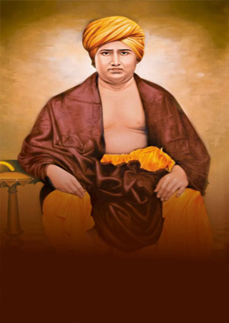
- The Prime Minister paid tributes to Maharshi Dayanand Saraswati on his birth anniversary.
Maharshi Dayanand Saraswati
- He was born on February 12, 1824, in Tankara, Gujarat. He later became a disciple of Swami Virajananda.
- He founded the Arya Samaj in 1875 to counter social inequities and promote social reform.
- He issued the slogan “Back to the Vedas” and emphasized two core ideas: the infallible authority of the Vedas and monotheism.
- Among his major beliefs were the rejection of idolatry and overly ritualistic traditions, support for women’s education, denunciation of child marriage, and opposition to untouchability.
- He also advocated the idea of shuddhi, supporting reconversion into the Hindu fold.
- Publications: Satyarth Prakash, Sanskar Vidhi, and Yajurved Bhashyam.
- Legacy: Inspired by his beliefs, teachings, and ideas, his disciples established the Dayanand Anglo Vedic College Trust and Management Society after his death in 1883.
Assam Rifles to Induct More Indigenous Dog Breeds
Syllabus: GS3/ Internal Security
Context
- The Assam Rifles is inducting two native Indian dog breeds, the Tangkhul Hui (Haofa) and the Kombai, into its specialized dog squad.
- The induction is being managed by the Assam Rifles Dog Training Centre (ARDTC) in Jorhat, Assam.
About the Indian Dog Breeds
- Tangkhul Hui: It is indigenous to Ukhrul district of Manipur and known for being highly courageous, possessing unique tracking abilities, and having the stamina to track animals for up to 48 hours without food or water.
- It is also known for disease resistance and adaptability to hilly terrain.
- Kombai: It is native to Tamil Nadu and recognized for agility, guarding instincts, and loyalty.
Assam Rifles
- Established in – 1835
- World War Participation: It is the only paramilitary force to have participated in both World Wars, as well as the 1962 Sino-Indian War.
- Headquarters – Shillong, Meghalaya, and currently consists of 46 battalions.
- It is one of the seven Central Armed Police Forces (CAPFs), primarily guarding India’s Indo-Myanmar border, focusing on border security, counter-insurgency, and law & order in Northeast India.
Kyasanur Forest Disease
Syllabus: GS2/Health
In News
- The Indian Council of Medical Research (ICMR) is steadily progressing towards the development of an improved vaccine against Kyasanur Forest Disease (KFD).
Kyasanur Forest Disease
- Origin : First identified in 1957 in Karnataka’s Kyasanur Forest, it is commonly known as Monkey Fever.
- Type: It is a tick-borne viral hemorrhagic fever caused by the Kyasanur Forest Disease Virus (family Flaviviridae).
- Transmission: Spread to humans via tick bites (mainly Haemaphysalis spinigera) or contact with infected animals, particularly sick or dead monkeys.
- No person-to-person transmission exists.
- Seasonality: Epidemics usually last from October to June, with a peak period between January and April.
- Symptoms: Sudden high fever, headache, and vomiting; severe cases may involve bleeding (hemorrhagic) and neurological issues.
- Mortality: The disease has a fatality rate of approximately 5% to 10%.
- Treatment: There is no cure; management relies on supportive care (hydration, oxygen, and maintaining blood pressure).
- Prevention: A vaccine is available and widely recommended in affected regions of India.
Rajaji National Park
Syllabus: GS3/Environment
In News
- The Supreme Court cleared the metalling of the 11.5-km Laldhang-Chillarkhal road project through Rajaji National Park.
Rajaji National Park
- It was established in 1983 by merging the Rajaji, Motichur, and Chilla sanctuaries.
- It was named in honor of freedom fighter and India’s first Governor-General, C. Rajagopalachari (Rajaji).
- Location – It is located in the Himalayan foothills near Haridwar, Rishikesh, and Dehradun.
- Rivers – It features diverse vegetation and rich biodiversity, with the Ganga and Son rivers flowing through it.
- It is home to elephants, tigers, leopards, deer, ghorals, and numerous bird species, making it a paradise for nature lovers.
Panchsheel Pact
Context
- The Chief of Defence Staff (CDS) mentioned that India believed the 1954 Panchsheel Agreement effectively addressed the northern boundary question, even though China viewed it differently.
Panchsheel Agreement
- In 1954, India recognised Tibet as part of China, and both countries signed the Panchsheel Agreement.
The Panchsheel Agreement stated the five principles as:
- Mutual respect for each other’s territorial integrity and sovereignty.
- Mutual non-aggression.
- Mutual non-interference in each other’s internal affairs.
- Equality and cooperation for mutual benefit.
- Peaceful co-existence.
- It was designed to promote trade and friendly relations, forming the basis of the bilateral ties.
- With this, India assumed that it had settled its northern border.
- In 2025 the Chinese President underscored that Panchsheel must be cherished and promoted by the two countries.
- It came as India and China reset their ties and PM Modi visited China after seven years.
The India-China Borders
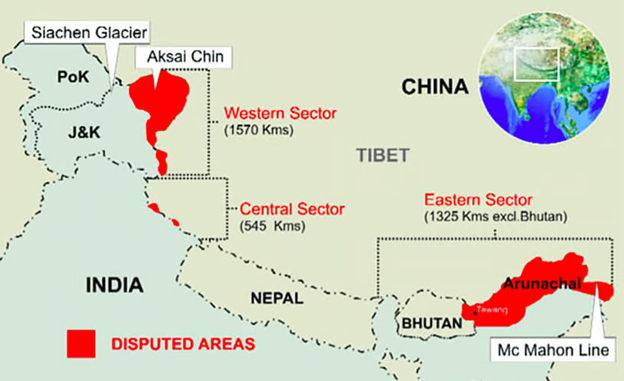
- India considers the Line of Actual Control (LAC) to be 3,488 km long, while the Chinese consider it to be only around 2,000 km.
- It is divided into three sectors: the eastern sector which spans
- Arunachal Pradesh and Sikkim,
- Middle sector in Uttarakhand and Himachal Pradesh,
- Western sector in Ladakh.
- Western Sector or Aksai Chin Sector: The region is claimed by the Chinese government post-1962 war as an autonomous part of the Xinjiang region which was originally a part of the Indian state of Jammu and Kashmir.
- Middle Sector: It is the less disputed section of the Indo-China border but the recent Doklam standoff and Nathu La Pass trading issues have brought distress at all levels.
- Eastern Sector or Arunachal Pradesh:McMahon Line had differentiated India and China in this sector but in the 1962 war the People’s Liberation Army covered 9000 sq. km. area.
- However, China has started to claim the whole of Arunachal Pradesh as their own.


Leave a Reply