
Seventh National Security Guard (NSG) Hub to Come up in Ayodhya
Syllabus :GS3/Security Forces
In News
- Union Home Minister Amit Shah announced that a new NSG hub will be set up in Ayodhya, Uttar Pradesh.
- This will be the seventh NSG hub, joining existing ones in Mumbai, Chennai, Kolkata, Hyderabad, Ahmedabad, and Jammu.
National Security Guard (NSG)
- Elite Counter-Terrorism Force: The NSG is a specialized force trained to combat terrorism and handle critical security situations.
- Establishment: In 1984, following Operation Blue Star. Created under the National Security Guard Act, 1986.
- Administrative and operational control: Union Ministry of Home Affairs
- Motto: “Sarvatra Sarvottam Suraksha” (Everywhere, Supreme Security)
- Key Roles: Counter-terrorism operations, Hijacking situations, Bomb disposal and post-blast investigations, VIP security.
Exercise Samudra Shakti 2025
Syllabus: GS3/ Defence
Context
- The Indian Navy is hosting the fifth edition of the Indo-Indonesian Joint Bilateral Maritime Exercise, ‘Samudra Shakti – 2025’ at Visakhapatnam.
Exercise Samudra Shakti 2025
- Place – Visakhapatnam
- Participating countries – India and Indonesia
- Type – Bilateral Maritime Exercise
Dr. APJ Abdul Kalam
Syllabus: Miscellaneous
Context
- Birth anniversary of former President Dr. A.P.J. Abdul Kalam (1931–2015) was observed recently.
Dr. APJ Abdul Kalam
- Born on 15 October in Rameswaram, Tamil Nadu,
- He was a renowned aeronautical engineer and scientist, widely known as the “Missile Man of India.”
- As Project Director at ISRO, he led the development of India’s first Satellite Launch Vehicle (SLV-III), successfully launching the Rohini satellite in 1980.
- Later, at DRDO, he spearheaded the Integrated Guided Missile Development Programme (IGMDP), overseeing the development of the AGNI and PRITHVI missiles and India’s nuclear capabilities, including the Pokhran-II nuclear tests.
- He served as the 11th President of India (2002–2007) and is fondly remembered as the ‘People’s President.’
- His literary works include Wings of Fire, India 2020, My Journey, and Ignited Minds.
- He was awarded the Padma Bhushan (1981), Padma Vibhushan (1990), and the highest civilian honour, Bharat Ratna (1997).
The ‘Critical Factor’ in India’s Clean Energy Ambitions
Syllabus: GS3/ Economy
Context
- As India targets 500 GW of renewable energy capacity by 2030 and net-zero emissions by 2070, securing access to critical minerals has become a national priority.
Critical Minerals
- These are minerals that are essential for economic development and national security.
- The lack of availability of these minerals could potentially lead to “supply chain vulnerabilities and even disruption of supplies”.
List of Critical Minerals
- A total of 30 minerals were found to be most critical for India : Antimony, Beryllium, Bismuth, Cobalt, Copper, Gallium, Germanium, Graphite, Hafnium, Indium, Lithium, Molybdenum, Niobium, Nickel, PGE, Phosphorous, Potash, Rare Earth Elements (REEs), Rhenium, Silicon, Strontium, Tantalum, Tellurium, Tin, Titanium, Tungsten, Vanadium, Zirconium, Selenium and Cadmium.
India’s Policy Push for Mineral Exploration
- Domestic Reserves: India has vast untapped mineral potential, with lithium in Jammu and Kashmir (J&K) and Rajasthan, and REEs in Odisha and Andhra Pradesh.
- Policy Initiatives: National Mineral Exploration Policy (NMEP), 2016 and Mines and Minerals (Development and Regulation) Act, 2021 have accelerated exploration through private participation and advanced surveys.
- KABIL (Khanij Bidesh India Ltd) is acquiring overseas mineral assets to ensure supply security.
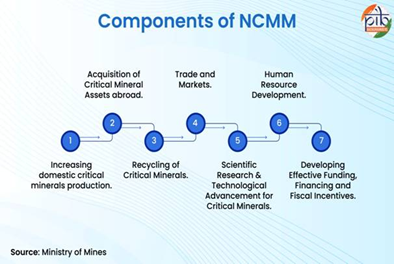
- National Critical Mineral Mission (NCMM) – It aims to strengthen the value chain from exploration to recovery.
SAIME model (Aquaculture model) of Sundarbans wins FAO recognition
Syllabus: GS3/Environment/Economy
In News
- The Sustainable Aquaculture in Mangrove Ecosystems (SAIME) model received Global Technical Recognition from the UN’s Food and Agriculture Organization (FAO).
Sustainable Aquaculture in Mangrove Ecosystems (SAIME) model
- Developed by – Nature Environment and Wildlife Society (NEWS) in West Bengal’s Sundarbans.
- Objective – It is a community-based initiative that integrates sustainable aquaculture practices with mangrove conservation and restoration
- Significance – It enhances coastal resilience, supports sustainable livelihoods, promotes chemical-free shrimp farming, and aids carbon sequestration and climate action.
Sundarbans in West Bengal
Geographical location
- It is a vast contiguous mangrove forest ecosystem present in the coastal region of Bay of Bengal
- It spread over India and Bangladesh on the Ganges, Brahmaputra and Meghna delta.
Conservation efforts
- UNESCO World Heritage site – Sundarbans National Park was designated a UNESCO World Heritage site in 1987.
- Biosphere Reserve – Sunderbans was designated as a Biosphere Reserve by UNESCO in 2001.
- Wetland of International Importance – Sundarban Wetland, India was recognised as the ‘Wetland of International Importance’ under the Ramsar Convention in January 2019.
- Flora and Fauna – Sunderban National Park is known for its wide range of fauna, including 260 bird species and is home to the Royal Bengal tiger, Gangetic dolphins and Estuarine crocodile
Indian wolf
Syllabus: GS3/Species in News
News
- The International Union for Conservation of Nature (IUCN) has for the first time evaluated the Indian wolf (Canis lupus pallipes)
Indian wolf (Canis lupus pallipes)
- Distribution – The Indian Wolf is primarily found in India and Pakistan, with its historic range confined south of the Himalayas .
- It is mainly found in sixteen states with major populations in Maharashtra, Madhya Pradesh, Gujarat, Rajasthan, and Karnataka.
- Threats : Habitat loss, persecution, and human-wildlife conflict.
- It is one of the most ancient wolf lineages
- It is now listed as Vulnerable on the IUCN Red List.


Leave a Reply