
Members of Parliament Local Area Development Scheme (MPLADS)
(Welfare Schemes)
In Context
- A recent controversy erupted over alleged misuse of MPLADS funds and critics demanding the scheme should be discontinued.
Members of Parliament Local Area Development Scheme (MPLADS)
- It is a Central Sector Scheme launched in 1993,
- Implementation – Ministry of Statistics and Programme Implementation (MoSPI).
- Objective: To enable Members of Parliament (MPs) to recommend works for the creation of durable community assets based on locally felt needs such as drinking water, sanitation, roads, public health infrastructure.
- Funds alloted: Each MP is entitled to ₹5 crore per year under MPLADS.
- It requires MPs to recommend at least 15% of funds for SC-inhabited areas and 7.5% for ST-inhabited areas annually.
- Non Lapsable Fund: MPLADS funds are non-lapsable, meaning unutilised funds are carried forward to subsequent years, ensuring continuity of projects.
- Geographical coverage: Lok Sabha MPs can recommend works within their constituencies, Rajya Sabha MPs within their state of election, and nominated MPs anywhere in the country.
- Exceptions: MPs may recommend up to ₹25 lakh per year outside their constituency/state, and up to ₹1 crore for an affected district during natural calamities.
Solid Waste Management (SWM) Rules, 2026
Syllabus: GS3/Environment
In News
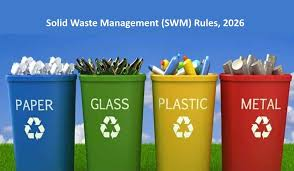
- The Union Ministry of Environment, Forest and Climate Change has notified the Solid Waste Management (SWM) Rules, 2026, superseding the Solid Waste Management Rules, 2016.
Solid Waste Management (SWM) Rules, 2026
- The rules have been notified under the Environment (Protection) Act, 1986 and will come into full effect from April 1, 2026.
- The rules provide for the levy of environmental compensation based on the ‘Polluter Pays’ principle for non-compliance, including cases of operating without registration, false reporting, submission of forged documents or improper solid waste management practices.
- The Central Pollution Control Board (CPCB) will prepare the relevant guidelines, while State Pollution Control Boards and Pollution Control Committees will levy the environmental compensation.
Major Features
- Four-stream Segregation of Solid Waste at Source has been made mandatory under the SWM Rules, 2026.
- Wet waste includes kitchen waste, vegetables, fruit peels, meat, flowers, etc., which shall be composted or processed through bio-methanation at the nearest facility.
- Dry waste comprises plastic, paper, metal, glass, wood and rubber, etc., and shall be transported to Material Recovery Facilities (MRFs) for sorting and recycling.
- Sanitary waste includes used diapers, sanitary towels, tampons and condoms, etc., which shall be securely wrapped and stored separately.
- Special care waste includes paint cans, bulbs, mercury thermometers and medicines, etc., which shall be collected by authorised agencies or deposited at designated collection centres
- Clear definition of Bulk Waste Generators: Bulk Waste Generators include entities with a floor area of 20,000 square metres or more, or water consumption of 40,000 litres per day or more, or solid waste generation of 100 kg per day or more.
- Faster Land Allocation for Waste Processing and Online Monitoring of Complete Solid Waste Management
- Duties of Local Bodies and Material Recovery Facilities (MRFs): Under the revised rules, local bodies must collect, segregate, and transport solid waste in coordination with Material Recovery Facilities (MRFs).
New START Treaty
Syllabus: GS2/IR
In News
- Experts caution that the expiry of the New START Treaty would eliminate the last remaining legally binding constraint on the nuclear arsenals of the world’s two largest nuclear powers.
New START Treaty
- Abbreviation- Strategic Arms Reduction Treaty.
START-I treaty –
- It was signed between the US and the former USSR in 1991 and came into force in 1994.
- It limited each side to 6,000 nuclear warheads and 1,600 intercontinental ballistic missiles (ICBMs) but expired in 2009.
- It was succeeded by the Strategic Offensive Reductions Treaty (SORT, also called the Treaty of Moscow) and later by the New START treaty (signed in 2010 & entered into force in 2011).
New START treaty
- It caps the number of deployed strategic warheads at 1,550 on each side, with no more than 700 deployed ground- or submarine-launched missiles and bomber planes, and 800 launchers.
Implications of Expiration
- Without a treaty, Russia and the US could freely expand their arsenals, risking a renewed nuclear arms race amid global tensions.
- The absence of a framework heightens nuclear risks and removes the transparency and stability that arms control agreements provide.
Pradhan Mantri Virasat Ka Samvardhan (PM VIKAS)
Syllabus: GS2/Governance/GS3(Economy)
In News
- PM VIKAS has allocated targets to train about 1.51 lakh beneficiaries through Project Implementing Agencies across States and UTs.
Pradhan Mantri Virasat Ka Samvardhan (PM VIKAS)
- Financing – Central Sector Scheme
- Implementation – Ministry of Minority Affairs
- It converges five erstwhile schemes vi ‘Seekho Aur Kamao’, ‘Nai Manzil’, ‘Nai Roshni’ and ‘USTTAD’ & ‘Hamari Dharohar’ .
- Aim – It focuses on upliftment of six notified minority communities through skill development; entrepreneurship and leadership of minority women; and education support for school dropouts.
Do you know?
- Six officially recognized minority groups in India —Muslims, Christians, Sikhs, Buddhists, Jains, and Zoroastrians (Parsis)—on socio-economic fronts.
India has Entered an Elite Group of Possessing SFDR Technology
Syllabus: GS3/ Defence
In News
- DRDO successfully demonstrated Solid Fuel Ducted Ramjet (SFDR) technology from the Integrated Test Range (ITR) in Chandipur, Odisha, advancing India’s long-range air-to-air missile capabilities.
Solid Fuel Ducted Ramjet (SFDR)
- SFDR is a missile propulsion system that uses a ramjet engine to provide sustained thrus
- Unlike traditional rockets, it is an air-breathing system, meaning it does not carry an onboard oxidizer, using atmospheric oxygen instead.
- Since ramjets only function at high speeds, the missile is first launched using a nozzle-less solid booster to reach supersonic speeds (Mach 2+).
Strategic Significance for India
- Long-Range Air-to-Air Missiles (LRAAM): SFDR will power the Astra Mark-3, enabling it to intercept high-speed, maneuvering enemy aircraft at ranges exceeding 150–300 km.
- Expanded “No-Escape Zone”: Because the missile stays “powered” until the very end, it can perform high-G turns near the target, making it nearly impossible for an enemy jet to out-maneuver it.
- Surface-to-Air Application: It can be adapted for futuristic SAM systems (like the proposed SAM-X) to defend against hypersonic or highly agile cruise missiles.
Agriculture Infrastructure Fund
Syllabus: GS3/Economy
In News
- Agriculture Infrastructure Fund (AIF) has sanctioned ₹80,224.15 crore in loans for over 1.5 lakh projects, mobilising investments of ₹1.27 lakh crore since 2020.
Agriculture Infrastructure Fund (AIF)
- It is a central sector scheme
- Objective – to mobilize medium and long-term debt financing for the development of post-harvest management infrastructure and community farming assets.
- It focuses on strengthening agri-logistics, reducing post-harvest losses, promoting modern storage, processing and value-addition facilities and improving farm-gate level infrastructure for efficient supply chains.
Leave a Reply