
India to Begin Mapping Its Manuscript Heritage
Culture
Context
- The Ministry of Culture has launched a first-of-its-kind, three-month nationwide survey to map India’s vast manuscript heritage.
- The initiative is part of the Gyan Bharatam Mission, announced in the Union Budget 2025–26.
Significance of the initiative
- Preservation of Heritage: Digitisation and documentation will protect fragile manuscripts from deterioration and loss.
- Research Accessibility: A centralised repository will enable easier access for scholars and the public.
- Curbing Intellectual Piracy: Proper records and metadata will help establish authenticity and prevent misuse.
- Cultural Revival: Greater visibility will promote India’s literary and knowledge traditions.
Additional information – Gyan Bharatam Mission
- Purpose – The mission aims to preserve and protect manuscripts found across the country.
- Objective: To undertake the “survey, documentation and conservation” of more than one crore manuscript heritage lying with academic institutions, museums, libraries, etc.
- Significance of Mission: Preserving historical value, unveiling ancient Indian knowledge to the world, ensuring longevity and round-the-clock access to Manuscripts, etc.
Manuscripts
- A manuscript is a handwritten composition on paper, bark, palm leaf etc. dating back at least 75 years that has significant scientific, historical or aesthetic value.
- g. Bakhshali manuscript (Third or fourth century A.D.), an ancient Indian mathematical text written on birch bark, is considered to be the earliest recorded example of use of zero.
- India possesses an estimated 10 million manuscripts in 80 ancient scripts like Brahmi, Kushan, Gaudi, Lepcha, and Maithili.
Other initiatives for manuscript conservation in India
- National Manuscripts Mission (NMM): Launched In 2003, by the Ministry of Tourism and Culture to locate and preserve manuscripts.
- National Library of India, Kolkata: It has about 3600 rare and historically important manuscripts.
- Asiatic Society of Bengal: Founded on Jan. 15, 1784, by Sir William Jones, undertakes digitization of ancient manuscripts.
- Abhilekh Patal is an initiative of the National Archives of India to provide online access to over a million files, including a significant collection of manuscripts, oriental records, and private papers.
- Gyan-Setu: It was launched as a national challenge to source AI-led solutions for manuscript preservation, decipherment, restoration and access.
- Antiquities and Art Treasures Act, 1972: It seeks to prevent the illegal export and smuggling of India’s cultural heritage, including valuable manuscripts.
Tropical Forest Forever Facility (TFFF)
Environment
Context
- The COP30 held in Belém brought global attention that effective forest conservation requires not only financial commitments but also a redistribution of decision-making power.
- Brazil introduced the Tropical Forest Forever Facility (TFFF) as a new model of forest finance aimed at transforming conservation efforts.
Tropical Forest Forever Facility (TFFF)
- It is a performance-based financial mechanism that seeks to reward countries for maintaining standing forests rather than merely reducing deforestation rates.
- It is designed to generate financial returns while supporting long-term forest conservation.
- The fund has already secured more than $5.5 billion in initial commitments, including a significant contribution of $3 billion from Norway.
Tribal Arts in Conversation
Culture
Context
- The Tribes Art Fest 2026, held at Travancore Palace in New Delhi, showcased India’s rich tribal artistic heritage.
Major Tribal Art Forms Highlighted
Warli Painting
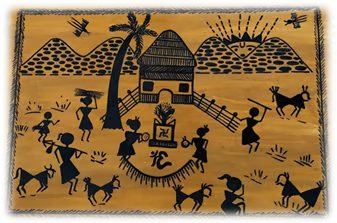
- It originates from Maharashtra and is practised by the Warli tribe.
- It has roots possibly dating back to the Neolithic period (2500–3000 BC). Key features are;
- Use of white pigment made from rice paste on mud walls.
- Representation through basic geometric shapes (circles, triangles, squares).
- Themes include agriculture, rituals, hunting, and Tarpa dance.
- Rabha and Tamang Masks: Mask-making is central to the Rabha tribe of Assam and North Bengal. Masks are made using wood, bamboo, gourd, or clay, and painted in vibrant colours.
- They depict gods, spirits, animals, and mythological beings, used in ritual dances and folk theatre.
Gond Art
- Gond painting originates from central India, especially Madhya Prades It has received a GI tag, ensuring legal protection and recognition.
Key features are;
- Use of dots and lines to create intricate patterns.
- Themes rooted in folklore, animals, forests, and ecology.
Bhil Painting:
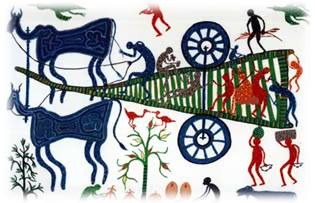
- It is practised by the Bhil tribe, one of India’s largest indigenous groups mainly from Madhya Pradesh, Maharashtra, Gujarat, and Rajasthan. It is considered among the oldest tribal art traditions.
Key features are:
- Use of thousands of coloured dots, symbolising seeds and nature’s rhythm.
- Themes include deities, animals, forests, and daily life.
NMDC Iron Ore Production
Economy
Context
- NMDC Limited has become India’s first mining company to achieve 50 million tonnes (MT) of iron ore production in a single financial year (FY 2025–26).
Iron Ore
- Iron ore refers to rocks and minerals from which metallic iron is extracted.
- Iron ore is categorized into four main types based on iron content and quality:
- Magnetite (best quality, >70% iron)
- Hematite (most important industrial ore, 60-70% iron)
- Limonite (lower grade, 40-60% iron)
- Siderite (poor quality, <40% iron).
- India is the 4th largest producer, after Australia, Brazil, and China.
- Odisha leads in production, followed by Chhattisgarh and Karnataka.
About NMDC
- Established in 1958 to develop India’s iron ore resources.
- India’s largest iron ore producer and a Navratna CPSE under the Ministry of Steel.
- It Supports India’s target of 300 MT steel production capacity by 2030.
Gynandromorphy
Environment
Context
- A rare case of gynandromorphy has been reported in a freshwater crab species Vela carli from Silent Valley National Park in the Western Ghats.
Gynandromorphy
- Gynandromorphy refers to the presence of both male and female characteristics in a single organism.
It occurs due to;
- Errors in cell division (mitosis/meiosis).
- Chromosomal anomalies during early development.
It is different from;
- Hermaphroditism: Organism has functional reproductive organs of both sexes.
- Intersex conditions: Mixed sexual characteristics but not distinct male/female halves.
Additional Information – Silent Valley National Park
- It is located in the Nilgiri hills, Kerala.
- Silent Valley was declared as a National Park in 1984 and formally inaugurated in the year 1985.
- Rivers – The Bhavani River, a tributary of the Kaveri River, and Kunthipuzha River, a tributary of Bharathapuzha river, originate in the vicinity of Silent Valley.
- Tribals – The indigenous tribal groups that live within park boundaries includeIrulas, Kurumbas, Mudugas and Kattunaikkars.


Leave a Reply