
India Germany Sign Pact to Shore Up Defence Industrial Cooperation
International
Context
- India and Germany signed agreements spanning sectors such as defence, technology, health, energy and human resources.
India and Germany Bilateral Ties
- Establishment of Ties: India and Germany entered into diplomatic relationship in 1951. 2026 marks the 75 years of the establishment of diplomatic relations.
- Strategic Partnership: Since 2000, India and Germany have had a ‘Strategic Partnership’ and 2025 marks the 25 years of Strategic Partnership.
- Defence Cooperation: Germany Participated in many multilateral exercises with India, such as: MILAN, PASSEX, EX TARANG SHAKTI-1.
- Trade Cooperation: India was Germany’s 23rd largest trading partner in 2024 and Germany was the 8th largest trading partner for India in and is India’s largest trading partner in the EU.
- Green and Sustainable Development Partnership (2022): Germany pledged €10 billion by 2030.
- Collaboration in renewable energy, metro projects, green corridors, and smart cities directly aids India’s climate goals and SDG commitments.
Multilateral Cooperation:
- Support for India’s permanent seat at UNSC.
- Coordination at G20, UN, WTO, COP climate talks.
- Indian Diaspora: There are around 2.46 lakh (2023) Indian passport holders and Indian-origin people in Germany.
Article 6 of the Paris Agreement and India
Geography & Environment
In Context
- At COP29, carbon markets under Article 6 (A6) of the Paris Agreement were made fully operational to improve the delivery and efficiency of climate finance.
- Earlier, India took a major step by signing the Joint Crediting Mechanism (JCM), effectively operationalising Article 6.2 and marking India’s formal entry into international carbon market cooperation.
Article 6 of the Paris Agreement
- It creates a framework that allows countries to cooperate voluntarily to achieve their Nationally Determined Contributions (NDCs) through two main routes:
- Article 6.2: Enables bilateral or plurilateral cooperation through the trading of emission reductions, called Internationally Transferred Mitigation Outcomes (ITMOs).
- Article 6.4: Establishes a centralized Paris Agreement Crediting Mechanism (PACM), evolved from the earlier Clean Development Mechanism (CDM), to validate and verify projects generating carbon credits.
- Both mechanisms are backed by strong accounting rules to avoid double counting and ensure transparency and environmental integrity.
India and the Joint Crediting Mechanism
- India’s entry into Article 6 through its JCM partnership with Japan represents the operationalisation of Article 6.2. The JCM framework will facilitate the adoption of low-carbon and advanced industrial technologies, offering mutual benefits—emissions reduction for Japan and technology transfer and finance for India.
- The Indian government has identified 13 eligible activities under A6, focusing on high-impact, emerging technologies such as:
- Renewable energy with storage and offshore wind
- Green hydrogen and compressed bio-gas
- Sustainable aviation fuel and fuel-cell mobility
- High-end energy efficiency applications
Carbon capture, utilisation, and storage (CCUS)
- These reflect a strategic alignment between India’s growth priorities and long-term decarbonisation goals, particularly for industries like steel, cement, and power generation.
First Fully Organic Village of Rajasthan
Economy
In News
- Bamanwas Kankar Panchayat, Rajasthan, has become the first fully organic village body in the state, covering seven hamlets.
Natural Farming
- It is a chemical free farming, involving livestock (preferably local breed of cow) integrated natural farming methods and diversified crop systems rooted in the Indian traditional knowledge.
- It is largely based on on-farm biomass recycling with major stress on biomass mulching, use of on-farm cow dung-urine formulations; maintaining soil aeration and exclusion of all synthetic chemical inputs.
Additional Information- National Mission on Natural Farming (NMNF)
- Launched in – November 2024
- It is a centrally sponsored Scheme
- Objective – to promote chemical-free, ecosystem-based natural farming rooted in traditional knowledge.
ISRO’s PSLV-C62/EOS-N1 Mission Experienced an Anomaly During the Third Stage
Science and Technology
In News
- ISRO’s first launch of the year, the PSLV-C62 mission failed to place its 16 satellites into the intended orbit, marking the second consecutive failure of the long-reliable PSLV rocket.
The PSLV-C62 / EOS-N1 Mission
- It was the 64th flight of India’s PSLV and ninth commercial mission by NewSpace India Limited (NSIL).
- It aimed to launch the EOS-N1 Earth observation satellite along with 15 co-passenger satellites.
- EOS-N1 is an Earth observation satellite intended for environmental monitoring, resource mapping, and disaster management.
Additional information – Polar Satellite Launch Vehicle (PSLV)
- It is the third generation launch vehicle of India.
- It has also been called “the workhorse of ISRO” for consistently delivering various satellites into low earth orbits with a high success rate.
- It is the first Indian launch vehicle to be equipped with liquid stages.
- It is a four-stage rocket in which each stage has its own engine and fuel.
Major launches
- First successful launch in October 1994.
- PSLV successfully launched two spacecraft – Chandrayaan-1 in 2008 and Mars Orbiter Spacecraft in 2013 that later travelled to Moon and Mars respectively.
- It also launched India’s first space observatory, Astrosat.
Geosynchronous Satellite Launch Vehicle (GSLV)
- It is India’s largest fourth-generation launch vehicle, designed to overcome the limitations of the PSLV by carrying heavier payloads to higher orbits.
- GSLV is a three-stage vehicle, capable of delivering up to 1,750 kg to low Earth orbit (up to 600 km) and smaller payloads to Geostationary Transfer Orbit.
- GSLVs use cryogenic engines with liquid hydrogen and liquid oxygen, providing greater thrust than earlier launch vehicles.
- Its advanced variant, LVM-3 (formerly GSLV Mk III), employs solid, liquid, and cryogenic engines, carrying up to 8,000 kg to low Earth orbit (up to 2,000 km) and 4,000 kg to geosynchronous orbit (36,000 km), earning the nickname ‘Bahubali’ for its payload capacity.
Major launches
- LVM-3’s first successful mission was in 2017 with GSAT-19.
- It was followed by Chandrayaan-2 in 2019 and Chandrayaan-3 in 2023.
- Note – ISRO is developing its heaviest rocket, the Lunar Module Launch Vehicle (LMLV), expected by 2035, to support future lunar missions, including India’s first human Moon mission planned for 2040.
Bhadrakali Inscription
Culture
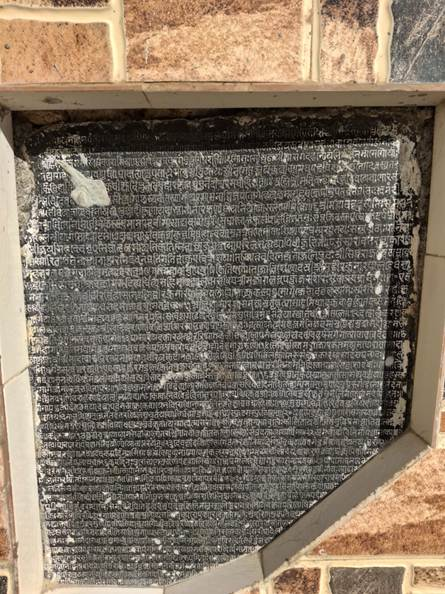
In News
- Recently, it has been highlighted that Prabhas Patan has a rich historical and spiritual heritage, with inscriptions like Bhadrakali, copper plates, and memorial stones showcasing its prosperity, valor, and devotion.
- Note – Prabhas Patan, also known as Dev Patan, is a historic and sacred locality in Veraval, Gujarat, celebrated as the site of the Somnath Temple. It remains one of India’s most significant pilgrimage destinations, housing the first of the twelve holy Jyotirlingas of Lord Shiva.
Bhadrakali Inscription
- It was carved in 1169 CE (Valabhi Samvat 850 and Vikram Samvat 1255) and currently protected by the State Department of Archaeology.
- It is located near the museum in Prabhas Patan, beside the old Ram Temple in Bhadrakali lane.
- It is a eulogistic inscription of Param Pashupata Acharya Shriman Bhavabrihaspati, the spiritual preceptor of Maharajadhiraj Kumarapala of Anhilwad Patan.
Features
- It records the ancient and medieval history of the Somnath Temple.
- It mentions the construction of Somnath Mahadev in all four yugas.
Accordingly, in the
- Satya Yuga, Chandra (Soma) built it of gold;
- In the Treta Yuga, Ravana built it of silver;
- In the Dvapara Yuga, Shri Krishna built it of wood
- In the Kali Yuga, King Bhimdev Solanki constructed a beautifully artistic stone temple.
- History confirms that Bhimdev Solanki built the fourth temple on the earlier remains, followed by the fifth temple constructed by Kumarapala in 1169 CE at the same site
Importance
- Prabhas Patan embodies the spiritual pride of Sanatan Dharma.
- The Bhadrakali inscription highlights the devotion of Solanki rulers and scholars like Bhavabrihaspati, and its rich artistic, architectural, and literary legacy continues to inspire, affirming that devotion and self-respect remain timeless.
Pax Silica
International
Context
- The US Ambassador announced that India would be invited next month to join Pax Silica.
Pax Silica
- Objective – It is a US-led strategic initiative to build a secure, prosperous, and innovation-driven silicon supply chain from critical minerals.
- The inaugural Pax Silica Summit was held in December 2025 and the signatories include Australia, Israel, Japan, South Korea, Singapore, the UK, the Netherlands, and the UAE.
- Together, these countries are home to the most important companies and investors powering the global AI supply chain.
- Note – Qatar became the latest signatory to Pax Silica.
- Significance – Its objective is to reduce coercive dependencies, protect the materials and capabilities foundational to artificial intelligence, and ensure aligned nations can develop and deploy transformative technologies at scale.
Significance for India
- Joining Pax Silica might help India diversify away from China to more secure suppliers like Australia for critical minerals.

Leave a Reply