
Ganges Treaty Nears Expiry
International Relations
Context
- India and Bangladesh have initiated a joint water measurement initiative on the Ganga and Padma rivers as the Ganges Water Sharing Treaty enters its final year before expiry in December 2026.
Ganges Water Sharing Treaty, 1996
- It was signed on 12 December 1996 between India and Bangladesh.
- It governs the sharing of Ganges waters at the Farakka Barrage, located in West Bengal, about 18 km upstream of the Bangladesh border.
Origins of the Ganges Water Dispute
- Construction of Farakka Barrage (1975): India completed the Farakka Barrage in 1975 to divert water into the Hooghly River.
- Purpose was to flush out silt & improve navigability of the Kolkata Port.
Bangladesh’s Concerns- As a lower riparian state, Bangladesh argued that reduced downstream flows:
- Harmed agriculture and fisheries
- Disrupted river navigation
- Increased salinity intrusion in coastal areas
- Threatened the Sundarbans ecosystem
- This disagreement became one of South Asia’s most persistent transboundary water disputes.
Steps Taken
- Five-year Ganges Agreement (Interim), 1977
- Memoranda of Understanding on Flow Sharing in 1982 & 1985
- Teesta Water Sharing Agreement: 2011; Proposed but unsigned.
Additional Information – Ganga River
- Origin: Gangotri Glacier in Uttarakhand
- Length: Approximately 2,525 km.
- Basin Area: Covers about 8,61,452 sq. km in India, nearly 27% of India’s landmass over 11 Indian states.
- Significance – It supports over 45% of India’s population.
- States Covered: Uttarakhand, Uttar Pradesh, Bihar, Jharkhand, West Bengal, and parts of several others.
Major Tributaries of the Ganga River,
- Left Bank Tributaries: Ramganga, Gomti, Ghaghara, Gandak, Burhi Gandak, Koshi, Mahananda.
- Right Bank Tributaries: Yamuna, Tons, Karamnasa, Sone, Punpun, Falgu, Kiul, Chandan, Ajoy, Damodar, Rupnarayan.
- The Ganga enters as the Padma River into Bangladesh below the Farakka Barrage, eventually merging with the Brahmaputra and Meghna rivers before emptying into the Bay of Bengal.
- Delta: Forms the world’s largest delta, the Sundarbans, shared by India and Bangladesh.
Sangita Kalanidhi Award
Culture
Context
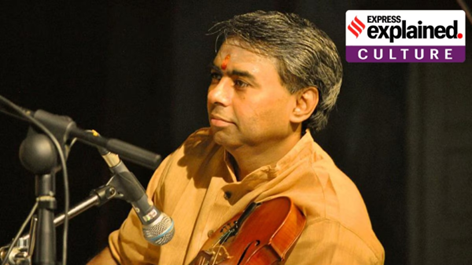
- Sangita Kalanidhi award was conferred on violinist R.K. Shriramkumar.
Sangita Kalanidhi award
- It was instituted in 1942 by the Madras Music Academy.
- The award is considered the highest recognition for excellence in Carnatic music and is often regarded as the “Nobel Prize” of Carnatic music.
- The award comprises a gold medal and a birudu patra (citation).
- Since 2005, the Sangita Kalanidhi awardees have also received the MS Subbulakshmi Award instituted by The Hindu.
Additional Information – M.S. Subbulakshmi’s Legacy
- S. Subbulakshmi was an iconic Carnatic singer, She was the
- first Indian musician to receive the Ramon Magsaysay award in 1974
- first Indian to perform at the United Nations General Assembly in 1966.
- first musician to be awarded the Bharat Ratna, India’s highest civilian award, in 1998.

Leave a Reply