
Chrysanthemum Flowers or Gul-e-Dawood
Syllabus: GS3/Environment
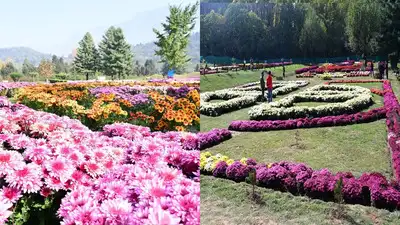
In News
- Kashmir’s new Chrysanthemum Garden, Bagh-e-Gul-e-Dawood will open near the Zabarwan range, featuring over 30 lakh blooms across 50+ varieties.
Chrysanthemum
- It is a perennial flowering plant from the Asteraceae family.
- It is widely cultivated in China, Japan, Europe, and the U.S. for its medicinal properties and use in aromatic beverages.
- Uniqueness – It is rich in phenolic compounds and exhibits potent antioxidant, antimicrobial, anti-inflammatory, anticancer, and other therapeutic activities.
International Convention Against Doping in Sport
Syllabus: Miscellaneous
In News
- India was re-elected as Vice-Chairperson of the Bureau representing the Asia-Pacific during the 10th Session of UNESCO’s International Convention against Doping in Sport, held in Paris.
Doping and its Concerns
- Doping refers to the practice of using banned chemical substances, known as performance enhancing drugs (PEDs), by athletes.
Conventions and Declarations related to Anti-Doping
Copenhagen Declaration
- Held in – Copenhagen Declaration on Anti-Doping in Sport was agreed upon by governments at the Second World Conference on Doping in Sport held in Copenhagen, Denmark in 2003.
- Purpose – The declaration was the political document through which governments signalled their intention to formally recognise and implement the World Anti-Doping Code.
- Significance – This declaration was the first step toward the preparation of the UNESCO International Convention against doping in sports.
- India agreed to this declaration in the year 2003.
International Convention Against Doping in Sport
- It is also known as the ‘UNESCO Anti-Doping Convention’.
- It was adopted at the General Conference of UNESCO in Paris in 2005. It entered into force in 2007.
- Objective – To promote the prevention of and the fight against doping in sports, with a view to its elimination.
- India ratified this convention in 2007.
- Note – National Anti-Doping Agency, an autonomous body under the Ministry of Youth Affairs, is responsible for adopting, implementing and enforcing anti-doping programmes in India.
Strengthening Governance through Blockchain Technology
Syllabus: GS2/ Governance. GS3/ Science and Technology
Context
- India is accelerating its adoption of blockchain technology to transform governance, enhance transparency, and strengthen digital trust through the National Blockchain Framework (NBF).
Connect with the basics- Blockchain
- Definition – Blockchain is a distributed, transparent, secure, and immutable database that functions like a ledger of records or transactions, resistant to tampering and accessible across a network of computers.
Applications of Blockchain Technology
Blockchain technology has numerous applications across various industries due to its secure, transparent, and decentralized nature.
- Cryptocurrencies: Enabling secure digital currencies like Bitcoin and Ethereum.
- Smart Contracts: Automating agreements without intermediaries.
- Supply Chain Management: Enhancing transparency and traceability.
- Healthcare: Securing patient records and improving data sharing.
- Banking and Finance: Streamlining cross-border payments and fraud detection.
- Voting Systems: Ensuring transparent and tamper-proof elections.
- Identity Management: Offering secure, verifiable digital identities.
- Real Estate: Simplifying property transfers with tokenized assets.
- Gaming: Enabling ownership of in-game assets and NFTs.
- Energy Sector: Supporting peer-to-peer energy trading.
National Blockchain Framework (NBF)
- Launched in- 2024
- Developed by – Ministry of Electronics and Information Technology (MeitY)
- Objective – to accelerate the development and deployment of permissioned blockchain-based applications.
Makhananomics
Syllabus: GS3/Economy
In News
- Prime Minister Narendra Modi described the newly launched National Makhana Board as a transformative “revolution” for the sector.
Makhana (Euryale ferox)
- It is a flowering plant classified in the water lily family (Nymphaeaceae).
- Climatic condition: Requires a temperature range of 20-35°C, and annual rainfall between 100- 250 cm.
- It is a fully organic non-cereal food found principally in India but also in Korea, Japan, as well as parts of eastern Russia.
- Bihar accounts for ~90% of India’s makhana production.
- GI Tag: In 2022, ‘Mithila Makhana’ was conferred a GI tag.
Cloud Seeding
Syllabus: GS3/Environment
Context
- Delhi Chief Minister has said cloud seeding is essential for the national capital as it could play a key role in controlling rising pollution levels during the winter season.
Cloud Seeding or Artificial Rain
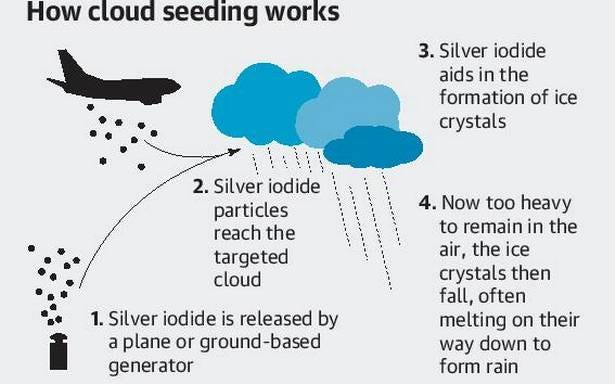
- Definition – Artificial rain refers to inducing precipitation by injecting certain chemicals into clouds to accelerate the process of raindrop formation.
- Cloud seeding involves dispersing substances like:
- Silver iodide (AgI)
- Potassium iodide
- Sodium chloride
- Dry ice (CO₂)
- Conditions Required: Potential rain-bearing clouds, sufficient humidity and atmospheric instability & Favorable wind and temperature conditions.
Advantages of Cloud Seeding
- Air Pollution Mitigation: In cities like Delhi, artificial rain can wash down particulate matter and other pollutants, providing temporary relief from severe air pollution.
- Drought Mitigation and Water Resource Augmentation: States like Maharashtra and Karnataka have used cloud seeding to combat water shortages (e.g., “Project Meghdoot” and “Varshadhari”).
- Forest Fire Control: By increasing moisture levels, cloud seeding can potentially reduce the risk and intensity of wildfires.
Sree Narayana Guru
Syllabus: GS1/Modern History

Context
- The President of India inaugurated the observance of the Mahasamadhi centenary of Sree Narayana Guru at Sivagiri Mutt, Varkala, Kerala.
Sree Narayana Guru(1856–1928)
- He was born in 1856 in Kerala into the Ezhava community, which faced severe caste disabilities.
- He was a saint, philosopher, and one of the foremost social reformers in modern India who challenged caste oppression and emphasized spiritual reform as the path to social reform.
- Sree Narayana Guru known for blending Advaita Vedanta with a call for social justice.
Key Contributions
- Social Philosophy: Propagated the radical message: “One Caste, One Religion, One God for Man”.
- Rejected birth-based caste hierarchy and promoted dignity of labour.
- Institution Building: Founded Sree Narayana Dharma Paripalana Yogam (SNDP, 1903) to advance education, social empowerment, and reform.
- Aruvipuram Movement (1888): Consecrated a Shiva idol himself, breaking the Brahmin monopoly over temple ritual Built temples, schools, and ashrams for the common people with egalitarian access.
- Political & Social Movements: Extended moral and ideological support to the Vaikom Satyagraha (1924–25) for temple entry rights of lower castes.
- Educational Upliftment: Stressed education as the foundation of empowerment and upliftment.
Gyan Bharatam Mission
Syllabus: GS1/Culture
Context
- The Gyan Bharatam Mission on manuscripts under the Union Culture Ministry, signed Memorandums of Understanding with around 20 institutes for conservation, upkeep and digitisation of manuscripts.
Gyan Bharatam Mission
- Purpose – The mission aims to preserve and protect manuscripts found across the country.
- Objective: To undertake the “survey, documentation and conservation” of more than one crore manuscript heritage lying with academic institutions, museums, libraries, etc.
- Significance of Mission: Preserving historical value, unveiling ancient Indian knowledge to the world, ensuring longevity and round-the-clock access to Manuscripts, etc.
Basic terms – Manuscripts
- A manuscript is a handwritten composition on paper, bark, palm leaf etc. dating back at least 75 years that has significant scientific, historical or aesthetic value.
- g. Bakhshali manuscript (Third or fourth century A.D.), an ancient Indian mathematical text written on birch bark, is considered to be the earliest recorded example of use of zero.
- India possesses an estimated 10 million manuscripts in 80 ancient scripts like Brahmi, Kushan, Gaudi, Lepcha, and Maithili.
Other initiatives for manuscript conservation in India
- National Manuscripts Mission (NMM): Launched In 2003, by the Ministry of Tourism and Culture to locate and preserve manuscripts.
- National Library of India, Kolkata: It has about 3600 rare and historically important manuscripts.
- Asiatic Society of Bengal: Founded on Jan. 15, 1784, by Sir William Jones, undertakes digitization of ancient manuscripts.


Leave a Reply