
Champions of the Earth Award
Syllabus: Miscellaneous
Context
- Supriya Sahu, a Tamil Nadu IAS officer honoured with the UN Environment Programme’s 2025 Champions of the Earth Award.
Do you know?
- In 2000, Supriya Sahu launched a campaign called Operation Blue Mountain to eliminate single-use plastic in the Nilgiris.
- She introduced low-cost climate solutions, from painting school roofs white under the Cool Roof Project to restoring mangroves, wetlands, and creating 65 new reserve forests.
- Her nature-first approach has created 2.5 million green jobs and contributed significantly to India’s national emissions-reduction goals.
Champions of the Earth Award
- Launched in 2005
- It is the UN’s highest environmental honor.
- It recognizes outstanding figures from the public and private sectors as well as civil society, whose actions have brought about a positive impact and a transformation on the environment.
- It is awarded across five categories:
- Policy Leadership
- Entrepreneurial Vision
- Science and Innovation
- Lifetime Achievement
- Inspiration and Action (Supriya Sahu has been honored in this category).
- Past Indian recipients include: Madhav Gadgil (2024), Narendra Modi (2018), Cochin International Airport (2018) and Afroz Shah (2016).
Deepavali Added to UNESCO Intangible Cultural Heritage List
Syllabus: GS1/ Culture
Context
- Deepavali has been inscribed on UNESCO’s Representative List of the Intangible Cultural Heritage of Humanity during the 20th Session of the Intergovernmental Committee, held in New Delhi.
- India is hosting the 20th session of the UNESCO Intergovernmental Committee for Safeguarding of the Intangible Cultural Heritage, 2025 in Red Fort complex, New Delhi.
Deepavali
- Deepavali, also known as Diwali, is celebrated on Kartik Amaavasya, which typically falls in October or Novem
- It is followed by Naraka Chaturdashi.
- The third day is the highlight of Deepavali- the sacred Lakshmi-Ganesha Puja.
Popular Legends of Deepavali
- In the Ramayana, it signifies the return of Lord Rama, Sita, and Lakshmana to Ayodhya after 14 years of exile and their victory over Ravana, celebrated with lamps lighting their path.
- In the Mahabharata, it marks the return of the Pandavas after their exile.
- Naraka Chaturdashi recalls Lord Krishna’s victory over Narakasura, symbolising the end of evil.
- Lord Mahavira, the 24th Tirthankar, attained Nirvana on Deepavali at Pavapuri. Jain devotees celebrate this festival with enthusiasm as Nirvana Day.
- King Bali’s Return: In Maharashtra, Deepavali marks the visit of King Bali, symbolising justice and generosity.
- Kali Puja: In Bengal, Odisha and Assam, Deepavali coincides with the worship of Goddess Kali for protection and inner strength.
Connect with the basics – Intangible Cultural Heritage
UNESCO defines “intangible” as “expressions that have:
- Passed from one generation to another.
- Evolved in response to their environments.
- Contributed to giving us a sense of identity and continuity.
- According to an official document by UNESCO, ‘intangible cultural heritage’ includes “oral traditions, performing arts, social practices, rituals, festive events, knowledge and practices concerning nature and the universe or the knowledge and skills to produce traditional crafts.”
- To date, 16 Indian elements have been inscribed on the UNESCO Representative List (including Deepavali)
- Garba of Gujarat (2023)
- Durga Puja in Kolkata (2021)
- Kumbh Mela (2017)
- Navroz (2016)
- Yoga (2016)
- Traditional brass and copper craft of utensil making among the Thatheras of Jandiala Guru, Punjab (2014)
- Sankirtana, ritual singing, drumming and dancing of Manipur (2013)
- Buddhist chanting of Ladakh: recitation of sacred Buddhist texts in the trans-Himalayan Ladakh region, Jammu and Kashmir (2012)
- Chhau dance (2010)
- Kalbelia folk songs and dances of Rajasthan (2010)
- Mudiyettu, ritual theatre and dance drama of Kerala (2010)
- Ramman, religious festival and ritual theatre of the Garhwal Himalayas (2009)
- Kutiyattam, Sanskrit theatre (2008)
- Tradition of Vedic chanting (2008)
- Ramlila, the traditional performance of the Ramayana (2008)
- Deepavali (2025) – Recently added
World Inequality Report 2026 Released
Syllabus: GS2/Social Issues; GS3/Inclusive Growth
Context
- The 3rd edition of the World Inequality Report was released by the World Inequality Lab.
Key Findings of Report
- Wealth Concentration: The richest 10% of the global population own approximately 75% of the total wealth
Focus on India
- India is identified as one of the most unequal large economies globally.
- Income: The top 10% of earners capture 58% of the national income, while the bottom 50% receive only 15%.
- Wealth: The richest 10% hold around 65% of India’s total wealth, and the top 1% alone hold about 40%.
- Gender: Female labor force participation remains very low and stagnant at 15.7%
Aditya-L1 Joins Global Effort To Study the Solar Storm
Syllabus: GS3/ Science and Technology
Context
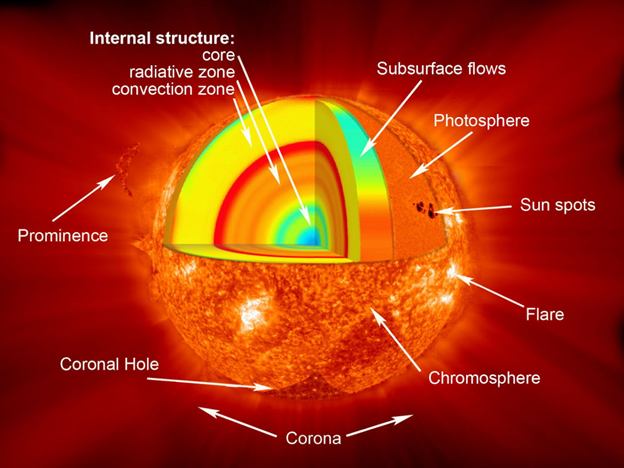
- India’s solar observatory Aditya-L1 has revealed unusual behaviour of the May 2024 solar storm called “Gannon’s storm”. It was triggered by a series of giant explosions on the Sun known as Coronal Mass Ejections (CMEs).
Solar Storm
- The solar storm is composed of a series of giant explosions on the Sun, known as coronal mass ejections (CMEs).
- A CME is like a massive bubble of hot gas and magnetic energy thrown out from the Sun into space.
- Impact on earth – When these bubbles hit Earth, they can shake earth’s magnetic shield and cause serious trouble for satellites, communication systems, GPS, and even power grids.
Additional information – Aditya-L1 mission
- Uniqueness – Aditya-L1 is the first space-based Indian observatory to study the Sun. It will be launched by the PSLV-C57.
- Note – The solar mission will not see the spacecraft actually go to the sun, it will instead create a space observatory at a point from which the sun can be observed even during an eclipse.
- The spacecraft is planned to be placed in a halo orbit around the Lagrange point 1 (L1), around 1.5 million km from the Earth, of the Sun-Earth system.
Major objectives of the mission
- The mission will focus on study of the Solar upper atmospheric (chromosphere and corona) dynamics.
- It will also identify what drives space weather, along with the origin, composition and dynamics of the solar wind.
Other missions to Sun
- NASA’s Parker Solar Probe, launched in 2018, has already gone far closer — but it will be looking away from the Sun.
- Helios 2 solar probe, a joint venture between NASA and the space agency of erstwhile West Germany,was launched to investigate solar processes of the Sun’s surface in 1976.
Global Environment Outlook
Syllabus: GS3/Environment
Context
- The Global Environment Outlook, Seventh Edition: A Future We Choose (GEO-7), was released during the seventh session of the United Nations Environment Assembly in Nairobi.
Global Environment Outlook (GEO)
- Published by – United Nations Environment Programme (UNEP)
- Mandate – to provide a comprehensive assessment of the planet’s environmental health
- Significance – To bridge the gap between science and policy by providing data-driven insights and policy options to guide global action towards sustainable development
- Latest Edition: The 7th edition, GEO-7, titled “A Future We Choose”, was released in December 2025.
Key Findings of the GEO-7 Report (2025)
- Climate Change & Tipping Points: Global warming is accelerating, with the world already having warmed by approximately 1.3°C.
- Pollution & Health: Approximately 9 million deaths globally are attributed annually to air, water, and soil pollution. Air pollution alone causes millions of premature deaths each year.
- Biodiversity Loss & Land Degradation: One million species are at risk of extinction, and 20-40% of land is degraded, affecting over 3 billion people.

Leave a Reply