
Appointment to Chief Information Commissioner
Polity and Governance
Context
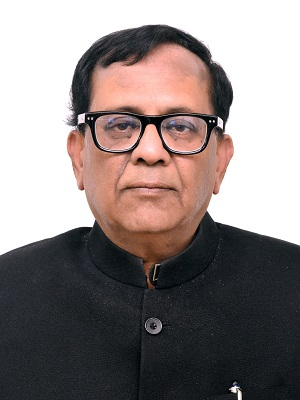
- The President of India administered the oath of office to Raj Kumar Goyal as the Chief Information Commissioner of the Central Information Commission.
Central Information Commission (CIC)
- Established – in 2005 by the Central Government under the provisions of Right to Information (RTI) Act, 2005.
- Objective – It hears appeals against public authorities who have not provided information satisfactorily to the public and also addresses major issues concerning the RTI Act.
- Annual report – CIC submits an annual report to the Union government on the implementation of the provisions of RTI Act.
Composition of CIC
- Head – The CIC is headed by the Chief Information Commissioner and not more than ten Information Commissioners.
- Tenure – The Chief Information Commissioner holds office for five years or until he attains the age of 65 years, whichever is earlier. He is not eligible for reappointment.
- Appointment of the commissioner in CIC – The commissioners are appointed by the President on the recommendation of a selection committee.
- Selection committee – It consists of the Prime Minister as Chairperson, the Leader of Opposition in the Lok Sabha and a Union Cabinet Minister nominated by the Prime Minister.
State Information Commission
- The Right to Information Act of 2005 provides for the creation of a State Information Commission at the state level.
- The State Information Commission is a high powered independent body which inter-alia looks into the complaints made to it and decides the appeals.
- It entertains complaints and appeals pertaining to offices, financial institutions, public sector undertakings, etc under the concerned state government.
- Composition – State Chief Information Commissioner and not more than ten State Information Commissioners appointed by the Governor.
Siliserh Lake and Kopra Jalashay Designated as New Ramsar Sites
Environment
Context
- India designated Siliserh Lake and Kopra Jalashay as its 95th and 96th Ramsar Sites, increasing the country’s total to 96, up from 26 in 2014.
Newly Designated Ramsar Sites:
Siliserh Lake:
- It is a man-made freshwater lake, constructed in 1845 by Maharaja Vinay Singh of Alwar.
- It was originally built to meet the drinking water needs of Alwar city.
- The lake is situated close to the Sariska Tiger Reserve, enhancing its ecological significance.
Kopra Jalashay:
- Located near Bilaspur, this is the first-ever Ramsar site in Chhattisgarh.
- It is a reservoir situated in the upper catchment of the Mahanadi River and serves as a freshwater source and biodiversity habitat.
Perumbidugu Mutharaiyar
Ancient History
Context
- A commemorative postage stamp in honour of the king Perumbidugu Mutharaiyar II (Suvaran Maran) was released by Vice President C P Radhakrishnan.
Perumbidugu Mutharaiyar (705 AD-745 AD),
- He was also known as Suvaran Maran, was a ruler of the Mutharaiyar lineage, feudatories of the Pallavas.
- He belonged to the illustrious Mutharaiyar dynasty, which ruled the central regions of Tamil Nadu between the 7th and 9th centuries CE.
- He ruled from Tiruchirappalli for nearly four decades and that his reign was marked by administrative stability, territorial expansion, cultural patronage, and military prowess.
- Perumbidugu Mutharaiyar is believed to have fought bravely in several battles alongside the Pallava king Nandivarman, and is remembered as a great administrator.
- Religious Policies: The Pallava reign saw a religious revivalism of Hinduism amid the dominance of Jainism and Buddhism.
- As their feudatories, the Mutharaiyars were great temple builders.
PM Visit to Jordan
International Relation
Context
- Prime Minister Narendra Modi concluded his two-day visit to Jordan.
- The visit marks India’s first full bilateral engagement with Jordan and comes as the two countries prepare to celebrate 75 years of diplomatic relations.
- Five memoranda of understanding were finalized covering culture, renewable energy, water management, digital public infrastructure and a twinning arrangement between the historic sites of Petra and Ellora.
- India is Jordan’s third-largest trading partner, Prime Minister Modi proposed enhancing bilateral trade to $5 billion over the next five years.
- He also encouraged collaboration between Jordan’s digital payment system and India’s Unified Payments Interface.
- Note – Jordan is a leading supplier of phosphates and potash fertilizers for India.
Additional Information – Jordan
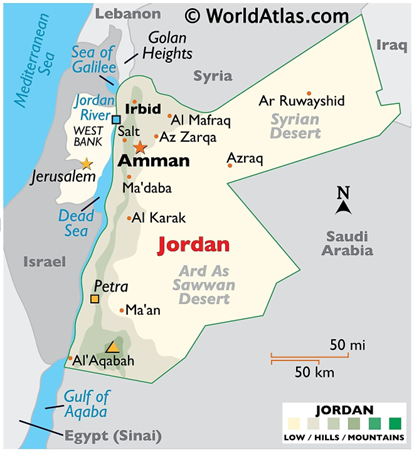
- West Asian country in the Middle East.
- Borders: Israel & Palestine (West), Saudi Arabia (South & East), Iraq (East), Syria (North).
- Dead Sea is a landlocked salt lake between Israel and Jordan in southwestern Asia.
- Landlocked except for a short coastline at Aqaba (Red Sea).
UN Alliance of Civilizations (UNAOC)
International Relation
In News
- The United Nations Alliance of Civilizations (UNAOC) has completed two decades of efforts aimed at bridging divides, reducing polarization, and promoting intercultural dialogue.
UN Alliance of Civilizations (UNAOC)
- Secretariat: New York
- Launched: 2005
- Initiated by: Republic of Türkiye & Spain, under the auspices of the United Nations.
Objectives:
- Improve cross-cultural and inter-religious relations between nations and communities.
- To counter polarisation, extremism, xenophobia and hate speech.
- Promote mutual understanding, inclusion, and peaceful coexistence.
- Relevance for India- Aligns with India’s civilisational ethos of pluralism and “Vasudhaiva Kutumbakam”.
National Blood Transfusion Bill 2025
Polity & Governance
Context
- The National Blood Transfusion Bill, 2025 was introduced in Parliament to establish a dedicated legal and institutional framework for blood transfusion services in India.
National Blood Transfusion Bill 2025
- Background – Blood transfusion services are regulated under the Drugs and Cosmetics Act, 1940, which is considered inadequate for managing blood as a life-saving public resource.
Key Provisions of the National Blood Transfusion Bill, 2025
- Establishment of a National Blood Transfusion Authority (NBTA) as a statutory body.
NBTA to prescribe uniform national standards for:
- Collection, testing and processing of blood
- Storage, distribution, issuance and transfusion of blood and blood components.
- Mandatory registration of all blood centres across the country.
- Introduction of strict penalties for unsafe, unethical or non-compliant practices.
- Promotion of voluntary blood donation through coordinated national programmes.
- Creation of a national haemovigilance system to monitor transfusion-related adverse events.
DHRUV64
Science & Technology
In News
- India has launched the DHRUV64 microprocessor.
DHRUV64
- Type: General-purpose microprocessor
- Developed By: Centre for Development of Advanced Computing (C-DAC) under the Microprocessor Development Programme (MDP) of the Government of India.
- Architecture: 64-bit, dual-core
- Clock Speed: 1.0 GHz
- Status: Fully indigenous (design and development in India)
- Function: Acts as the “brain” of electronic devices such as computers, mobiles, embedded systems and control units.
Significance
- Suitable for 5G infrastructure, automotive, consumer electronics, industrial automation, IoT, and strategic uses
- It reduces import dependence amid India’s 20% global microprocessor consumption.
National Energy Conservation Award
Environment
In News
- Karnataka Renewable Energy Development Limited (KREDL) has won the National Energy Conservation Awards 2025 under the State Energy Efficiency Performance Award (SDA Group-1) category.
National Energy Conservation Awards (NECA)
- Instituted by: Bureau of Energy Efficiency (BEE)
- Ministry: Ministry of Power, Government of India
- Objective: Recognise exemplary performance in energy efficiency and conservation
- Encourage States, industries and institutions to reduce energy intensity
- First instituted: 1991 (as National Energy Conservation Award scheme)


Leave a Reply