
Amazon’s ‘flying rivers’
Syllabus: GS1/ Geography
In News
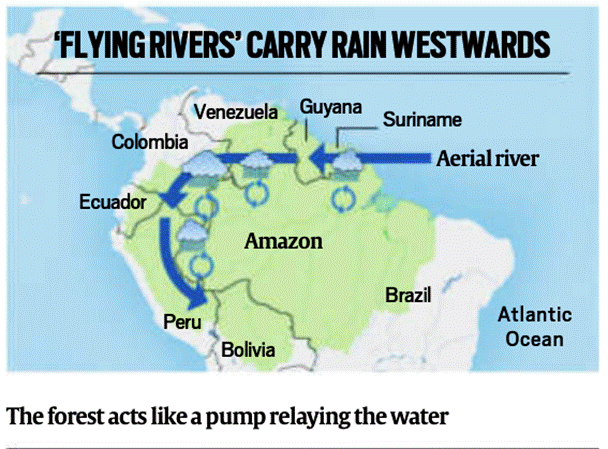
- The Amazon rainforest plays a critical role in South America’s water cycle through the phenomenon called “flying rivers”.
Flying Rivers
- “Flying rivers” are massive streams of water vapour carried in the atmosphere, invisible to the eye.
Flying Rivers
Process:
- Moisture originates from the Atlantic Ocean.
- Trade winds push moist air westward across the equator.
- Amazon trees act as a “biological pump” – absorb water from soil → transpire it back into the air → release huge amounts of water vapour.
- This recycled water forms clouds and rainfall further inland, supplying regions as far as the Andes and southern South America.
Sir Creek
Syllabus: GS1/Places
In News
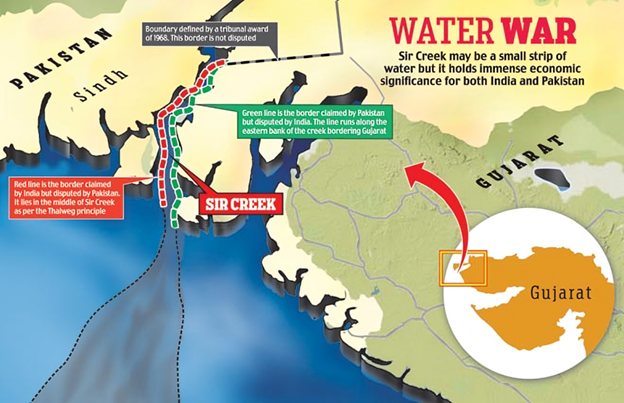
- Defence Minister Rajnath Singh warned Pakistan that any aggression in the disputed Sir Creek area will be met with a strong response.
Sir Creek region
- Sir Creek is a 96-km-long tidal estuary between Gujarat’s Rann of Kutch and Pakistan.
- The Rann lies on the border between Gujarat and the Pakistani province of Sind.
- It is considered a disputed region due to varying interpretations of maritime boundary lines by both sides.
- Sir Creek is a strategic and sensitive zone along the Gujarat coastline
DigiLocker
Syllabus: GS2/ Governance
Context
- The Union Public Service Commission (UPSC) has announced that candidates’ documents, including caste, income, and disability certificates, will now be verified through DigiLocker.
DigiLocker
- Launched by – It is a flagship initiative launched in 2015 of the Ministry of Electronics & IT (MeitY) under the Digital India programme.
- Mandate – It is a digital platform and a paperless solution designed to ensure that a user can access the latest and updated versions of their documents online.
- Significance – It aims to provide a digital wallet to every citizen so that all lifelong documents, including educational, identity, health records, insurance policy papers, PAN records, and driving licences and certificates, can be accessed anywhere, anytime.
Hike in Wheat MSP
Syllabus: GS3/ Agriculture
Context
- The Union Cabinet, approved a 6.59% increase in the Minimum Support Price (MSP) for wheat to Rs 2,585 per quintal for 2026-27 marketing year.
Minimum Support Prices (MSP)
- Definition – It is a form of market intervention by the Government of India to insure agricultural producers against any sharp fall in farm prices.
- Announcement and Recommendation – The Cabinet Committee of Economic
Affairs announces the MSP at the start of each sowing season, taking into account the recommendations of the Commission for Agricultural Costs and Prices (CACP)
- Significance – MSP protects the producer- farmers against distress sale during bumper production years.
Crops Covered
- The Centre announces the MSP (which is not legally guaranteed) for 22 mandated crops and Fair & Remunerative Price for sugarcane.
These include
- 14 kharif crops – paddy, jowar, bajra, maize, ragi, tur/arhar, moong, urad, groundnut, soyabean, sunflower, sesamum, niger seed, cotton,
- 6 rabi crops – wheat, barley, gram, masur/lentil, rapeseed and mustard, and safflower
- 2 commercial crops – Jute and Copra
Fair and Remunerative Price (FRP) of sugarcane
- Recommended by – Commission for Agricultural Costs and Prices (CACP)
- Objective – to assure margins on account of profit and risk to farmers, irrespective of the fact whether sugar mills generate profit or not.
Wheat Production in India
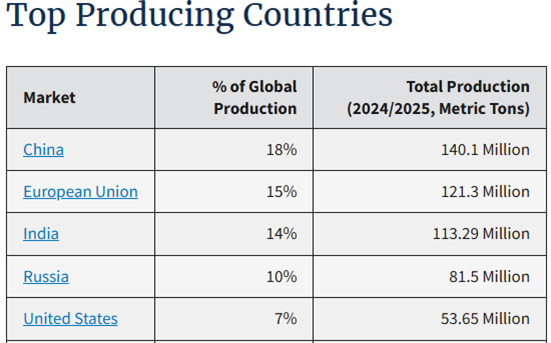
- Area: In 2023-24, the area under wheat stood at 33 lakh hectares, while the production is estimated at 113.92 million tonnes.
- In India wheat is the second largest crop after paddy in terms of area coverage.
- Major producing states – Uttar Pradesh,Madhya Pradesh, Punjab, Haryana, Rajasthan, Bihar, Gujarat and Maharashtra.
- Major Export Destinations (2023-24): Nepal, Iraq, South Korea, UAE and Mongolia.
Condition for Wheat Cultivation
- Climate: Temperature: Requires 10-15°C during sowing (germination) and 21-26°C during ripening and harvesting.
- Rainfall: Optimal rainfall is 50-100 cm. Excess rainfall can damage the crop.
- Soil Type: Grows best in well-drained loamy and clayey soil.


Leave a Reply