
Abhidhamma Divas
Syllabus :GS1/History
In News
- The International Buddhist Confederation (IBC), in collaboration with Gautam Buddha University (GBU), Antarrashtriya Baudh Shodh Sansthan and the Ministry of Culture celebrated International Abhidhamma Day
Abhidhamma Divas
- It commemorates the Buddha’s descent from the Tāvatiṃsa Heaven after imparting Abhidhamma teachings.
- According to tradition, after attaining enlightenment, the Buddha spent three months in the Tāvatiṃsa Heaven. He taught the Abhidhamma to his mother, Māyā, who had passed away and was reborn there.
Significance in Modern Times:
- Abhidhamma Divas encourages mindfulness, self-reflection, and spiritual growth.
- It reinforces the core values of Buddhism, including compassion and the pursuit of wisdom.
- The observance also highlights the importance of connecting with the teachings of the Buddha to lead a life of peace and purpose.
Supermoon
Syllabus: GS1/Geography

Context
- The Supermoon, also known as the Harvest Moon, was observed recently.
Supermoon
- A supermoon occurs when a full moon or new moon coincides with the moon’s closest approach to the earth in its elliptical orbit — a point known as the perigee.
- Because the moon’s orbit is not a perfect circle, its distance from the earth varies throughout the month by around 50,000 km.
- When the moon is near its perigee and also directly opposite the sun, the full moon appears about 14% larger and 30% brighter than when it is at its farthest point. This is the supermoon.
- Culturally, supermoons have long captured human imagination, inspiring folklore and spiritual observances across civilisations.
- The term “supermoon” was first used by astrologer Richard Nolle in the 1970s and is now common in astronomy and the media.
Moscow Format Talks
Syllabus: GS2/ International Relation
In News
- India, China, Pakistan attend 10-nation Moscow Format talk.
Moscow Format Talks
- Established in – 2017
- Objective – It is a regional diplomatic initiative to address the Afghanistan conflict, promote stability, and foster national reconciliation.
- Significance – It serves as a platform for regional countries to coordinate on Afghan peace and stability.
- Members – India, Afghanistan, China, Iran, Kazakhstan, Kyrgyzstan, Pakistan, Russia, Tajikistan, and Uzbekistan.
Polar Silk Road
Syllabus: GS2/ International Relation
In News
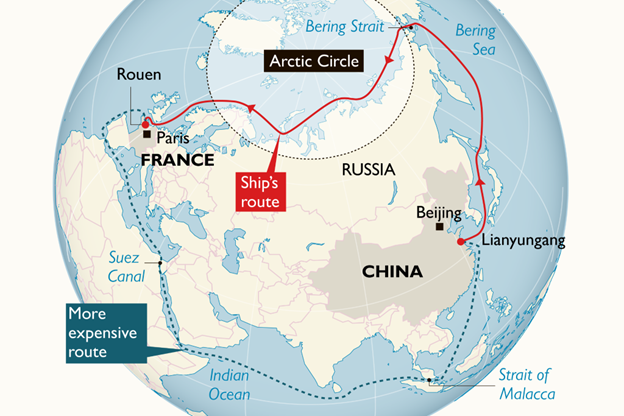
- The Chinese ship “Istanbul Bridge” became the first commercial vessel to sail from Ningbo-Zhoushan (China) to Felixstowe (UK) via the Arctic in 18 days, marking the operational launch of the Polar Silk Route.
Polar Silk Road
- The Polar Silk Road is a part of China’s broader Belt and Road Initiative (BRI), envisioned as a “blue economic corridor” through the Arctic Ocean.
- It focuses on developing navigable Arctic sea routes connecting East Asia, North America, and Western Europe via the Northern Sea Route (NSR) along Russia’s coast.
- Significance – It establishes a new shipping corridor between Asia and Europe — shorter and more cost-effective than the Suez Canal route.
Additional Information – China’s Belt and Road Initiative (BRI)
OBOR
- One Belt One Road (OBOR) is an ambitious project of China that focuses on connectivity and cooperation among multiple countries spread across the continents of Asia, Africa and Europe. OBOR spans about 78 countries.
- Initially announced in the year 2013, the project involves building networks of roadways, railways, maritime ports, power grids, oil and gas pipelines and associated infrastructure projects.
The project Covers two parts
- Silk Road Economic Belt – It is land-based and is expected to connect China with Central Asia, Eastern Europe and Western Europe.
- 21st Century Maritime Silk Road – It is sea-based and is expected to connect China’s southern coast to the Mediterranean, Africa, South-East Asia and Central Asia.
Operation HAECHI-VI
Syllabus: GS2/International Institutions; GS3/Cybersecurity
Context
- The Central Bureau of Investigation (CBI) has arrested eight accused and identified 45 suspects as part of Interpol’s Operation HAECHI-VI.
Operation HAECHI-VI
- The operation focused on seven categories of offences:
- cyber-enabled financial crime,
- voice phishing,
- love and romance scams,
- online sextortion,
- investment fraud,
- money laundering linked to illegal online gambling,
- business email compromise,
- e-commerce fraud.
- Investigators worked together to detect and disrupt online fraud as well as money laundering activities, blocking over 68,000 associated bank accounts and freezing close to 400 cryptocurrency wallets.
Additional Information – International Criminal Police Organization (INTERPOL)
- It is an intergovernmental organization established in
- Objective – To facilitate worldwide police cooperation and crime control in around 195 countries.
- Headquarters – Lyon, France
Different Types of Notices issued by INTERPOL
- INTERPOL issues various notices to facilitate worldwide police cooperation and crime control.
- Red Notice
- It is issued to seek the arrest of a person.
- The person is in the wanted list of an international tribunal or in a judicial jurisdiction.
- Green Notice
- It is issued to warn about the criminal activities of a person.
- It is issued if the person is considered as a possible threat to public safety.
- Blue Notice
- It is issued to obtain information about a person.
- Yellow Notice
- To locate a missing person. It is also issued when a person is unable to identify himself or herself.
- Black Notice
- To seek information about unidentified bodies.
- Orange Notice
- It is issued to process an imminent threat or danger to property or person.
- Purple Notice
- To provide information on procedures, modus operandi, devices or hiding place
Central Bureau of Investigation
- Set up in – It was set up in 1963 by a resolution of the Ministry of Home Affairs.
- Established under – It comes under the administrative control of the Department of Personnel and Training (DoPT) of the Ministry of Personnel, Public Grievances and Pensions.
- Recommended by – It was established on the recommendation of the Santhanam Committee.
- Legal status – The CBI is not a statutory body. It derives its powers from the Delhi Special Police Establishment (DSPE) Act, 1946.
Functions
- The CBI is the main investigating agency of the Central Government.
- It also provides assistance to the Central Vigilance Commission and Lokpal.
- It is also the nodal police agency in India which coordinates investigations on behalf of Interpol Member countries.
PM Gati Shakti National Master Plan
Syllabus: GS3/Infrastructure
Context
- The Union Cabinet on Economic Affairs approved four multi-tracking projects under the PM Gati Shakti National Master Plan.
- These projects span across Maharashtra, Madhya Pradesh, Gujarat, and Chhattisgarh, adding about 894 km to the Indian Railways network.
PM GatiShakti
- It was launched in – 2021
- Objective – to enhance the country’s infrastructure and promote seamless connectivity across various sectors.
- Significance – It is a transformative approach for economic growth and sustainable development which is driven by seven engines – railway, roads, ports, waterways, airports, mass transport and logistics infrastructure.
- Implementation: PM Gati Shakti will incorporate the infrastructure schemes of various Ministries and State Governments like Bharatmala, Sagarmala, inland waterways, dry/land ports, UDAN etc.

Leave a Reply