
India’s First National Report (NR1) on Nagoya Protocol
Environment
In News
- India recently submitted its first National Report (NR1) on Nagoya Protocol implementation to the CBD Secretariat, marking a key milestone in biodiversity governance.
Nagoya Protocol
- Adopted on – October 29, 2010, in Nagoya, Japan
- Enforced in – October 12, 2014
- Objective – it ensures fair access to genetic resources
- India ratified it in 2012, aligning with its Biological Diversity Act, 2002.
Nominations for Padma Awards-2027 Begins
Miscellaneous
News
- The Centre has opened nominations and recommendations for the Padma Awards 2027, one of the country’s highest civilian honours.
Padma Awards
- The Padma Awards are among India’s highest civilian honours instituted in 1954.
- They are presented in three categories: Padma Vibhushan, Padma Bhushan and Padma Shri.
- ‘Padma Vibhushan’ is awarded for exceptional and distinguished service;
- ‘Padma Bhushan’ for distinguished service of high order and
- ‘Padma Shri’ for distinguished service in any field.
- The awards recognise “work of distinction” and are given for exceptional achievements or service across a wide range of fields, including art, literature and education, sports, medicine, social work, science and engineering, public affairs, civil service, trade and industry.
- All individuals are eligible for the awards regardless of race, occupation, position or gender.
- Note – However, government servants, including employees of public sector undertakings, are generally not eligible, except for doctors and scientists.
- The government is committed to transform Padma Awards into “People’s Padma”, encouraging citizens to nominate deserving individuals.
- Self-nominations are also allowed.
- The nominations must include detailed information about the nominee’s distinguished achievements in their respective fields
- nominations will be accepted only through the online Rashtriya Puraskar Portal.
- The awards are announced on the occasion of Republic Day every year.
- These Awards are conferred by the President of India at ceremonial functions which are held at RashtrapatiBhawan usually around March/ April every year.
Gajapati Inscription in Guntur
History
Context
- A medieval inscription linked to the Gajapati Dynasty has been discovered at the Lakshmi Narasimha Swamy Temple in Guntur, Andhra Pradesh.
- The inscription is engraved on a stone pillar in the temple mandapam.
- It mentions Kumaraguru Mahapatra, an officer serving under Purushottama Deva in the 15th century CE.
- The record indicates that the idol of Lord Narasimha and the mandapa pillars were relocated from Kondaveedu Fort following invasions in the region.
- The inscription was originally dedicated to Lord Mallikarjuna of Kondaveedu but was later shifted to the Guntur temple.
Gajapati Dynasty
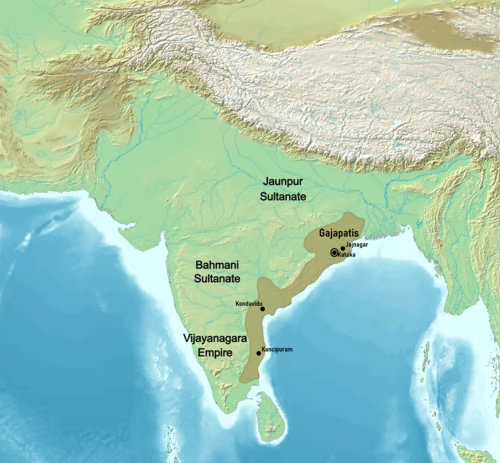
- The Gajapati Dynasty was a powerful medieval kingdom that originated in Odisha and flourished during the 15th–16th centuries.
- It was founded by Kapilendra Deva after the decline of the Eastern Ganga dynasty.
- At its peak, the empire extended from parts of present-day West Bengal to Tiruchirappalli in Tamil Nadu, with its capital at Kataka (modern-day Cuttack).
- The Gajapati rulers were known for their patronage of art, architecture, and literature, and they maintained continuous rivalry with the Vijayanagara Empire.
Ladakh Magmatic Arc
Geography

News
- Scientists from the Wadia Institute of Himalayan Geology have recently decoded the evolution of the Ladakh Magmatic Arc (LMA) in the North-West Himalaya.
Ladakh Magmatic Arc
- It is a belt of igneous rocks located in the Trans-Himalayan region of India (mainly Ladakh).
- It represents a long-extinct volcanic arc system.
- The present-day Ladakh region once lay above the Neo-Tethys Ocean.
- Beneath this ocean, the oceanic crust of the Indian Plate was moving towards the Eurasian Plate.
- The denser oceanic plate subducted (sank) beneath the Eurasian Plate.
- This process led to melting of mantle material, formation of magma & rise of magma to form volcanic arcs.
Adoptive Mothers Get Equal Maternity Rights
Governance
Context
- The Supreme Court of India held that all female employees adopting children are entitled to 12 weeks of paid maternity leave, regardless of the child’s age.
Background
- The legal framework governing maternity benefits in India originates from the Maternity Benefit Act, 1961 and through the 2017 Amendment for the first time, adoptive and commissioning mothers were granted 12 weeks of maternity leave.
- However, a restrictive condition was introduced that maternity leave was available only if the adopted child was below 3 months of age.
Supreme court ruling
- Concern: India’s adoption process, governed by Central Adoption Resource Authority guidelines, rarely permits adoption of children below three months.
- As a result, most adoptive mothers were effectively denied maternity benefits, rendering the provision largely illusory.
- The court ruled that age-based classification was discriminatory and violative of Articles 14 and 21 of the Constitution, emphasising that adoption is an equally valid pathway to parenthood and cannot be treated differently from biological childbirth.




Leave a Reply