
Sangita Kalanidhi Award
Syllabus: Miscellaneous
Context
- Veena player Jayanthi Kumaresh has been announced the coveted Sangita Kalanidhi at the 100th Conference and Concerts of The Music Academy, Madras.
- Bharatanatyam dancer Narendra G will be conferred the Nritya Kalanidhi award.
Sangita Kalanidhi Award
- Instituted in 1942 by The Music Academy, Madras.
- It is regarded as the highest honour in Carnatic music, often described as the “Nobel Prize of Carnatic music.”
- The award comprises a gold medal and a ‘birudu patra’ (citation).
Additional Information – Music Academy, Madras
- It originated as an offshoot of the All India Congress Session of 1927 held in Chennai (then Madras).
- It was established to promote and standardise Carnatic music traditions.
- The Academy organizes the annual Music and Dance Festival, one of the most prominent cultural events in the Carnatic tradition.
- The Academy also confers several awards, including the Sangita Kala Acharya, TTK Award, and Musicologist Award.
Jnanpith Award
Syllabus: Miscellaneous
Context
- Tamil poet and lyricist Vairamuthu has been selected for the Jnanpith Award for the year 2025.
Vairamuthu
- He is the third Tamil litterateur to receive the award after Akilan (1975) and Jayakanthan (2002), and the first to be honoured for Tamil poetry, while the earlier awardees were recognised for prose.
- He has written over 8,000 songs, won seven National Film Awards for lyrics, and earned the honorific “Kaviperarasu” (Emperor of Poets).
- The award, however, has been met with sharp criticism from some writers, artists and activists who point to sexual harassment allegations made against him during the #MeToo movement in India.
About Jnanpith Award (also spelled Gyanpeeth Award)
- Instituted in 1961 by the Bharatiya Jnanpith,
- It is India’s highest literary honour, awarded annually to an Indian author for outstanding contribution to literature.
- Bharatiya Jnanpith is a literary and research organization founded by Sahu Shanti Prasad Jain and Rama Jain.
- It is awarded for the work in 22 languages recognized by the Constitution of India and, from 2013, in the English language.
- The award carries a ₹11 lakh cash prize, citation, and a bronze statuette of Vagdevi (Saraswati).
- The first recipient was Malayalam writer G. Sankara Kurup in 1965 for Odakkuzhal.
Western Tragopan: King of Birds
Syllabus: GS3/Environment
Context
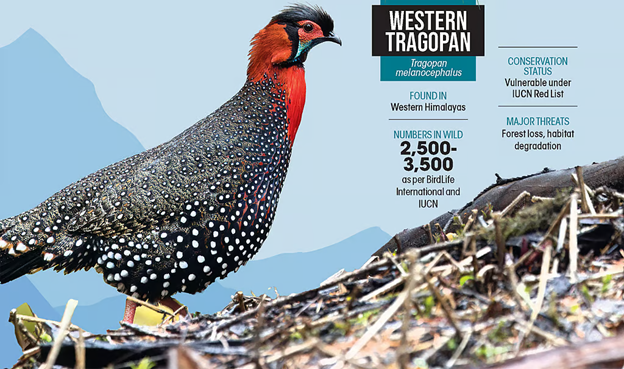
- The Western Tragopan, a rare Himalayan pheasant, faces increasing threats due to forest loss and human pressures.
Western Tragopan (Tragopan melanocephalus),
- It is also known as Jujurana or “king of birds,” is one of the rarest and most stunning pheasant species in the world.
- Habitat and Distribution: Found in temperate and subalpine forests at 2,400–3,600 m (occasionally down to 2,000 m in winter).
- From Swat Valley (Pakistan) across Kashmir and Himachal Pradesh to Uttarakhand.
- Diet: They are omnivores, feeding on berries, seeds, buds, shoots, and insects.
- Major Threats: Forest degradation, climate change, and human disturbances.
- Conservation Status: It is listed as Vulnerable by BirdLife International and the International Union for Conservation of Nature (IUCN).
Do you know?
- The bird is also the state bird of Himachal Pradesh, highlighting its cultural and ecological value.
Paid Menstrual Leave May Hurt Women’s Careers: SC
Health & Society
Context
- The Supreme Court expressed apprehensions that a law making paid leave during menstrual pain compulsory may damage the careers of young women and deprive them of equal opportunities.
Menstrual Leave
- Menstrual leave refers to paid or unpaid leave granted to women during menstruation when they experience health issues such as:
- Dysmenorrhea: painful menstrual cramps
- Endometriosis: a disorder where tissue similar to uterine lining grows outside the uterus
Highlights of the SC Judgement
- Such a move could create a psychological barrier among women that they are inferior to men as they can’t work when they are menstruating.
- The Court encouraged “voluntary” initiatives in this regard by States like Odisha, Karnataka and Kerala, which gives leave to students in State-run universities and institutions up to 60 days’ leave annually for menstrual pain.
Arguments in Favour of Paid Menstrual Leave
- Promotes Gender-Sensitive Workplaces: Recognises biological realities of women and promotes inclusivity and empathy in the workplace.
- Aligns with Constitutional Principles: Supports Article 42 of the Constitution of India, which directs the state to ensure just and humane conditions of work.
- Improves Productivity and Well-being: Allows women to rest during periods of pain or discomfort, leading to better overall performance and morale.
- Health and Human Rights Perspective: Upholds women’s right to health, dignity, and bodily autonomy.
- De-stigmatising Menstruation: Recognising menstrual health in workplace policy can help break social taboos & promote gender equality.
- Global Alignment: Reflects global best practices, countries like Japan, South Korea, Indonesia, Taiwan, and Spain have similar policies.
Arguments Against
- Risk of Workplace Discrimination: Employers may become reluctant to hire or promote women, viewing them as less productive or more costly.
- Informal Sector Dominance: Nearly 88% of India’s workforce is in the informal sector, where formal leave policies are largely absent.
- Implementation Challenges in the Private Sector: Ensuring compliance and monitoring across diverse industries could be difficult.
Existing Menstrual Leave Policies in India
- India does not have a national law on menstrual leave, but some states have introduced policies.
- Bihar was the first state to introduce menstrual leave (1992) for government employees.
- Some companies have introduced voluntary menstrual leave policies like Zomato, Swiggy.
Additional Information – Karnataka Menstrual Leave Policy-2025
- Women in the state of Karnataka will be entitled to up to 12 menstrual leaves annually.
- This development marks a significant step in recognising menstrual health at a workplace and rights issue.
- The Dr. Sapna S committee was appointed by the Karnataka government to study and recommend menstrual leave policy
- Significance – It aims to create a more inclusive and stigma-free workplace and is considered a landmark decision in India, as it covers both government and private sectors comprehensively.
Transgender Persons (Protection of Rights) Amendment Bill, 2026
News-
- The Transgender Persons (Protection of Rights) Amendment Bill, 2026 was introduced in the Lok Sabha by the Union Minister for Social Justice and Empowerment.
Major Highlights of the Bill
- The Bill aims to amend the Transgender Persons (Protection of Rights) Act, 2019.
- Definition of Transgender Person: It seeks to narrow the definition of “transgender person” and clarifies that persons with different sexual orientations or self perceived sexual identities will not fall within the definition of transgender persons under the Act.
- Changes To Recognition Of Gender Identity: The District Magistrate will issue a certificate of identity after examining the recommendation of a designated medical board headed by a Chief Medical Officer or Deputy Chief Medical Officer.
Additional Information – LGBTQIA+
- LGBTQIA+ is an umbrella term for lesbian, gay, bisexual, transgender, queer, intersex, and asexual persons, with ‘+’ representing other identities that are not specifically included in these letters.
India’s Position on LGBTQIA+ Rights
- As per census 2011, there were 4.87 lakhs persons in India who opted for “other” in gender category.
- Decriminalisation: Navtej Singh Johar v. Union of India (2018) decriminalised consensual homosexual acts (Section 377 partially struck down).
- Transgender Rights: NALSA v. Union of India (2014) recognised the right to self-identify gender.
- It recognises transgender as the “third gender” upholding their fundamental rights.
- Constitutional Provisions: Article 14 – Right to equality, Article 15 – No discrimination on grounds of sex and Article 21 – Right to life and personal liberty.
- Legislation: The Transgender Persons (Protection of Rights) Act, 2019 provides legal recognition of transgender identity.
Challenges Faced by the Transgenders
- Societal Issues: Trans persons face deep-rooted societal prejudices, leading to ostracisation from families and communities.
- Lack of Access to Education: High school dropout rates due to bullying, harassment, and gender-based violence.
- Barriers in Employment: Trans persons face widespread discrimination in hiring and the workplace. Often forced into informal, unsafe, and exploitative sectors, like begging or sex work, due to lack of opportunities.
- Healthcare Exclusion: They face lack of gender-affirmative healthcare, discrimination by medical staff, and unavailability of hormonal and surgical services in public hospitals.
- High mental health burden due to social rejection and isolation.
- Violence and Abuse: Prone to verbal, physical, and sexual violence both in public and private spaces.
- Political Underrepresentation: Low political visibility and representation in mainstream parties and institutions.
- Lack of policy-making participation hinders the articulation of their needs.
Government Initiatives
- National Portal for Transgender Persons – launched in 2020, enables online applications for identity certificates and access to benefits.
- SMILE (Support for Marginalised Individuals for Livelihood and Enterprise)Scheme, introduced in 2022, provides livelihood, skill training, and shelter support through Garima Greh centres and Ayushman Bharat TG Plus health coverage.
- National Council for Transgender Persons: It serves as a statutory body under the Ministry of Social Justice and Empowerment to safeguard and promote the rights of transgender persons in India.
Kharg Island
Syllabus: GS1/Geography
Context
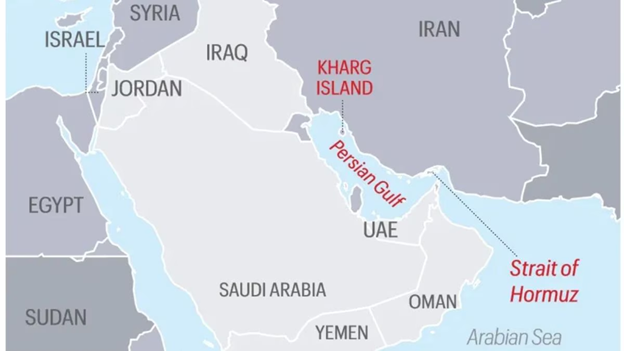
- Recently, U.S. forces struck military targets at Kharg Island in Iran.
Kharg Island
- It is often referred to as the ‘Orphan pearl’.
- It is a small island in the northeastern Persian Gulf, approximately 25 kilometres off the coast of Iran’s Khuzestan Province.
- Despite its modest size, it is the single most important oil export terminal in Iran and one of the most strategically significant energy chokepoints in the world.
- Almost all Iranian crude destined for international markets is loaded here before passing through the Strait of Hormuz into global shipping lanes.
Do you know?
- Iran is the third-largest producer in Organization Of The Petroleum Exporting Countries (OPEC), accounting for roughly 4.5% of global oil supply.


Leave a Reply