
Golestan Palace
Art & Culture
In News
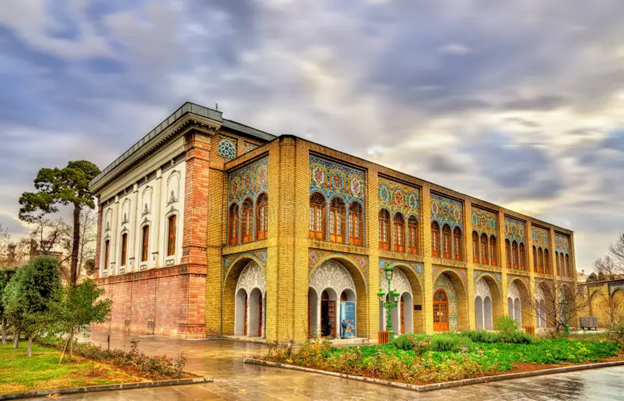
- Tehran’s Golestan Palace, a UNESCO World Heritage Site, sustained damage from shockwaves and debris caused by US-Israel airstrikes.
Golestan Palace
- It is a historic royal complex that served as the official residence of the Qajar dynasty and is one of the oldest historic monuments in Tehran.
- The origins of the complex date back to the Safavid Dynasty, when Tehran first gained importance as a political centre. Later rulers expanded and renovated the palace complex.
- Golestan Palace reflects a blend of traditional Persian architecture and Western influences introduced during the 19th century.
- Inscribed by UNESCO in 2013, it preserves cultural archives, early Iranian photography, and sites of historic coronations.
Important Structures within the Complex
- Shams-ol-Emareh (Edifice of the Sun): One of the most famous buildings in the palace complex.
- It was built in the 1860s by Naser al-Din Shah Qajar.
- Marble Throne Hall (Takht-e-Marmar): Used for royal coronations and official ceremonies.
- Mirror Hall: Famous for extensive mirror mosaics and luxurious decoration.
- Museum Buildings: The complex houses several museums displaying Qajar-era paintings & royal gifts and artefacts.
High Chances of El Niño After July: WMO
Geography
In News
- The World Meteorological Organization forecasts a high likelihood of El Niño developing in the latter half of 2026, following the fading of the current La Niña into ENSO-neutral conditions.
- El Nino and La Nina are complex weather patterns resulting from variations in ocean temperatures in the Equatorial Pacific Region.
Difference between El Niño and La Niña
|
Feature |
El Niño (Warm Phase) |
La Niña (Cold Phase) |
|
Meaning |
Spanish for “Little Boy” |
Spanish for “Little Girl” |
|
Ocean Temp. |
Abnormal warming of eastern Pacific |
Abnormal cooling of eastern Pacific |
|
Trade Winds |
Weaken or reverse direction |
Become unusually strong |
|
Indian Monsoon |
Weakens monsoon; often leads to droughts |
Strengthens monsoon; brings heavy rainfall |
|
Winter in India |
Generally warmer/milder winters |
Severely cold winters in North India |
|
Frequency |
Occurs every 2–7 years; lasts 9–12 months |
Occurs every 2–7 years; can last 1–3 years |
United Nations Convention on the Law of the Sea (UNCLOS)
International Relations
Context
- The Iranian frigate IRIS Dena was reportedly sunk off the south-western coast of Sri Lanka after a torpedo strike by a United States Navy submarine.
United Nations Convention on the Law of the Sea (UNCLOS)
- It is a comprehensive international treaty that establishes the legal framework for governance of oceans and seas.
- Adopted in 1982 at Montego Bay, Jamaica and entered into force in 1994.
It defines:
- Maritime boundaries of coastal states
- Rights and duties of states in maritime zones
- Rules for navigation, resource exploitation, and environmental protection
- Because of its extensive scope, it is commonly referred to as the “Constitution of the Oceans.”
- Membership: 168 parties, including the European Union.
- Countries such as India, Japan, and China are parties.
- Note – The United States has signed but not ratified the convention.
Maritime Zones under UNCLOS
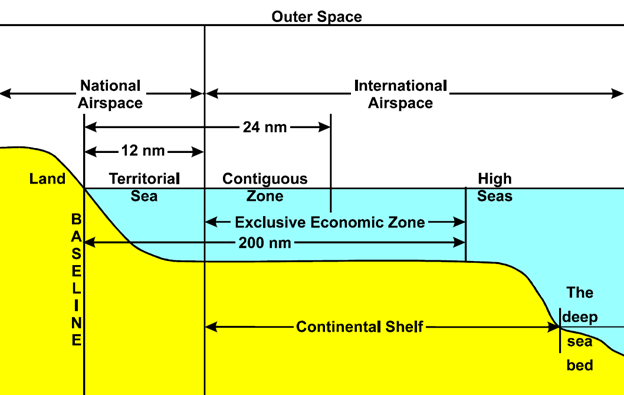
- UNCLOS divides the oceans into several legal zones, each with different rights and responsibilities.
- Territorial Sea: Extends up to 12 nautical miles from a coastal state’s baseline. The coastal state has full sovereignty over these waters. Foreign ships enjoy the right of innocent passage.
- Contiguous Zone: Extends 12–24 nautical miles from the baseline. Coastal states can enforce laws relating to Customs, immigration, sanitation & security.
- Exclusive Economic Zone (EEZ): Extends up to 200 nautical miles. The coastal state has exclusive rights over natural resources. However, other states retain freedom of navigation and overflight.
- High Seas (International Waters): Areas beyond the EEZ of any state. No country has sovereignty over them. Governed by international law and UNCLOS principles.
India renews Bilateral Swap Arrangement with Japan
International Relations
In News
- India has renewed its Bilateral Swap Arrangement (BSA) with Japan with effect from 28th February, 2026.
Basic terms -Currency swap
- It is a financial agreement where two parties exchange the principal and interest of a loan in one currency for the equivalent in another.
- These are typically medium- to long-term contracts used by multinational corporations and central banks to manage risks or reduce borrowing costs.
Additional Information – India & Japan relations
Defence and Security
- Military Exercises: Malabar, Dharma Guardian, and JIMEX exercises enhance interoperability and Indo-Pacific security.
- Trade: Bilateral trade reached approximately $23 billion in 2023-24.
- FDI: Japan is India’s fifth-largest source of FDI
- Bullet Train: The Mumbai-Ahmedabad High Speed Rail exemplifies flagship India-Japan transport cooperation.
- Energy: Clean Energy Partnership (2022) expands hydrogen, renewables, and climate cooperation.
- Quad: Quad coordination ensures Indo-Pacific stability through collective maritime commitments.
- SCRI: Supply Chain Resilience Initiative (SCRI) reduces dependency on China for the supply of critical goods.
- F orums: India and Japan cooperate in G20, International Solar Alliance (ISA), CDRI, and IPEF, strengthening multilateral governance.
- Space: ISRO–JAXA LUPEX mission exemplifies frontier collaboration in space exploration.




Leave a Reply