
Bela Gram Emerge as First Net-zero Village
Environment
News
- Recently, Bela Gram has become India’s first net-zero panchayat.
Basic term – Net zero
- It refers to achieving a balance between the amount of greenhouse gas emissions produced and the amount removed from the atmosphere, effectively reducing human-caused emissions to a net value of zero
Bela Gram
- It is situated in the Bhandara district of Vidarbha region of Maharashtra.
- It was recognized as India’s first net-zero panchayat during Mumbai Climate Week 2026 for its sustainable and carbon-neutral initiatives.
- The panchayat leadership plays a vital role in shaping localised climate action and combating climate change.
- It planted over 90,000 trees, transitioned from smoky chulhas to LPG.
- It installed solar panels, promoted waste segregation, and eliminated single-use plastics.
- It received the 2024 Rashtriya Panchayat Puraskar.
Other panchayat-led climate initiatives across India
- Perinjanam, Kerala – “Solar Gramam” project: 850 households became rooftop solar prosumers, reducing bills by 80% and lowering emissions.
- Siyari, Jharkhand – Water conservation, revived lakes, solar irrigation, streetlights, and plantation of thousands of fruit and shade trees using District Mineral Fund support.
- Badakichab, Odisha – Indigenous women mapped commons and planted over 16,000 trees on 10 hectares of unused land, restoring forests.
- Garhi, Bihar – Built 45 mud check dams, 90 boulder dams, and ponds to tackle water scarcity, flash floods, and soil erosion.
- Kolar, Karnataka – Revived lakes and groundwater, reduced chemical fertilizer use, and implemented climate-resilient agriculture practices.
Red Sanders
Environment
Context
- The busy Tirupati pilgrimage route has made Red Sanders smuggling easier in southern Andhra Pradesh.
Red Sanders (Pterocarpus santalinus)
- Endemic Species: Found only in three districts of southern Andhra Pradesh — Chittoor, Nellore, and YSR Kadapa.
- Largest Reserve: Located in the Seshachalam Biosphere Reserve, part of the Eastern Ghats, covering about 4,755 sq km.
- Growth: A slow-growing species that takes 25–40 years to reach maturity.
Conservation Status:
- Listed as Endangered on the IUCN Red List.
- Included under CITES, which strictly regulates international trade.
- Protected under the Wildlife Protection Act, 1972.
India AI Impact Summit 2026
Science and Technology
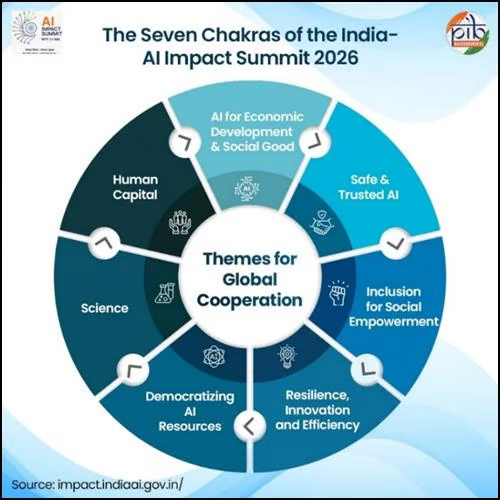
Context
- The India AI Impact Summit 2026 concluded in New Delhi recently.
Background of AI Summits
- 2023 Bletchley Park Summit (UK): The first global AI summit was held at Bletchley Park and focused on safety. It brought together countries and experts to discuss AI risks and resulted in the Bletchley Declaration.
- 2024 Seoul Summit (South Korea): The second summit was held in Seoul in May 2024, building on the discussions from the Bletchley Park meeting and broadening to include innovation and inclusivity alongside safety.
- 2025 AI Action Summit (Paris, France): In February 2025, the AI Action Summit took place at the Grand Palais in Paris. It was co-chaired by France and India and followed the earlier Bletchley Park and Seoul events.
- 2026 India AI Impact Summit (New Delhi): This is the next major summit in the series, held in India in February 2026.
India–AI Impact Summit 2026
- Hosted by – the Ministry of Electronics and Information Technology (MeitY).
- It will be the first-ever global AI summit hosted in the Global South.
- The Three Sutras: Three foundational pillars, known as ‘Sutras’ e. People, Planet and Progress, define how AI can be harnessed through multilateral cooperation for collective benefit.
Outcomes of the summit
- New Delhi Declaration on AI Impact: Endorsed by 89 countries and international organisations (including the US, China, and France).
- It is a non-binding agreement focused on the democratisation of AI.
- It is guided by the philosophy of “Sarvajan Hitaya, Sarvajan Sukhaya” (Welfare for all, Happiness for all).
- MANAV Vision: India unveiled the MANAV governance framework, which stands for Moral and ethical systems, Accountable governance, National sovereignty, Accessible and inclusive, and Valid and legitimate.
- Pax Silica Initiative: India formally joined this US-led coalition aimed at securing resilient supply chains for semiconductors, advanced hardware, and critical minerals.
- New Delhi Frontier AI Commitments: A voluntary framework signed by global tech giants (Google, OpenAI, Microsoft, Anthropic) to ensure AI systems are effective across diverse languages and cultures, particularly for the Global South.
Technological & Social Deliverables
- Indigenous Sovereign AI: Launch of several “Made in India” Large Language Models (LLMs):
- Sarvam AI: Unveiled multi-billion parameter open-source models trained on Indian data.
- BharatGen: A 17-billion-parameter multilingual foundational model.
- ai: Launched a multilingual voice model supporting 12 Indian languages.
- Sectoral Impact: Showcased AI applications like Kisan E-Mitra (agriculture), ai (healthcare diagnostics), and the Bhashini platform for real-time translation.
Strategic Framework: Sutras & Chakras
- The summit’s architecture was built on:
- 3 Sutras (Pillars): People, Planet, and Progress.
- 7 Chakras (Working Groups): Human Capital, Inclusion, Safe & Trusted AI, Resilience/Sustainability, Science, Democratising Resources, and Economic Development
India’s Indigenous Tetanus and Adult Diphtheria (Td) Vaccine
Health
Context
- The Union Minister for Health and Family Welfare launched the indigenously manufactured Tetanus and Adult Diphtheria (Td) Vaccine at the Central Research Institute (CRI), Kasauli in Himachal Pradesh.
Td Vaccine
- The Td vaccine protects against tetanus and diphtheria, two potentially fatal bacterial diseases.
- It replaces the earlier Tetanus Toxoid (TT) vaccine, expanding protection to include diphtheria.
- In 2006, the World Health Organization (WHO) recommended that countries transition from Tetanus Toxoid (TT) vaccine to Td vaccine.
Tetanus
- Tetanus is a non-contagious infection that affects the nervous system, leading to painful muscle stiffness and spasms.
- Cause: It is caused by the bacterium Clostridium tetani, which is commonly found in soil, dust, and animal manure.
- Transmission: The bacteria typically enter the body through a break in the skin, such as a deep cut, puncture wound (like stepping on a rusty nail), or burn.
Diphtheria
- Diphtheria is a highly contagious infection that primarily affects the mucous membranes of the nose and throat.
- The toxin released by the bacteria can travel through the bloodstream and damage the heart (myocarditis), kidneys, and nerves.
- Cause: It is caused by Corynebacterium diphtheriae bacteria.
- Transmission: It spreads from person to person through respiratory droplets (coughing or sneezing) or by touching contaminated objects.
Leave a Reply