
‘Anupam’ model of Waste Management
(Environment)
Context
- Following the New Delhi Municipal Council (NDMC) decision to eliminate the household waste, Anupam Colonies now segregate and process waste within their own premises.
‘Anupam’ model of Waste Management
- It is a decentralized waste management strategy launched by the New Delhi Municipal Council (NDMC) in 2025
- Objective – to achieve zero-waste, self-sustainable urban living.
- The Hindi word Anupam was chosen to reflect that these colonies are “incomparable” in their waste practices.
Core Principles & Features
- Uniqueness- The model shifts the focus from traditional centralized waste disposal to on-site resource management.
- 100% Source Segregation: Residents must divide waste into three primary streams: wet, dry, and sanitary.
Scientific Processing:
- Wet Waste: Composted on-site using wire-mesh bins or Organic Waste Converters (OWC).
- Dry Waste: Meticulously sorted into 12 different categories (e.g., paper, metal, glass, e-waste) at local Material Recovery Facilities (MRF).
- Horticulture Waste: Converted into compost or eco-friendly briquettes within the colony.
- Community-Led Governance: Management is handled by Resident Welfare Associations (RWAs) and NGOs rather than a top-down municipal approach.
- RRR Centers & “Neki Ki Deewar”: Dedicated hubs (Reduce, Reuse, Recycle) where residents donate usable items like clothes and books for those in need.
- Waste-to-Wealth: Produced compost is distributed free of cost to residents, while income from selling recyclables often funds colony repairs
Ol Chiki Script
Culture
Context
- President Droupadi Murmu inaugurated the centenary celebration of the Ol Chiki script in New Delhi, emphasising its importance in preserving Santhal heritage.
Ol Chiki Script
- Ol Chiki was developed in 1925 by Pandit Raghunath Murmu to provide a dedicated writing system for the Santhali language.
- It comprises 30 letters designed to capture Santhali phonetics with precision, allowing systematic documentation of its vocabulary and grammar.
- Santhali, a member of the Austro asiatic language family, is spoken across Jharkhand, Odisha, West Bengal, Assam, and Bihar.
- It was included in the Eighth Schedule of the Constitution in 2003.
Bhu-Aadhaar
Syllabus: GS2/ Governance
Context
- The Government of Delhi has initiated the assignment of a 14-digit Unique Land Parcel Identification Number (ULPIN), popularly termed ‘Bhu-Aadhaar’, to every land parcel in the Capital.
ULPIN (Bhu-Aadhaar)
- It is part of the Digital India Land Records Modernization Programme (DILRMP).
- It is a 14-digit identification number accorded to a land parcel based on the longitude and latitude coordinates of the land parcel.
- The system integrates GIS mapping, drone surveys, and Ortho Rectified Images (ORI) for accuracy.
- It functions as a digital land identity, similar in concept to Aadhaar for individuals.
Significance
- The initiative aims to enhance transparency, curb fraudulent transactions, and modernise land records through geospatial technology.
- It complements the SVAMITVA Scheme, under which 48 villages in Delhi have already been covered.
Cheer Pheasant
Environment
In News
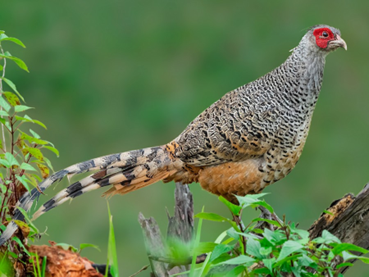
- BirdLife International and the International Union for Conservation of Nature (IUCN) classified the cheer pheasant as ‘Vulnerable’.
Cheer Pheasant
- Scientific name- Catreus wallichii. It is also known as Wallich’s pheasant or Chir pheasant,
- Habitat- It is a ground-dwelling bird endemic to the Western HimalayaIt is found in Pakistan, Kashmir, Himachal Pradesh, Uttarakhand, and central Nepal
- Diet: Feeds mainly on roots, tubers, bulbs, seeds, berries, and occasionally insects or worms.
- Behaviour: Known for high natal philopatry, meaning individuals often return to their birthplace to breed. They are predominantly monogamous.
- Threats: Hunting, habitat degradation (conversion of grasslands to agriculture), and forest fires during the breeding season (April–June) which destroy ground nests.
- Conservation Breeding: An exclusive breeding centre is located at Chail, Himachal Pradesh.
Conservation Status
- IUCN Red List: Vulnerable.
- Wildlife (Protection) Act, 1972: Schedule I (highest legal protection in India).
- CITES: Appendix I.


Leave a Reply