
Jiyo Parsi Scheme
Syllabus:GS2/Social Justice
In News
- The Jiyo Parsi Scheme has supported the birth of over 490 Parsi children and provided ₹35.05 crore in financial assistance to Parsi couples
Parsi Community in India
- According to the 2011 Census of India, the Parsi population in the country was 57,264.
- This represented a significant decrease of approximately 22% from the 2001 census figure of 69,601.
Jiyo Parsi Scheme
- Launched in – 2013-14
- Objective – to reverse the declining trend of Parsi population by adopting a scientific protocol and structured interventions.
The scheme has three components:
- Medical Assistance: Provides financial aid for infertility treatments such as IVF, ICSI, surrogacy, and post-conception care.
- Advocacy: Provides for counselling of couples with fertility issues
- Health of the Community: Offers monthly financial support to Parsi couples with children as well as to dependent elderly members.
Global Teacher Prize 2026
Miscellaneous
Context
- Indian teacher Rouble Nagi has won the Global Teacher Prize 2026, receiving the one million dollar award at the World Government Summit in Dubai.
Global Teacher Prize
- It was Launched in 2014 and is often referred to as the “Nobel Prize of Teaching”.
- It is Presented by GEMS Education and organised by the Varkey Foundation in collaboration with UNESCO.
- Mandate – It recognises exceptional educators for their outstanding contributions to teaching and social transformation.
Do you know?
- Rouble Nagi, is a pioneering educator from India, dedicated to making learning accessible to the most marginalised communities.
- Over the past two decades, she has established more than 800 learning centres across over 100 underserved communities and villages.
Supreme Court Allows Abortion of 30-week Pregnancy of a Minor
Polity and Governance; Social Justice
Context
- The Supreme Court has permitted the medical termination of a 30-week pregnancy of a minor, emphasising that no woman can be compelled to carry a pregnancy to full term against her will.
Medical Termination of Pregnancy (Amendment) Act, 2021
- The Act permits abortion up to 20 weeks in the opinion of one registered medical practitioner.
- Between 20–24 weeks, termination is allowed for specified categories of women (including minors, rape survivors, and differently-abled women) on the opinion of two doctors.
- Beyond 24 weeks, termination is permitted only in cases of substantial fetal abnormalities as diagnosed by a Medical Board.
Key Observations of the Supreme Court
- The Court reiterated that reproductive autonomy is an integral part of personal liberty under Article 21 of the Constitution.
- The Court observed that the pregnancy of a minor is “ex facie illegitimate” because she lacks legal capacity to consent to sexual relations.
Hakki-Pikki tribe
Society
In News
- The Embassy of India assisted Hakki-Pikki community members from Davangere, Shivamogga, and Chikkamagaluru districts, who were at risk of imprisonment in Chad.
The Hakki Pikki tribe
- It is a tribe that lives in several states in west and south India, especially near forest areas.
- Hakki Pikkis (Hakki in Kannada means ‘bird’ and Pikki means ‘catchers’) are a semi-nomadic tribe, traditionally of bird catchers and hunters.
- Hakki Pikki people are believed to hail originally from the bordering districts of Gujarat and Rajasthan.
- Hakki Pikkis in Karnataka follow Hindu traditions and celebrate all Hindu festivals.
- They are non-vegetarians. The eldest son in a family is not supposed to cut his hair so that he can be identified easily.
- The tribe prefers cross-cousin marriages. The society is matriarchal, where the groom gives dowry to the bride’s family. Monogamy is the norm.
Greater Flamingos
Syllabus: GS3/Environment
Context
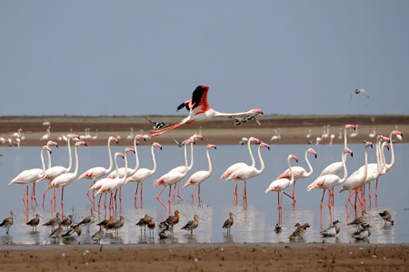
- Nearly 70 Greater Flamingos were recorded for the first time at Hope Island in the Coringa Wildlife Sanctuary, Kakinada Bay, Andhra Pradesh.
Greater Flamingos (Phoenicopterus roseus)
- Description: The greater flamingo is the most widespread and largest species of the flamingo family, averaging 110–150 cm tall and weighing 2–4 kg.
- Distribution: They are found in Northern (coastal) and Sub-Saharan Africa, the Indian subcontinent (south of the Himalayas), the Middle East, the Persian Gulf, the Gulf of Aden, the Red Sea, and the Mediterranean countries of Southern Europe.
- Greater flamingos usually migrate to India from Israel, Afghanistan, and Pakistan.
- Diet and lifespan: Average lifespan is 30–40 years, and they feed on small fish and other aquatic organisms.
- Threats: The primary threats to flamingo populations are bacteria, toxins, and pollution in water supplies, which is usually run-off from manufacturing companies, and encroachment on their habitat.
- State Bird: The greater flamingo is the State bird of Gujarat.
Types and IUCN status:
- The greater flamingo – Least Concern
- Chilean flamingo – Near Threatened
- American flamingo – Least Concern
- Lesser flamingo – Near Threatened
- Andean flamingo – Vulnerable
James’s flamingo – Near Threatened.
Sickle Cell Disease
GS2/Health
Context
- The U.S. Food and Drug Administration (U.S. FDA) has granted Orphan Drug Designation (ODD) to treat Sickle Cell Disease (SCD).
Orphan Drug Designation
- Orphan drugs are pharmaceutical agents developed specifically to treat rare (orphan) diseases.
- Once designated, orphan drugs receive several incentives to encourage their development, including market exclusivity, tax credits for research and development (R&D) expenses, and fee waivers for regulatory applications.
Sickle cell anaemia
- Disease – It is an inherited group of blood disorders that is genetic in nature.
- Cause – It is caused by a mutation in the hemoglobin-β gene found on chromosome 11. This mutation results in defective haemoglobin (Hb).
- Characteristics – After giving up oxygen, these defective Hb molecules cluster together resulting in formation of rod like structures.
- The red blood cells become stiff and assume sickle shape. (Haemoglobin (Hb) is a protein found in the red blood cells that carries oxygen in your body and gives blood its red colour)
- Transmission – It is usually transferred from the parents to the child during birthe. both parents can be carriers of SCDs.
- Symptoms – Babies who are born with sickle cell anaemia might not show symptoms for many months.
- Extreme tiredness, fussiness and painfully swollen hands and feet and jaundice.
- Effects – The misshapen cells lack plasticity and can block small blood vessels, impairing blood flow.
- The sickle cells die prematurely, resulting in a chronic lack of red blood cells (anaemia), often called sickle-cell anaemia.
- Treatment – Medication, blood transfusions and rarely a bone-marrow transplant are done.
Mountain Gorillas
Environment / Species
Context
- Rare twin mountain gorillas were recently born in eastern Democratic Republic of the Congo (DRC).
Mountain gorillas (Gorilla beringei beringei)
- They are a subspecies of the eastern gorilla, one of the two gorilla species found globally (eastern and western gorillas).
- In the wild, gorillas can live for over 40 years, and humans share nearly 98% DNA with them.
- Habitat and Distribution: They live at elevations of about 8,000–13,000 feet and have thicker fur than other great apes to adapt to cold mountain climates.
- They are typically found in Rwanda, Uganda, and the Democratic Republic of the Congo in Africa.
- Diet mainly includes leaves, shoots, and stems, along with insects, roots, bark, and decaying wood as a source of minerals.
- Conservation Status and Population: Endangered (IUCN Red List); estimated population is around 1,063 individuals in the wild.




Leave a Reply