
Bactrian Camels
Syllabus: GS3/Environemet
Context
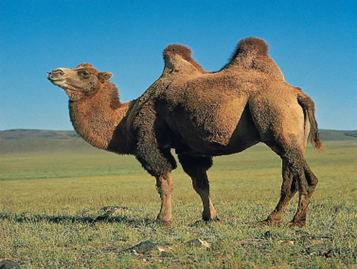
- Two majestic Bactrian camels named ‘Galwan’ and ‘Nubra’, were showcased at the Republic Day Parade on Kartavya Path.
- ‘Galwan’ and ‘Nubra’ are named after places in the cold desert of Ladakh, the only place in India where this species is found.
Bactrian camels (Camelus bactrianus)
- The name “Bactrian” comes from a region (former kingdom conquered by Alexander the Great) located between Afghanistan, Iran, and Kazakhstan.
- It is a double-humped camel, also called the Asian or Mongolian camel and is listed as Critically Endangered on the IUCN Red List.
- It is mainly found in Northern Pakistan, Iran, Turkey, India, with the largest domestic population in China.
- Bactrian camels are considered omnivorous; however, they are primarily herbivorous, feeding on a wide selection of vegetation, even those that other animals might refuse, such as thorny, tough, or dry plants.
- Bactrian camels, known as the ‘Ships of the Silk Road’, were crucial for crossing the harsh trade routes of Central Asia.
Congestion Index
Syllabus: GS2/Governance
Context
- According to the latest 2025 TomTom Traffic Index, ranked India as the fifth most traffic-congested country globally and second in Asia.
Congestion Index
- The index evaluates cities worldwide based on average travel time, congestion levels and vehicle speeds.
- The index is widely used to track changes in urban mobility and compare congestion trends across regions and countries.
- Bengaluru emerged as India’s most traffic-congested city, recording an average congestion level of 74.4%
- Bengaluru and Kolkata were both listed among the world’s five slowest cities.
- Of the top 10 cities with the highest congestion in Asia, six were from India: Bengaluru (1), Pune (2), Mumbai (6), New Delhi (7), Kolkata (9), and Jaipur (10).




Leave a Reply