
Cabinet Approves SHANTI Bill
Syllabus: GS3/ Energy
Context
- The Union Cabinet has approved the Atomic Energy Bill, 2025, titled SHANTI
SHANTI Bill
- Acronym – Sustainable Harnessing of Advancement of Nuclear Technology for India.
- Mandate – The Bill seeks to create a unified and modern legal framework for India’s nuclear sector.
About
- Traditionally, nuclear power plants in India have been owned and operated only by state-owned Nuclear Power Corporation of India Ltd (NPCIL) and its fully-owned subsidiary Bharatiya Nabhikiya Vidyut Nigam (BHAVINI).
- To allow private sector participation government has to amend key legislations;
- Atomic Energy Act, 1962, a framework for nuclear energy development and regulation.
- Civil Liability for Nuclear Damage Act, 2010, ensuring compensation mechanisms for nuclear incidents.
Key Provisions of the Bill
- Partial Opening of the Nuclear Value Chain: The Bill allows private and global companies to participate in atomic mineral exploration, manufacturing of nuclear equipment and components.
- Core and strategic areas such as reactor operation and weapons-related activities will continue to remain under government control.
- Nuclear Safety Authority: The legislation proposes the establishment of an independent nuclear safety authority.
- Dedicated Nuclear Tribunal: It calls for a dedicated tribunal to handle nuclear-related disputes, intended to streamline resolution and enhance transparency in the sector.
Cabinet Approves India-Oman Free Trade Pact
Syllabus: GS2/IR
Context
- The Union Cabinet has approved the proposed Free Trade Agreement between India and Oman.
Highlights of the FTA
- With the Comprehensive Economic Partnership Agreement (CEPA), India will get access to 98% of its products in Oman and significant access in services.
India-Oman Ties
- Diplomatic relations were formalised in 1955 and elevated to a Strategic Partnership in 2008.
- Trade Relations: Oman is India’s 30th largest trading partner in FY 2023-2024 with total trade of US$ 8.947 billion.
- India is among Oman’s top trading partners and Oman is the third largest export destination among the Gulf Cooperation Council (GCC) countries.
- India is the 4th largest market for Oman’s crude oil exports for the year 2023 after South Korea.
- Defence Cooperation: India and Oman conduct regular biennial bilateral exercises between all three services.
- Army exercise: Al Najah
- Air Force exercise: Eastern Bridge
- Naval Exercise: Naseem Al Bahr
- Maritime Cooperation: Oman is at the gateway of Strait of Hormuz through which India imports one-fifth of its oil imports.
- India signed a pact with the country in 2018 to access the Duqm port of Oman.
- The Port of Duqm is situated on the southeastern seaboard of Oman, overlooking the Arabian Sea and the Indian Ocean. It is strategically located, in close proximity to the Chabahar port in Iran.
- Gulf Cooperation Council (GCC)
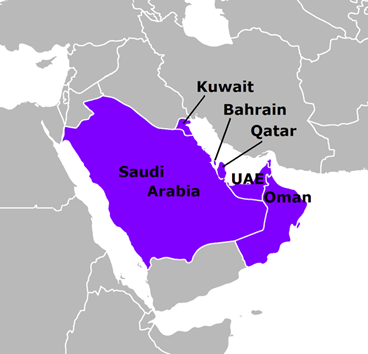
- It is a political and economic union of six Arabian Peninsula countries
- Members: Bahrain, Kuwait, Oman, Qatar, Saudi Arabia, and the United Arab Emirates.
- Establishment: Founded on May 25, 1981, through an agreement signed in Riyadh, Saudi Arabia.
- Objectives: To achieve unity and coordination among member states in all fields, including economic, security, cultural, and social cooperation.
- Headquarters: Riyadh, Saudi Arabia.
India out of Pax Silica Initiative
Syllabus: GS2/IR, GS3/Economy
Context
- India has been excluded from the US-led Pax Silica initiative, a new US critical mineral diversification plan.
Pax Silica Initiative
- Objective – It is a US-led strategic initiative to build a secure, prosperous, and innovation-driven silicon supply chain from critical minerals.
- Members – Japan, Republic of Korea, Singapore, the Netherlands, The United Kingdom, Israel, United Arab Emirates, and Australia.
Critical minerals
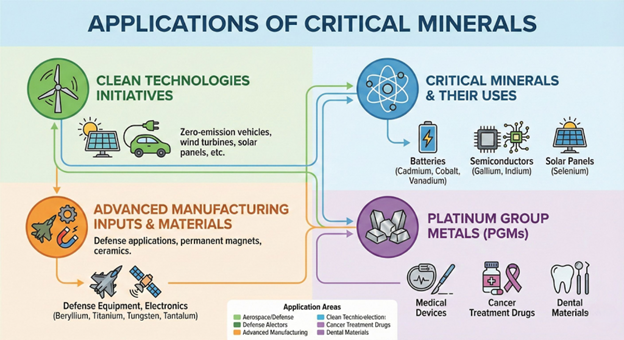
- Definition – Critical minerals are those minerals which are essential for economic development and national security
- The government has released a list of 30 critical minerals for India.
- These minerals are Antimony, Beryllium, Bismuth, Cobalt, Copper, Gallium, Germanium, Graphite, Hafnium, Indium, Lithium, Molybdenum, Niobium, Nickel, PGE, Phosphorous, Potash, REE,Rhenium, Silicon, Strontium, Tantalum, Tellurium, Tin, Titanium, Tungsten, Vanadium,Zirconium, Selenium and Cadmium.
- The Mines and Minerals Development and Regulation Act, 1957 (MMDR Act, 1957) has identified critical and strategic minerals for the country.
Preah Vihear Temple
Syllabus: GS1/ Art & Culture
In News
- India has expressed concern over reports of damage to conservation facilities at the Preah Vihear temple complex.
Preah Vihear Temple
- Location – It is an ancient Hindu temple dedicated to Shiva located in Cambodia, near the border with Thailand.
- It was built mainly during the reigns of Khmer kings Suryavarman I and Suryavarman II (9th–12th centuries CE).
- It was declared a UNESCO World Heritage Site in 2008.
Pradhan Mantri Garib Kalyan Package
Syllabus: GS2/ Welfare Scheme
In News
- The Supreme court extends ₹50 Lakh Pradhan Mantri Garib Kalyan Package (PMGKY) insurance to all doctors who died on COVID.
Pradhan Mantri Garib Kalyan Package
- The PMGKP Insurance Scheme is a specific component under the larger Pradhan Mantri Garib Kalyan Package, launched in March 2020.
- Coverage: Personal accident insurance cover of ₹50 lakh per eligible health worker.
- Risks Covered: Death due to COVID-19 infection.

Leave a Reply