
23rd India-Russia Annual Summit
Syllabus: GS2/IR
Context
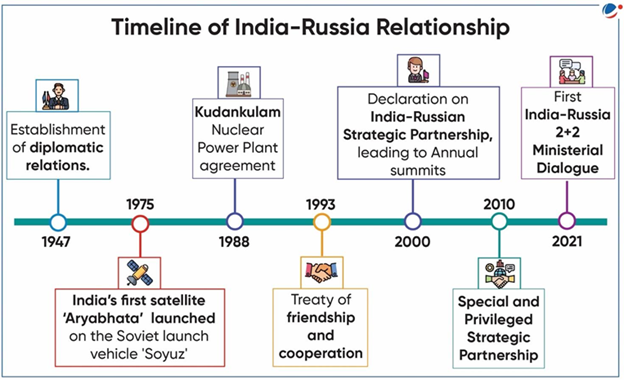
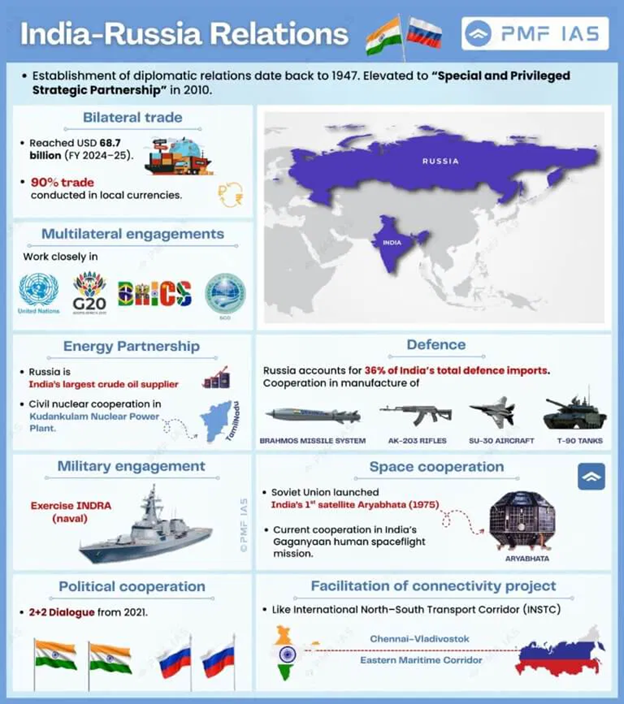
- India and Russia held their 23rd annual bilateral summit, marking a major milestone — 25 years of the Declaration on Strategic Partnership (2000).
Key Outcomes of the Visit
- Economic Programme 2030: The Leaders welcomed the adoption of the Programme for the Development of Strategic Areas of India – Russia Economic Cooperation till 2030 (Programme 2030).
- Trade Target: timely achievement of the revised bilateral trade target of USD 100 billion by 2030.
- Strategic Agreements Signed: India and Russia exchanged sixteen agreements in areas related to defence, trade, economy, healthcare, academics, culture and media.
- Free Trade Agreement (FTA) Push: Both sides are working towards the early conclusion of a Free Trade Agreement with the Eurasian Economic Union.
- Migration Cooperation: India will soon be launching a free 30-day e-tourist visa and a 30-day Group Tourist Visa for Russian citizens.
- Cooperation in Global and Multilateral Platforms: The Russian side has decided to join the International Big Cat Alliance.
70th Mahaparinirvan Diwas
Syllabus: GS1/History
In News
- President Droupadi Murmu and Prime Minister Narendra Modi paid floral tributes to Dr. B.R. Ambedkar on Mahaparinirvan Diwas at the Parliament complex in New Delhi.
Mahaparinirvan Diwas
- Meaning – Parinirvana, regarded as one of the major principles as well as goals of Buddhism, is a Sanskrit term which means release or freedom after death.
- As per the Buddhist text ‘Mahaparinibbana Sutta’, the death of Lord Buddha at the age of 80 is considered as the original Mahaparinirvan.
- Observed on – 6th December is observed to commemorate the unfathomable contribution to society given by Dr. Bhimrao Ambedkar and his achievements.
- Owing to Dr. B.R.Ambedkar’s status as a Buddhist leader, his death anniversary is referred to as Mahaparinirvan Diwas.
Dr. Bhimrao Ambedkar
- Babasaheb Dr. Bhimrao Ambedkar was a social reformer, jurist, economist, author, polyglot (knowing or using several languages), orator, a scholar and thinker of comparative religions.
- Birth – He was born in 1891 in Mhow, Central Province (now Madhya Pradesh).
Brief Profile
- He is known as the Father of the Indian Constitution and was India’s first Law Minister.
- He was the Chairman of the Drafting Committee of the Constitution.
- He was a well-known statesman who fought for the rights of the Dalits and other socially backward classes.
Contributions
- He led the Mahad Satyagraha in March 1927 against Hindus who were opposing the decision of the Municipal Board which had barred the untouchables from using water from the mahad tank.
- In 1926, the Municipal Board of Mahad (Maharashtra) passed an order to open the tank to all communities.
- He participated in all three Round Table Conferences.
- In 1932, Dr. Ambedkar signed the Poona pact with Mahatma Gandhiji, which abandoned the idea of separate electorates for the depressed classes (Communal Award).
- However, the seats reserved for the depressed classes were increased from 71 to 147 in provincial legislatures and to 18% of the total in the Central Legislature.
- His ideas before the Hilton Young Commission served as the foundation of the Reserve Bank of India (RBI).
Election and Designation
- In 1937, he was elected to the Bombay Legislative Assembly as a legislator (MLA).
- He was appointed to the Executive Council of Viceroy as a Labour member in 1942.
- In 1947, Dr. Ambedkar accepted PM Nehru’s invitation to become Minister of Law in the first Cabinet of independent India.
Shift to Buddhism
- He resigned from the cabinet in 1951, over differences on the Hindu Code Bill. He converted to Buddhism in 1956.
- He was awarded India’s highest civilian honour the Bharat Ratna in 1990.
Important Works
Journals
- Mooknayak (1920), Bahishkrit Bharat (1927), Samatha (1929), Janata (1930).
Books
- Annihilation of Caste, Buddha or Karl Marx, The Untouchable: Who are They and Why They Have Become Untouchables
- Buddha and His Dhamma
- The Rise and Fall of Hindu Women
Organizations
- Bahishkrit Hitkarini Sabha (1923)
- Independent Labor Party (1936)
- Scheduled Castes Federation (1942)
Death
- He died on 6th December 1956.
- Chaitya Bhoomi is a memorial to B R Ambedkar, located in Mumbai.
Relevance of Ambedkar in Present Times
- Caste-based inequality in India still persists. While Dalits have acquired a political identity through reservation and forming their own political parties, they lag behind in social (health and education) and economic dimension.
India’s Groundwater Contamination Crisis
Syllabus: GS3/ Environment
Context
- The Central Ground Water Board (CGWB) highlights a disturbing rise in toxic contaminants across India’s aquifers.
India’s Groundwater Contamination Crisis
- India holds 18% of the world’s population but only 4% of its freshwater resources, placing enormous pressure on available water systems.
- India depends on groundwater for about 85% of its rural drinking water needs and around 60% of irrigation water.
Crisis of Groundwater Contamination
- India’s aquifers show simultaneous contamination with, Arsenic, Fluoride, Nitrate, Uranium, Salinity and Heavy metals.
Government Initiatives
- Jal Shakti Abhiyan (2019): Focuses on water conservation and groundwater recharge in water-stressed districts.
- Amrit Sarovar Mission: Aims to develop and rejuvenate 75 water bodies per district.
- National Aquifer Mapping Program (NAQUIM): Helps delineate and understand aquifers for sustainable management.
- Atal Bhujal Yojana – It was launched to improve groundwater management in priority areas with critical and overexploited blocks.
Leave a Reply