
PM JI-VAN
Syllabus: GS2/Govt Policy & Intervention; GS3/Environment
Context
- Recently, the Union Government has expanded the timeline of the Pradhan Mantri JI-VAN Yojana, reaffirming its commitment to sustainable development and energy security.
PM JI-VAN
- It was launched in 2019
- Implementation- Ministry of Petroleum and Natural Gas (MoP&NG).
- Objective: To promote 2G ethanol projects, use agricultural waste (biomass), meet Ethanol Blending (EBP) targets, increase farmers’ income and help in environmental goals (such as net-zero emissions).
- Methodology: The scheme encourages ethanol production from molasses and non-edible biomass (such as crop residues) instead of the petrochemical route.
Importance
- Energy security: reducing dependence on fossil fuel imports.
- Rural Economy: Providing farmers with new markets for their crop residues, increasing their income.
- Environment: Reducing greenhouse gas emissions, tackling pollution, contributing to the net-zero emissions target.
- Investment: Attracting private investment in the 2G ethanol sector.
- Example: India’s first 2G ethanol project (at Panipat by IOCL) was set up under this scheme and dedicated to the nation by the Prime Minister in 2022.
Additional Information – Biofuels
- Definition – Biofuels are alternative fuels made from plant and plant-derived resources.
- Example: Bioethanol, Biodiesel, Green diesel, Biogas etc.
National Policy on Biofuels, 2018
- The National Policy on Biofuels 2018 (amended in 2022) provides a framework for increasing the use of biofuels in India to enhance energy security.
Government Efforts for Biofuel Expansion
- Pradhan Mantri JI-VAN Yojana (Jaiv Indhan – Vatavaran Anukool fasal awashesh Nivaran Yojana): It promotes 2G ethanol production from agricultural waste and residues.
- GOBAR-Dhan Scheme (Galvanizing Organic Bio-Agro Resources Dhan): It promotes biogas and bio-CNG production from cattle dung and organic waste.
- SATAT Scheme (Sustainable Alternative Towards Affordable Transportation): It promotes Compressed Bio-Gas (CBG) production as a fuel alternative.
Antarctic Ozone Hole Closes Early in 2025
Syllabus: GS3/Environment
In News
- The Antarctic ozone hole that formed in August 2025 closed earlier than usual, offering hope for recovery amid record global warming.
OZONE LAYER DEPLETION
Basics – Ozone Layer (O3)
- It is a highly reactive molecule containing three oxygen atoms.
- Found in – It is present between 10 and 50 km above the earth’s surface, called the stratosphere.
- Function – This ozone layer serves as a natural filter for blocking deadly incoming UV radiation from the sun.
- Significance – This ozone shield is necessary for the survival of human life on the earth.
OZONE LAYER DEPLETION
- Definition – The decrease in ozone concentration in the middle layers of the atmosphere – mainly in the stratosphere is referred to as the depletion of the ozone layer.
- Caused by – It is caused by emissions of anthropogenic halogenated hydrocarbons such as CFCs, HCFCs, Halons, Carbon tetrachloride and Methyl bromide.
Why is ozone depletion more in Antarctica than the equator?
- The severe depletion of the Antarctic ozone layer known as the “ozone hole” occurs because of the special weather conditions that exist there and nowhere else on the globe.
- The very low temperatures of the Antarctic stratosphere create ice clouds called polar stratospheric clouds (PSCs).
Measures to Prevent Ozone Layer Depletion
Vienna Convention
- Objective – To protect human health and the environment from any harmful effects of the depletion of the ozone layer.
- Held in – Vienna , Austria
- Adopted in – 1985.
- Came into force – 1988.
Montreal Protocol
- Enforcement – It was agreed upon in 1987 in Montreal, Canada and entered into force in 1989.
- Objective – To protect the Ozone layer by reducing the production of substances that are supposed to be responsible for Ozone layer depletion.
- Kigali Agreement – The protocol was further strengthened with the ratification of the legally binding Kigali Agreement in 2016 in Kigali, Rwanda.
- Significance – It seeks to phase out the production of hydrofluorocarbons (HFCs) that are potent greenhouse gases by the late 2040s.
BNHS to Reintroduce Two Vulture Species in Assam
Syllabus: GS3/ Environment
Context
- The Bombay Natural History Society (BNHS), is set to reintroduce two critically endangered vulture species, Slender-billed Vultures (Gyps tenuirostris) and White-rumped Vultures (Gyps bengalensis), in Assam.
Vulture
- Vultures are one of the 22 species of large carrion-eating birds that live mostly in the tropics and subtropics.
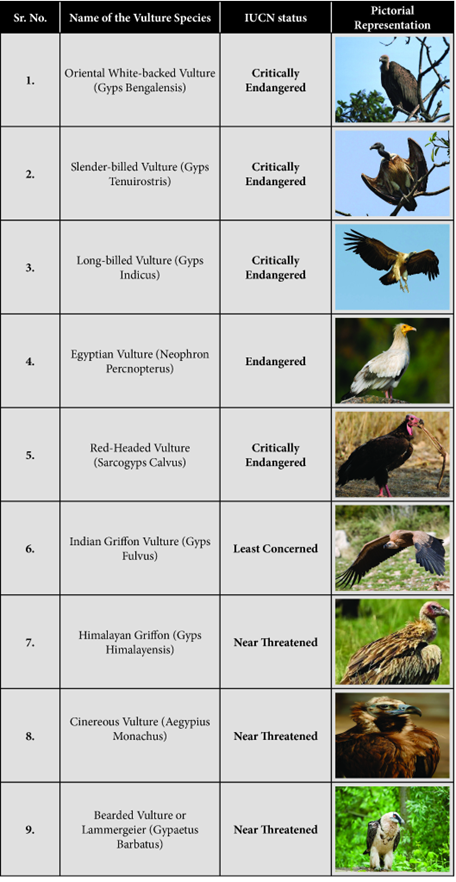
India is home to nine species of Vulture namely
- Oriental white-backed,
- Long-billed,
- Slender-billed
- Himalayan,
- Red-headed,
- Egyptian,
- Bearded,
- Cinereous
- Eurasian Griffon.
Threats
- Use of Diclofenac: A veterinary nonsteroidal anti-inflammatory drug (NSAID) found in the carcass of cattle the vultures feed on. The veterinary use of diclofenac was banned in 2008.
- Pesticides: The presence of organochlorine pesticide, polychlorinated biphenyls, polycyclic aromatic hydrocarbons and heavy metals were also the major cause of mortality.
- Other threats include lack of nesting trees, electrocution by power lines, and food dearth and contaminated food.
Conservation Efforts
- The National Board for Wildlife (NBWL) has approved an Action Plan for Vulture Conservation 2020-2025. It includes:
- Vulture Conservation Centre: Uttar Pradesh, Tripura, Maharashtra, Karnataka and Tamil Nadu will get a vulture conservation and breeding centre.
- India has lost 99 percent of the population of the three species, Oriental White-Backed Vulture, Long-billed Vulture and Slender-billed Vulture.
Conservation Status
- Schedule-1 of the Wildlife Protection Act 1972: Bearded, Long-billed, Slender-billed, Oriental white-backed.
- Rest are protected under ‘Schedule IV’.
IUCN Red List;
- Critically Endangered: Oriental White-backed Vulture, Long-billed Vulture, Slender-billed Vulture and Red-headed Vulture.
- Endangered: Egyptian Vulture.
- Least Concerned: Eurasian Griffon.
- Near Threatened: Himalayan, Bearded and Cinereous.
Additional Information – Bombay Natural History Society (BNHS)
- It is one of the largest and oldest non-governmental organizations in India
- Founded on September 15, 1883, in Mumbai,
- Objective – to conserve nature through action based on research, education, and public awareness.
Leprosy
Syllabus: GS2/Health
Context
- The Supreme Court has directed the NHRC to address discrimination against persons affected by leprosy.
Leprosy in India
- India continues to report about 57 % of leprosy cases worldwide,
- States with highest prevalence of leprosy – Bihar, Chhattisgarh, Jharkhand, Maharashtra, and Odisha.
Elimination efforts –
- National Strategic Plan (NSP) and Roadmap for Leprosy (2023-27) – Launched in 2023, to achieve zero transmission of leprosy by 2027.
- The Sustainable Development Goal (SDG) 3.3 aims to end leprosy by 2030.
- The World Health Organization (WHO) declared Jordan as the first country in the world to eliminate leprosy in 2024.
Leprosy
- Leprosy is also known as Hansen’s disease.
- Pathogen – It is a chronic infectious disease caused by a type of bacteria, Mycobacterium leprae.
- It is known to occur at all ages ranging from early childhood to old age.
- Symptoms: The disease predominantly affects the skin and peripheral nerves.
- Loss of sensation in affected areas.
- Left untreated, the disease may cause progressive and permanent disabilities.
- Transmission: Through droplets from the nose and mouth.
- Treatment: Leprosy is a curable disease through the multi-drug therapy (MDT).
Inhalable Microplastics (iMPs)
Syllabus: GS2/ Health
In News
- Recent study has revealed the presence of inhalable microplastics (iMPs) in the air of major Indian markets, marking them as a new class of pollutants comparable to PM2.5 and PM10.
Inhalable microplastics (iMPs)
- They are plastic particles less than 10 micrometres (microns) in size and can enter human lungs through the nose.
- It found the highest concentrations in Kolkata and Delhi, with iMPs contributing up to 5% of urban particulate matter, largely from synthetic clothing, packaging, tyre wear, and footwear.
- Inhalable microplastics (iMPs) can penetrate deep into the lungs, enter the bloodstream, and act as carriers for toxic chemicals like diethyl phthalate and heavy metals such as lead.
- It poses risks of cancer, respiratory, hormonal, and neurological disorders.
Invasive Alien Plants in India
Syllabus: GS3/Environment
In News
- Invasive alien plants are rapidly transforming India’s ecosystems, nearly doubling their range in sensitive regions like the Western Ghats, Himalayas, and the north-east, driven by climate change, land-use shifts, and biodiversity loss.
Invasive Alien Plants
- Definition – Invasive species refer to non native species that, when introduced to a new environment, can cause harm to the ecosystem, economy, or human health.
- These species often outcompete or negatively interact with native species, disrupt natural processes, and can lead to significant ecological imbalances.
- They can be plants, animals, fungi, or even microbes.
Characteristics of Invasive Species
- Rapid reproduction and growth
- High dispersal ability
- Broad dietary range
- Physiological adaptability to new conditions
- Tolerance to a wide range of environmental factors
- Capacity to alter growth forms based on surroundings
Common Invasive Species Found in India
- Viper grass
- Lantana camara
- Prosopis juliflora
- Water hyacinth
- African catfish
- Cotton Mealy Bug
- Primrose Willow
Measures taken at the International Level
- United Nations Convention on Biological Diversity (CBD – 1992): The Convention emphasizes the need to prevent the introduction of, control, or eradicate invasive alien species that threaten ecosystems, habitats, or species.
- Kunming-Montreal Global Biodiversity Framework (KMGBF – 2022): It has been agreed under the UN CBD and aims to reduce the rate of introduction and establishment of invasive alien species by at least 50% by 2030.
- Global Invasive Species Programme (GISP): It supports research, capacity building, and management strategies to address invasive species issues worldwide.
Measures taken at the National Level
- National Action Plan on Invasive Alien Species (NAPINVAS): It focuses on the prevention, early detection, control, and management of invasive species.
- National Invasive Species Information Center (NISIC) – It provides information and resources on invasive species in India.
- The Himalayan Environmental Foundation is working to control invasive species like Lantana camara in the Himalayas.
World Soil Day
Syllabus: GS3/ Environment
Context
- World Soil Day is observed annually on December 5 to raise awareness about the importance of healthy soil and to advocate for sustainable management.
World Soil Day
- Observed on – December 5
- Observed by – International Union of Soil Sciences (IUSS).
- 2025 theme – “Healthy Soils for Healthy Cities”.
Initiatives for Soil Conservation
- Soil Health Card Scheme: It provides farmers with soil nutrient status reports to encourage balanced fertilizer use and improve productivity.
- Promotion of Organic Farming: Initiatives like Paramparagat Krishi Vikas Yojana (PKVY) encourage organic farming practices to maintain soil health.
Global Initiatives
- Global Soil Partnership (GSP): It is an FAO-led initiative to improve global soil governance and promote sustainable soil management.
- United Nations Convention to Combat Desertification (UNCCD): It works to prevent land degradation and promote sustainable land management
- It has a pledge for land degradation neutrality (LDN) by 2030.
Kuno National Park (KNP)
Syllabus: GS3/Environment
Context
- On International Cheetah Day (December 4), the Madhya Pradesh Chief Minister released three cheetahs into the wild at Kuno National Park.
Kuno
- Located in – Sheopur district, Madhya Pradesh.
- It is named after the Kuno River, a perennial tributary of the Chambal that flows through the park.
- Notified as – Kuno Wildlife Sanctuary in 1981
- Forest type – Northern Tropical Dry Deciduous
Do you know?
- Twelve years after the Supreme Court’s 2013 order to shift some Asiatic lions from Gujarat to Madhya Pradesh’s Kuno as a second home, the translocation still hasn’t materialised.
About
- India declared the cheetah extinct in 1952, after decades of over-hunting, habitat fragmentation, and depletion of prey species.
- The launch of Project Cheetah in 2022 and the arrival of cheetahs from Namibia and South Africa created the world’s first intercontinental relocation programme for a large carnivore.
- Botswana – It’s a landlocked country with nearly 70% of its landmass covered by the Kalahari Desert, and holds one of the world’s largest wild cheetah populations.
Project Cheetah
- Overview: Project Cheetah is India’s ambitious attempt to reintroduce the cheetah in suitable open forest and grassland ecosystems.
- Launched By: National Tiger Conservation Authority (NTCA), a statutory body under the Wildlife (Protection) Act, 1972 (amended 2006).
- Uniqueness – It is the world’s first intercontinental translocation of a large wild carnivore.
Translocations So Far:
- 8 cheetahs from Namibia in 2022
- 12 cheetahs from South Africa in 2023
- 8 cheetahs from Botswana (2025 announcement)
Cheetah(Acinonyx jubatus)
- It is the world’s fastest mammal and the only large carnivore to have gone extinct in India (1952).
- Unlike other big cats, cheetahs do not roar.
- There are two main species: the African cheetah (Vulnerable) and the Asiatic cheetah (Critically Endangered), found only in eastern Iran and parts of Africa.



Leave a Reply