
World AIDS Day
Syllabus: GS2/Health
Context
- World AIDS Day is observed on December 1 every year.
World AIDS Day
- It is observed every year to raise awareness about the HIV/AIDS epidemic.
- It was first marked in 1988 by the World Health Organization (WHO).
- Theme 2025: Overcoming disruption, transforming the AIDS response.
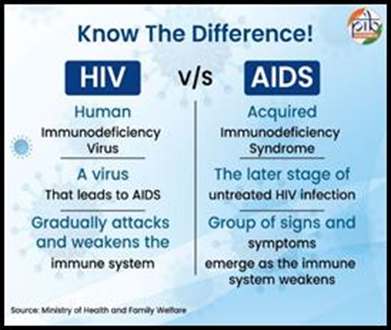
Acquired immunodeficiency syndrome (AIDS)
- Pathogen – It is a chronic, potentially life-threatening health condition caused by the human immunodeficiency virus (HIV) which damages the human immune system.
- Transmission: Through direct contact with certain body fluids (blood, semen, rectal fluid, vaginal fluid or breast milk) from a person infected with HIV.
- Symptoms:
- Stage 1: Flu-like illness (Fever, chills, rashes, night sweats)
- Stage 2: Clinical latency (No particular symptoms)
- Stage 3: AIDS (Weakening of Immune System)
- Prevention: Prevention is better than cure, using protective techniques, non-contaminated needles & preventing mother to child transmission.
- Treatment: There is no cure for HIV infection. It is treated with antiretroviral drugs, which stop the virus from replicating in the body. Untreated HIV can progress to AIDS, often after many years.
Steps taken by Government of India
- National AIDS Control Programme (NACP) (Central Sector Scheme)
- India has achieved the 6th MDG of halting and reversing the HIV epidemic.
- Prevention from Parent to Child Transmission (PPTCT) programme
- HIV/AIDS Act 2017 (Prohibits discrimination against HIV-infected people on any grounds)
- 90:90:90 strategy as adopted by UNAIDS (90% (diagnosed, treatment (by a nti-retroviral treatment (ART)) & suppression)) by 2020. Extended by 10 years with the goal post of 95-95-95.
- Project ACCELERATE (John Hopkin & NACO initiative): To provide HIV Services through Safe Zindagi online portal.
- Mission Sampark: Its purpose was to “bring back” people living with HIV (PLHIV) who had stopped antiretroviral therapy (ART).
Private Sector Entry in India’s Nuclear Sector
Syllabus: GS3/ Energy
Context
- Prime Minister Narendra Modi has said that the government is moving towards opening up the nuclear sector for private players.
India’s Nuclear Sector
- Nuclear power plants in India are owned and operated only by Nuclear Power Corporation of India Ltd (NPCIL).
- Key legislations – To allow private sector participation the government has proposed amendments to key legislations.
- Atomic Energy Act, 1962, a framework for nuclear energy development and regulation.
- Civil Liability for Nuclear Damage Act, 2010, ensuring compensation mechanisms for nuclear incidents.
Additional Information – Nuclear Energy
- Definition – Nuclear energy is the energy released during nuclear reactions, either through fission (splitting of atomic nuclei) or fusion (merging of atomic nuclei).
Status of Nuclear power capacity in India
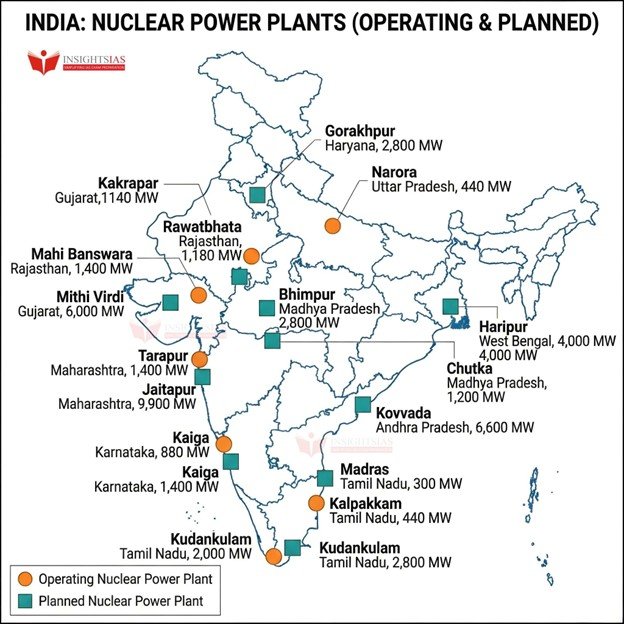
- Nuclear power capacity of India – 8,180 MW, spread across 24 nuclear power reactors.
- Nuclear power capacity target – 100 GW by 2047
- Capacity Expansion: 10 new reactors (totaling 8 GW) under construction across Gujarat, Rajasthan, Tamil Nadu, Haryana, Karnataka, and Madhya Pradesh.
Important Nuclear Power Plants in India
|
NUCLEAR POWER STATION |
STATE |
TOTAL CAPACITY (MW) |
|
Tarapur |
Maharashtra |
1,400 |
|
Rawatbhata |
Rajasthan |
1,180 |
|
Kudankulam |
Tamil Nadu |
2,000 |
|
Kaiga |
Karnataka |
880 |
|
Kakrapar |
Gujarat |
1140 |
|
Kalpakkam |
Tamil Nadu |
440 |
|
Narora |
Uttar Pradesh |
440 |
|
POWER STATION |
OPERATOR |
STATE |
TOTAL CAPACITY (MW) |
|
Jaitapur |
National Power Corporation of India Limited |
Maharashtra |
9,900 |
|
Kovvada |
National Power Corporation of India Limited |
Andhra Pradesh |
6,600 |
|
Mithi Virdi |
National Power Corporation of India Limited |
Gujarat |
6,000 |
|
Haripur |
National Power Corporation of India Limited |
West Bengal |
4,000 |
|
Kudankulam |
National Power Corporation of India Limited |
Tamil Nadu |
2,800 |
|
Gorakhpur |
National Power Corporation of India Limited |
Haryana |
2,800 |
|
Bhimpur |
National Power Corporation of India Limited |
Madhya Pradesh |
2,800 |
|
Mahi Banswara |
National Power Corporation of India Limited |
Rajasthan |
1,400 |
|
Kaiga |
National Power Corporation of India Limited |
Karnataka |
1,400 |
|
Chutka |
National Power Corporation of India Limited |
Madhya Pradesh |
1,200 |
|
Madras |
Bharatiya Nabhikiya Vidyut Nigam Limited |
Tamil Nadu |
300 |
Ellora Caves
Syllabus: GS1/ History and Culture
Context
- Scottish historian William Dalrymple has urged the Maharashtra government to bring greater visibility to the lesser-known heritage sites around the Ellora Caves.
Ellora Caves
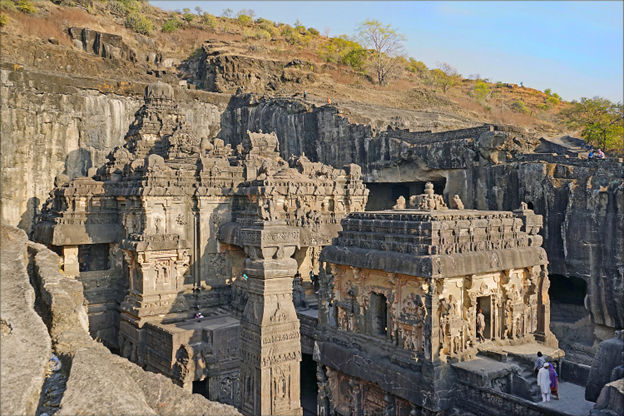
- Located in – Chhatrapati Sambhajinagar, Maharashtra, the Ellora Caves are among India’s first UNESCO World Heritage sites.
- The cave complex was carved between 600 CE and 1000 CE, spanning the rule of the Chalukyas, Rashtrakutas, and Yadavas.
- Religious Pluralism: The complex comprises 34 major caves, 12 Buddhist, 17 Hindu, and 5 Jain, demonstrating a unique period of interreligious harmony and artistic exchange.
Key Architectural Features
- Kailasa Temple (Cave 16): It is carved from a single monolithic basalt rock, dedicated to the Hindu god Lord Shiva.
- Buddhist Caves: These include monasteries (viharas) and prayer halls (chaityas).
- Jain Caves: Built during the later phase of Ellora’s development.
Hornbill Festival
Syllabus: GS1/Culture

In News
- The 26th edition of Nagaland’s famed Hornbill Festival, known as the “Festival of Festivals,” began at the Naga Heritage Village in Kisama, Kohima, coinciding with the state’s Statehood Day (December 1st).
Hornbill Festival
- It is held annually in the first week of December at Kisama near Kohima.
- It is a vibrant cultural showcase of all Naga tribes.
Significance –
- It was conceived in 2000 to promote unity and preserve ethnic heritage.
- It highlights both traditional and contemporary Naga culture through music, crafts, cuisine, and folklore.
- Additional Information -Great Hornbill
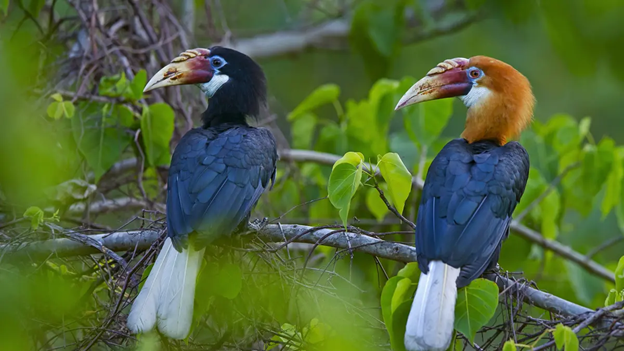
- Scientific name – Buceros bicornis.
- Also known as – It is also known as the concave-casqued hornbill, great Indian hornbill or great pied hornbill.
- Habitat – It is found in the Indian subcontinent and Southeast Asia.
- Uniqueness – The most prominent feature of the Great Hornbill is the bright yellow and black casque (hard structure on the head of some birds) on top of its massive bill.
- Festival – The Hornbill Festival is celebrated in Nagaland.
- State Bird – Great Hornbill is the state bird of Arunachal Pradesh and Kerala.
Conservation status
- IUCN Status – Vulnerable
- Indian Wildlife Protection Act,1972 – Schedule I
India Re-Elected to UNESCO Executive Board
Syllabus:GS2/IR
In News
- India has been re-elected to the UNESCO Executive Board for the 2025-29 term.
UNESCO Executive Board
- It is one of the three constitutional organs of the U.N. agency (the others being the General Conference and the Secretariat) and it is elected by the General Conference.
- It acts under the authority of the General Conference.
- It examines the programme of work for the organisation and corresponding budget estimates submitted to it by the Director-General.
- It consists of 58 Member States each with a four-year term of office.
Central Industrial Security Force (CISF)
Syllabus: GS3/Internal Security
Context
- The Central Industrial Security Force (CISF) has introduced a revised posting policy for personnel assigned to Parliament security duties.
Central Industrial Security Force
- It is a paramilitary force established in 1969, under the Central Industrial Security Force Act, 1968.
- Every year, CISF Raising Day is observed on March 10.
- Operates under – Ministry of Home Affairs of India.
Functions – It provides security to the strategic establishment including
- Department of Space
- Department of Atomic Energy,
- Airports, Delhi Metro and ports.
- Historical monuments
- Basic areas of the Indian economy such as petroleum and natural gas, electricity, coal, steel and mining.
- Additional Information – Paramilitary forces of India
Hansa-3 NG Trainer Aircraft
Syllabus: GS3/ Defence
Context
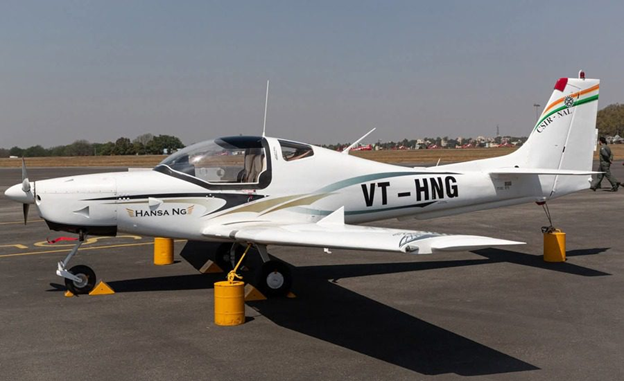
- The CSIR-National Aerospace Laboratories (NAL), Bengaluru, launched a “production version” of the indigenous Hansa-3(NG) trainer aircraft.
Hansa-3
- It is India’s indigenous two-seat trainer aircraft developed by CSIR-NAL.
- It is designed for basic flight training catering mainly to flying clubs and pilot training schools.


Leave a Reply