
Rhesus Monkeys
Syllabus: GS3/Species in News
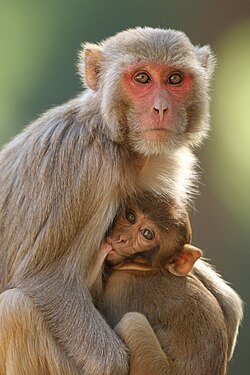
In News
- The National Board for Wildlife has recommended reinstating Rhesus Macaques under Schedule II of the Wildlife (Protection) Act, 1972.
Rhesus Macaque(Macaca mulatta)
- Habitat: It is a diurnal, omnivorous species that lives both in trees and on the ground. It occupies a wide range of habitats—from coniferous, deciduous, bamboo, and mixed forests to mangroves, scrublands, rainforests, and even areas near human settlements.
- Distribution :It is found throughout most of southern Asia, in eastern Afghanistan, Bangladesh, Bhutan, China and India.
- Ecological Roles : It is vital seed dispersers, aiding forest regeneration and biodiversity, making their protection essential for both ecological balance and sustainable coexistence.
- Threats : It is generally unthreatened, though its original habitat is increasingly being lost to development
- Protection status : It is listed as Least Concern by the IUCN.
- It is listed on CITES Appendix II.
AJEYA WARRIOR-25
Syllabus: GS3/Defence
Context
- The 8th edition of the India–United Kingdom (UK) Joint Military Exercise “AJEYA WARRIOR-25” commenced in Rajasthan.
AJEYA WARRIOR-25
- Objective – The exercise focuses on counter-terrorism operations in semi-urban environments.
Additional information –
- KONKAN is a bilateral naval exercise conducted between the Indian Navy and the Royal Navy (UK).
- Indradhanush is a bilateral air exercise conducted between the Indian Air Force (IAF) and the Royal Air Force of UK.
Sentinel-6B
Syllabus: GS3/Space
Context
- Sentinel-6B has been successfully launched from the Vandenberg Space Force Base in California, USA.
Sentinel-6B
- It is an ocean-tracking satellite with six onboard science instruments that will measure the rising sea levels and its impacts on the planet.
- It will orbit Earth at a speed of 7.2 km per second, completing one revolution every 112 minutes.
- The mission is a joint collaboration between NASA, NOAA, and the European Space Agency (ESA).




Leave a Reply