
Himachal natural farming
Syllabus:GS3/Economy
In News
- Farmers in Himachal Pradesh are increasingly adopting natural farming, supported by the State’s flagship Prakritik Kheti Khushhal Kisan Yojana (PK3Y), which promotes chemical-free agriculture.
Natural Farming
- It is a chemical free farming, involving livestock (preferably local breed of cow) integrated natural farming methods and diversified crop systems rooted in the Indian traditional knowledge.
- It is largely based on on-farm biomass recycling with major stress on biomass mulching, use of on-farm cow dung-urine formulations; maintaining soil aeration and exclusion of all synthetic chemical inputs.
Additional Information- National Mission on Natural Farming (NMNF)
- Launched in – November 2024
- It is a centrally sponsored Scheme
- Objective – to promote chemical-free, ecosystem-based natural farming rooted in traditional knowledge.
Pradhan Mantri Dhan-Dhaanya Krishi Yojana and Self-Reliance in Pulses Mission
Syllabus: GS3/ Agriculture
Context
- PM Modi launched two new agriculture schemes, the PM Dhan Dhaanya Krishi Yojana (PMDDKY) and the Mission for Aatmanirbharta in Pulses, at a special Krishi programme in New Delhi.
Prime Minister Dhan-Dhaanya Krishi Yojana
- Launched in – The scheme will be launched in partnership with states.
Key Focus Areas:
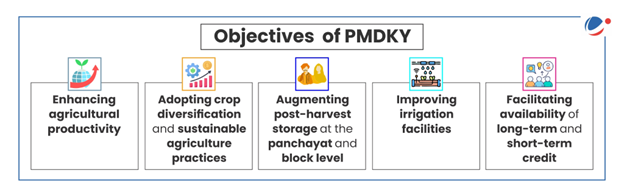
- Enhancing agricultural productivity.
- Promoting crop diversification and sustainable practices.
- Expanding post-harvest storage at Panchayat and Block levels.
- Improving irrigation facilities.
- Facilitating long-term and short-term credit access.
Building Rural Prosperity and Resilience Program
- Purpose: launched in partnership with states to address under-employment in agriculture.
- Key Focus Areas: Skilling, investment, and technology to invigorate rural economy. Modernizing agriculture with improved productivity and warehousing.
- Target Beneficiaries: Rural women, young farmers, marginal & small farmers and landless families.
Mission for Aatmanirbharta in Pulses
- The Mission was launched for 2025–26 to 2030–31 with a budgetary allocation of ₹11,440 crore.
- Objective – It aims to make India self-sufficient in pulses production, reducing dependence on imports in light of rising domestic demand.
- It aims to ensure 100 percent procurement of Tur, Urad, and Masoor at MSP for four years.
Additional Information- Pulses Production and Consumption in India
- Global Leader: India is the largest global producer (25%), consumer (27%), & importer (14%) of pulses.
- Seasonal Production: Pulses are grown in Kharif and Rabi seasons
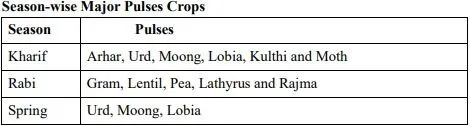
- Madhya Pradesh, Maharashtra and Rajasthan are the top three pulses producing states in the country.
Government Initiatives for Achieving Self-Sufficiency in Pulse Production
- National Food Security Mission (NFSM-Pulses): Boosts area, production, and productivity through HYV seeds, improved agronomy, and demonstrations.
- Minimum Support Price (MSP) for Pulses: Regularly revised MSPs (E.g., Tur ₹7000/qtl in 2023-24) ensure price security and encourage pulse cultivation.
- Seed Hub Program by ICAR-IIPR: Expands availability of certified, short-duration, and high-yielding pulse seeds at the grassroots level.
- PM-AASHA Scheme: Ensures MSP realisation via Price Deficiency Payment (PDP) and targeted procurement by private and public agencies.
- Climate-Resilient Varieties Development (ICAR): Develops varieties resistant to drought, pests, and diseases suited to changing climates.
- e-NAM Integration for Pulses: Enhances market access, reduces middlemen, and enables transparent price discovery through online pulse trading.
Durand Line
Syllabus: GS1/Geography; GS2/IR
News –
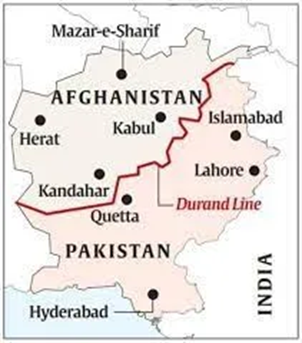
- Border clashes erupted between Afghanistan and Pakistan along the Durand Line.
Durand Line
- It is a 2,640 km land border established in 1893 following an agreement between Sir Mortimer Durand, then Foreign Secretary of British India, and Amir Abdur Rahman Khan, the ruler of Afghanistan.
- The line was intended to define the spheres of influence between British India and Afghanistan, effectively splitting ethnic Pashtun and Baloch communities between the two sides.
Thalassemia
Syllabus: GS2/Health
News
- Thalassemia patients in Kerala are facing serious health risks due to a shortage of leukocyte filter sets and iron chelation drugs.
Thalassemia
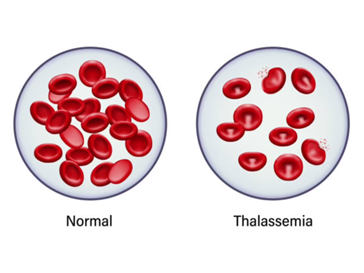
- Thalassemia is an inherited blood disorder (passed from parents to children through genes) where the body cannot produce enough hemoglobin (it is the protein in red blood cells (RBCs) that carries oxygen).
- Symptoms – Anemia, weak bones, delayed or slow growth, Iron overload (due to frequent transfusions), poor appetite, enlarged spleen or liver, and pale skin.
- Note – India is known as the thalassemia capital of the world, with over 1,00,000 patients dying before the age of 20 due to lack of access to treatment.
- In India, thalassemia, along with two other blood disorders (Hemophilia and Sickle Cell disease) are recognised under Rights of Persons with Disabilities Act, of 2016.
- Every year, World Thalassemia Day is observed on May 8 to raise awareness among the public and policymakers.
Thalassemia Bal Sewa Yojana (TBSY)
- Launched by – Union Health Ministry, in partnership with Coal India Limited
- Objective – to Rs. 10 lakh financial aid to eligible patients for bone marrow transplants (BMT) at 17 empanelled hospitals nationwide,
Maitri II: India’s New Frontier in Antarctica
Syllabus: GS3/ Science & Technology
Context
- The Ministry of Finance has approved the establishment of Maitri II, India’s upcoming research station in eastern Antarctica, to be completed by January 2029.
India’s Antarctic Presence
- In 1983, India established the first permanent base in Antarctica named Dakshin Gangotri. However it is no longer in operation.
- India presently has two research stations at Antarctica namely ‘Maitri’ and ‘Bharati’.
Maitri II
- Nodal Agency: National Centre for Polar and Ocean Research (NCPOR), Goa.
- Estimated Cost: ₹2,000 crore over seven years.
- Location: Eastern Antarctica, near the Schirmacher Oasis, replacing the aging Maitri station.
- Green Research Base: Designed to operate on renewable energy sources, solar during summer and wind energy year-round, reducing dependence on fossil fuels.
Additional Information – Antartica
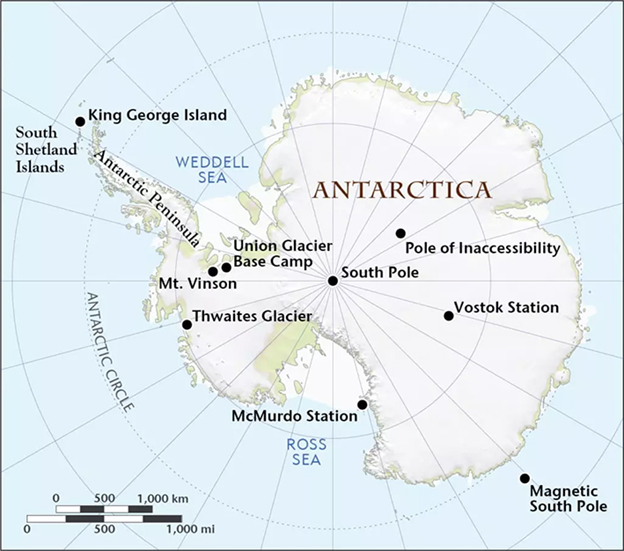
- Antarctica is the world’s southernmost and fifth largest continent.
- Uniqueness – It is also the world’s highest, driest, windiest, coldest, and iciest continent.
- The continent is divided into East Antarctica (Greater Antarctica) and West Antarctica (Lesser Antarctica). They are separated by Transantarctic Mountains.
- East Antarctica is composed of older, igneous and metamorphic rocks whereas West Antarctica, is made up of younger, volcanic and sedimentary rock.
- West Antarctica, is part of the “Ring of Fire,” a tectonically active area around the Pacific Ocean.
- Mount Erebus, located on Antarctica’s Ross Island, is the southernmost active volcano on Earth.
- Longest River: Onyx
- Largest Lake: Vostok
Conservation efforts to protect Antartica
Antarctica treaty
- The Treaty covers the area south of 60°S latitude.
- It was signed at Washington D.C. in 1959 with the objective of the Demilitarisation of Antarctica.
- The signatories are supposed to bring laws so that no activity in contravention of the treaty takes place.
- India signed the treaty in 1983.
The Convention on the Conservation of Antarctic Marine Living Resources (CCAMLR):
- Signed in – Canberra in 1980
- Objective – to protect and preserve the Antarctic environment and, particularly, for the preservation and conservation of marine living resources in Antarctica.
- India ratified the CCAMLR in 1985.
The Protocol on the Environmental Protection to the Antarctic Treaty (Madrid Protocol)
- Signed in – Madrid in 1991.
- Objective – It aims to strengthen the Antarctic Treaty system and develop a comprehensive regime for the protection of the Antarctic environment and dependent and associated ecosystems.
- India ratified the Madrid Protocol in 1998.
Council of Managers of the National Antarctic Programme (COMNAP)
- India is also a member of the COMNAP which shows the significant position that India holds among the nations involved in Antarctic research.
Indian Antarctic Bill, 2022
- Objective: To demilitarize Antarctica; use of Antarctica for peaceful purposes; promote international scientific cooperation in Antarctica.
- Prohibited activities: The Bill prohibits certain activities in Antarctica including:
- Nuclear explosion or disposal of radioactive wastes
- Discharge of garbage, plastic or other substances into the sea which is harmful to the marine environment.
International Blue Flag Certification
Syllabus: GS3/ Environment
In News
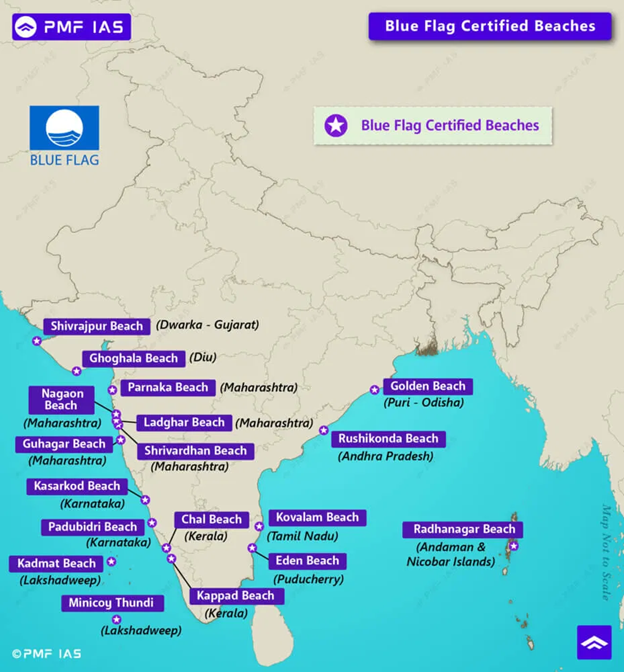
- Five beaches in Maharashtra have received the international Blue Flag certification.
- The list includes Shrivardhan and Nagaon beaches, Parnaka, and Guhagar and Ladghar beaches.
Blue Flag Certification
- Objective – ‘Blue Flag’ is a certification that can be obtained by a beach, marine, or sustainable boating tourism operator, and serves as an eco-label.
- Awarded by – The certification is awarded by the Denmark-based non-profit Foundation for Environmental Education.
- Parameters – The certification is accorded based on four major parameters:
- Environmental education and information
- Bathing water quality
- Safety and services at the beaches
- Environment management and conservation
Indian Sites under Blue Flag
- There are now a total of 10 sites under Blue Flag Certification.
- Shivrajpur – Gujarat
- Ghoghla – Diu
- Kasargod – Karnataka
- Padubidri – Karnataka
- Kappad – Kerala
- Rushikonda – Andhra Pradesh
- Golden – Odisha
- Radhanagar – Andaman and Nicobar
- Kovalam – TamilNadu
- Eden beach – Pondicherry.
- Minicoy Thundi (Lakshadweep)
- Kadmat (Lakshadweep).
- Shrivardhan (Maharashtra)
- Nagaon (Maharashtra)
- Parnaka (Maharashtra)
- Guhagar (Maharashtra)
- Ladghar beaches (Maharashtra)


Leave a Reply