
Foreign Minister of Afghanistan Visited India
Syllabus: GS2/IR
Context
- Afghanistan’s Taliban foreign minister met external affairs minister S. Jaishankar in New Delhi.
India–Taliban Diplomatic Engagement
- Assurance for Terror Concerns: Afghanistan reassured India that it would not allow any group to use its territory against another country
- India’s Embassy Reopening: External Affairs Minister S. Jaishankar announced that India would reopen its full embassy in Kabul.
- Diplomatic Context: Around a dozen countries — including China, Russia, Iran, Pakistan, and Turkey — already operate embassies in Kabul.
- Strategic Balance: The move reflects India’s pragmatic approach to maintain influence in Afghanistan amid Pakistan and China’s growing presence.
- Counterterrorism Focus: India’s emphasis on Afghan soil not being used for terrorism directly addresses concerns about groups like LeT and JeM.
National Red List Roadmap and Vision 2025–2030
Syllabus:GS3/Environment
In News
- India has officially launched its National Red List Roadmap and Vision 2025–2030 at the IUCN World Conservation Congress 2025.
- It marks a transformative step in species assessment and conservation planning.
National Red List Roadmap and Vision 2025–2030
- Mandate – It envisions publishing Red Data Books for both flora and fauna, providing authoritative documentation of threatened species.
- It is developed by the Zoological Survey of India (ZSI), Botanical Survey of India (BSI), IUCN India, and the Centre for Species Survival.
- India aims to publish National Red Data Books for both flora and fauna by 2030.
Key Features
- It will assess nearly 11,000 species of plants and animals by 2030, including terrestrial and marine biodiversity
- It adheres to IUCN Red List protocols and supports India’s commitments under the Convention on Biological Diversity and the Kunming-Montreal Global Biodiversity Framework.
- It includes a centralized digital platform for data collection, monitoring, and public access to conservation status.
Relevance for India
- India, one of the world’s 17 megadiverse countries, is home to four of the 36 global biodiversity hotspots, the Himalayas, Western Ghats, Indo-Burma, and Sundaland.
- It occupies just 2.4% of the world’s land area and it harbours nearly 8% of global flora and 7.5% of global fauna, with over 28% of plants and 30% of animals being endemic.
Sawalkote Hydroelectric Project
Syllabus: GS1/Geography
In News
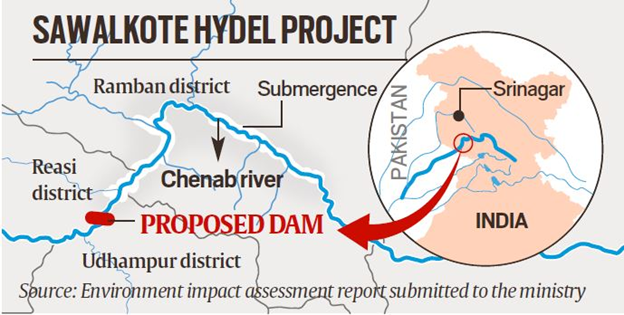
- Recently, an apex committee of the Environment Ministry has accorded a fresh environmental clearance to the Sawalkote hydroelectric project.
Sawalkote Hydroelectric Project
- Origin: First proposed 1984,
- Location – It is a run-of-the-river hydroelectric initiative located on the Chenab River in Jammu and Kashmir.
- Developed by – National Hydroelectric Power Corporation (NHPC).
- Energy capacity – It is one of India’s largest hydroelectric projects in the Indus basin, with a proposed capacity of 1,856 MW.
- Additional Information – Chenab river
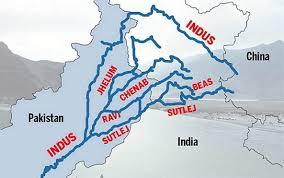
- Origin: The Chenab is formed at Tandi in Himachal Pradesh by the confluence of the Chandra and Bhaga rivers.
- Source: The Chandra and Bhaga rivers originate from the Barelacha Pass in the Himalayas.
- Flow: It flows through Himachal Pradesh and the Jammu region of Jammu and Kashmir, India, before entering Pakistan.
- Joining the Indus: In Pakistan, it joins the Sutlej River to form the Panjnad, which then merges with the Indus River.
Key facts for UPSC
- Other name: It is also known as the Chandrabhaga river.
- Historical name: In ancient texts, it was called
- Indus Waters Treaty: As a transboundary river, it is governed by the 1960 Indus Waters Treaty. Pakistan is allocated the Chenab’s waters, but India is permitted to use the water for non-consumptive purposes like hydroelectric power generation.
- Tributaries: The Marusudar is a major tributary of the Chenab.
Bharat Taxi
Syllabus: GS2/ Governance
In News
- A new cooperative ride-hailing platform called “Bharat Taxi” is set to launch in December 2025.
Bharat Taxi
- Launched by – The platform is being built with support from the National e-Governance Division (NeGD) and will integrate with national digital platforms like DigiLocker and UMANG.
- Promotion: The initiative is jointly promoted by a number of major cooperative and financial institutions, including NCDC, IFFCO, Amul, KRIBHCO, NAFED, NABARD, NDDB, and NCEL.
- Mission: It aims to create a driver-owned platform that provides higher earnings for drivers, transparent fares for riders, and an inclusive mobility ecosystem.
- Significance – The service is designed to compete with private ride-hailing services like Ola and Uber, without surge pricing, by leveraging a cooperative pricing model.
CCRAS Launches SPARK 4.0
Syllabus: GS2/ Governance
In News
- The Central Council for Research in Ayurvedic Sciences (CCRAS), under the Ministry of Ayush, announced the fourth edition of its flagship Studentship Program for Ayurveda Research Ken (SPARK) for 2025–26.
Studentship Program for Ayurveda Research Ken (SPARK)
- Objective – It aims to promote scientific curiosity and research skills among undergraduate Ayurveda students across the country.
Features –
- Under SPARK–4.0, 300 Bachelor of Ayurvedic Medicine and Surgery (BAMS) students from colleges recognised by the National Commission for Indian System of Medicine (NCISM) would be receiving a studentship of ₹50,000, disbursed as ₹25,000 per month over two months.
- The student would get short-term independent research projects and a certificate on completion.
- Significance – to strengthen Ayurveda’s research ecosystem.
Three Major Ports Recognised as Green Hydrogen Hubs Under The National Green Hydrogen Mission
Syllabus:GS3/Environment
In News
- The Ministry of New and Renewable Energy has designated Deendayal, V.O. Chidambaranar, and Paradip ports as Green Hydrogen Hubs under the National Green Hydrogen Mission.
Green Hydrogen
- Green Hydrogen: It is produced using electrolysis of water with electricity generated by renewable energy.
- Benefit: It is a clean burning element that can decarbonise a range of sectors including iron and steel, chemicals, and transportation.
- Hydrogen can be stored for long periods of time which can be used to produce electricity using fuel cells.
National Green Hydrogen Mission
- Aim: To make India a global hub for the production of green hydrogen.
- Implementing Ministry: Ministry of New and Renewable Energy(MNRE)
Additional Information – Hydrogen
- Symbol and Atomic number – Hydrogen is the chemical element with the symbol H and atomic number 1.
- Hydrogen is the lightest element and the most abundant chemical substance in the universe, constituting roughly 75% of all normal matter.
- It is colorless, odorless, tasteless, non-toxic, and highly combustible gas.
Leave a Reply