
Supreme Court on Retrospective Application of Surrogacy Act
Syllabus: GS2/ Health
In News
- In a landmark judgment, the Supreme Court ruled that the age restrictions under the Surrogacy (Regulation) Act, 2021, cannot be applied retrospectively to couples who had frozen embryos and initiated the surrogacy process before the Act came into force.
Surrogacy (Regulation) Act, 2021
- Definition of Surrogacy – The Act defines surrogacy as a practice where a woman gives birth to a child for an intending couple with the intention to hand it over to them after the birth.
- It is permitted only for altruistic purposes or for couples who suffer proven infertility or disease.
- Surrogacy is prohibited for commercial purposes including for sale, prostitution or any other forms of exploitation.
- Abortion: Abortion of such a fetus is allowed only with the consent of the surrogate mother and the authorities and must adhere to the provisions of the Medical Termination of Pregnancy Act.
- Eligibility and Conditions for Couples: A couple should procure certificates of eligibility and essentiality in order to have a child via surrogacy.
- The couple is deemed ‘eligible’ if they have been married for five years, the wife is aged between 23-50 years and the husband is between 26-55 years.
- The couple must not have any living child (biological, adopted or surrogate.)
- A child with mental or physical disabilities, or one suffering from a life-threatening disorder has been exempted from the above criterion.
- The couple can get an ‘essential’ certificate if suffering from proven infertility of either partner certified by a District Medical Board.
- They must also have insurance coverage for 16 months for the surrogate mother, covering any postpartum complications.
- Eligibilty to be a surrogate – A surrogate mother has to be a close relative of the couple, a married woman with a child of her own, aged between 25-35 years, who has been a surrogate only once in her life.
- She must also possess a certificate of medical and psychological fitness for surrogacy.
- Regulation: The Centre and State governments will constitute a National Surrogacy Board (NSB) and State Surrogacy Boards (SSB) respectively.
- Offences: Offences under the Act include commercial surrogacy, selling of embryos, exploiting, abandoning a surrogate child etc.
- These may invite up to 10 years of imprisonment and a fine of up to Rs. 10 lakh.
- Importance : The Act expands access to reproductive options for individuals and couples who are unable to conceive or carry a pregnancy due to medical reasons.
World Mental Health Day
Syllabus: GS2/Health
Context
- On October 10, every year, World Mental Health Day highlights the extent of mental illness in the world.
- Global Mental Health Issue (as per WHO): More than a billion people are living with mental health disorders.
World Mental Health Day
- Most Common Mental Health Disorders: Anxiety and depressive disorders together accounted for more than two-thirds of all mental health conditions in 2021.
- Mental Health in India: India has a 7% lifetime prevalence of mental disorders in the country.
- According to the latest NCRB data, 1,71,418 suicides were reported in India in 2023, a 0.3% increase from 2022, with Maharashtra recording the highest number.
- Even more alarming, student suicides reached 13,892, a 64.9% rise over the past decade.
Rise in Mental Health Issues Among Youth
- Excessive internet & social media use: Leads to anxiety, sleep disorders, and attention issues.
- Lack of family engagement: Weak social support systems negatively impact emotional well-being.
- Hostile workplaces & long working hours: Cause burnout, stress, and reduced productivity.
- Unhealthy lifestyle choices: Ultra-processed foods and lack of physical activity worsen mental and physical health.
Understanding Mental Wellbeing
The India’s National Mental Health Survey defines mental well-being as a multidimensional concept that includes:
- Emotional health: Managing stress and emotions effectively.
- Social health: Building healthy relationships and a supportive community.
- Cognitive health: Enhancing focus, decision-making, and problem-solving abilities.
- Physical health: Maintaining overall fitness through a healthy lifestyle.
Key Initiatives by the Government of India
- Mental Healthcare Act, 2017: The act decriminalised suicide attempts in India and also included WHO guidelines in the categorisation of mental illnesses.
- The most significant provision in the act was “advance directives”, which allowed individuals with mental illnesses to decide the course of their treatment.
- It also restricted the use of electro-convulsive therapy (ECT) and banned its use on minors, finally introducing measures to tackle stigma in Indian society.
- Rights of Persons with Disabilities Act, 2017: The Act acknowledges mental illness as a disability and seeks to enhance the Rights and Entitlements of the Disabled.
- In Sukdeb Saha vs State of Andhra Pradesh, the Supreme Court of India reinforced mental health as a fundamental right under Article 21.
- District Mental Health Programme (DMHP): Delivered in 767 districts, offering services like suicide prevention, stress management, and counseling.
- National Tele Mental Health Programme (NTMHP): Launched in 2022 to provide access to mental health services through 53 Tele MANAS Cells across 36 states/UTs.
Atacama Desert
Syllabus: GS1/ Geography
In News
- A rare burst of winter rains has triggered in Chile’s Atacama Desert
Atacama Desert
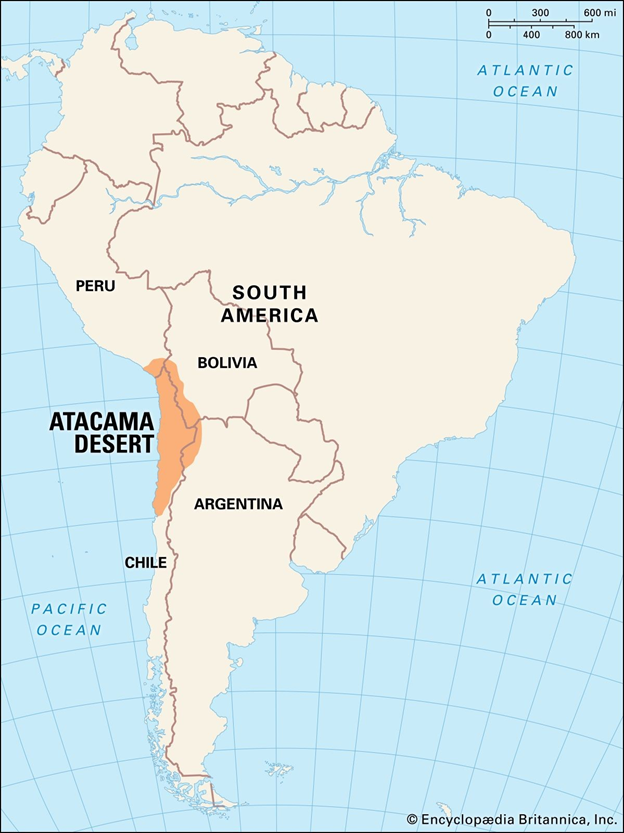
- Location: It is the driest desert in the world, located in northern Chile.
- It is nestled between the Andes Mountains on the east and the Pacific Ocean on the west.
- It forms a continuous strip for nearly 1,000 km along the narrow coast of the northern third of Chile.
- Bordered by: It is bordered by Argentina, Peru, and Bolivia
- It also hosts 12 volcanoes, mainly located in the western outliers of the Andes.
- Rainfall: Average rainfall in this region is about 1 mm per year. Some locations within the desert have never had any rainfall whatsoever.
- Temperature: Temperatures are comparatively mild throughout the year. The average temperature in the desert is about 63 degrees F (18 degrees C).
- Natural Resources: This region has the largest natural supply of Sodium Nitrate, which can be used for producing fertilizers and explosives, amongst other things.
- Chinchorro Mummies: The oldest artificially mummified human remains have been found in the Atacama Desert.
Africa’s Great Green Wall project
Syllabus: GS2/IR
Context
- Despite ambitious goals to restore 100 million hectares of land across Africa, the Great Green Wall project faces significant challenges in Senegal.
Africa’s Great Green Wall project
- Launched by – African Union in 2007,
- Objective – It aims to combat desertification and land degradation across the Sahel region by creating a mosaic of green and productive landscapes.
Key aspects of the Great Green Wall
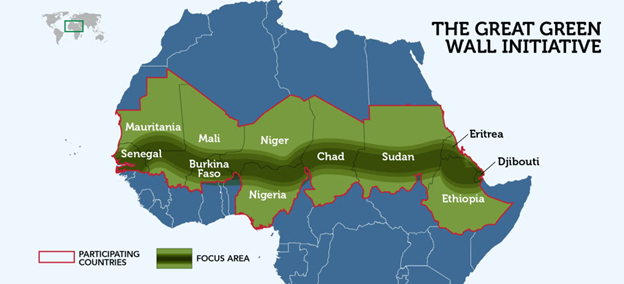
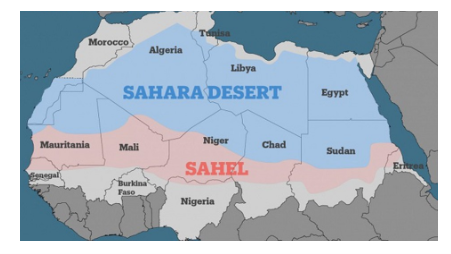
- Location: The project focuses on the Sahel region, a semi-arid zone that stretches across Africa, forming a transition between the Sahara Desert to the north and the savannas to the south.
- Countries involved: Originally involving 11 countries, the initiative now includes over 20 nations across Africa’s width, from Senegal in the west to Djibouti in the east. Core participating countries include Burkina Faso, Chad, Djibouti, Eritrea, Ethiopia, Mali, Mauritania, Niger, Nigeria, and Sudan.
Objectives
- Land restoration: To restore 100 million hectares of degraded land by 2030.
- Climate change mitigation: To sequester 250 million tonnes of carbon from the atmosphere.
- Livelihood improvement: To create 10 million green jobs for local communities, enhancing food security and reducing poverty.
Additional Information – African Union
- The African Union (AU) is a continental body consisting of the 55 member states that make up the countries of the African Continent.
- It was officially launched in 2002 as a successor to the Organisation of African Unity (OAU, 1963-1999).
- Aim: integration of African states to drive Africa’s growth and economic development.
UN to Cut 25% of its Global Peacekeeping Force
Syllabus:GS2/IR
In News
- The United Nations is going to reduce its global peacekeeping operations by 25%, with 13,000–14,000 personnel expected to withdraw from nine missions due to significant U.S. funding cuts.
United Nations peacekeepers
- The United Nations (UN) Peacekeepers, commonly known as the ‘Blue Helmets’
- They are military, police, and civilian personnel deployed by the United Nation
- Objective – to help countries transition from conflict to peace.
- Duties – It includes protecting civilians, preventing conflict, strengthening security, and supporting peace processes.
- Peacekeeping operations are authorized by the UN Security Council and supported by member states, with personnel drawn from many countries around the world.
Saksham
Syllabus:GS3/Defence
In News
- The Indian Army has initiated the procurement of SAKSHAM (Situational Awareness for Kinetic Soft and Hard Kill Assets Management).
Saksham
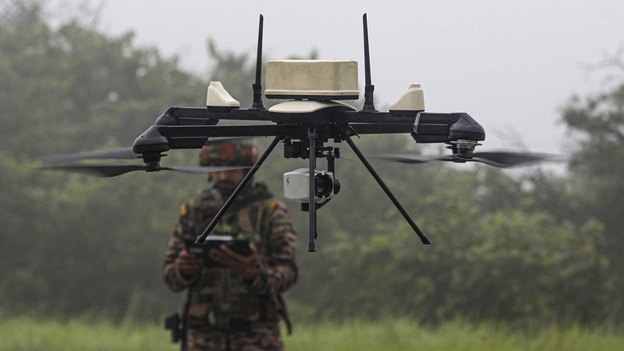
- It is an indigenously developed Counter-Unmanned Aerial System (CUAS) Grid System, to bolster operational readiness against emerging drone threats.
- It is a modular Command and Control (C2) system that integrates real-time sensor data, AI-driven analytics, and counter-drone capabilities to secure the Tactical Battlefield Space (TBS).
- It was developed in collaboration with Bharat Electronics Limited (BEL).
Leave a Reply