
150 Years of Vande Mataram
Syllabus: GS1/ Modern History
Context
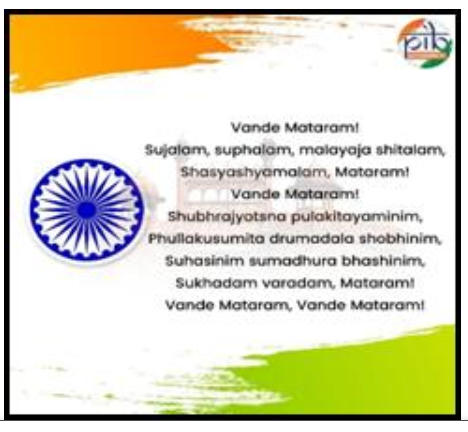
- India is celebrating the 150th anniversary of its national song, Vande Mataram.
Historical Background
- It was composed by Bankim Chandra Chatterjee in Sanskrit and first appeared in the novel Anandamath in 1882.
- First sung by Rabindranath Tagore at the 1896 Indian National Congress session gave it national exposure.
- The song celebrates the motherland as an embodiment of strength, prosperity, and divinity and provided a poetic voice to India’s awakening national consciousness.
Rise of National Consciousness
- During the Swadeshi Movement of 1905, Vande Mataram emerged as the anthem of civil resistance.
- Vande Mataram, as a political slogan, was first used on 7 August 1905.
- For many young revolutionaries facing execution, Vande Mataram became the last chant before martyrdom, turning the song into a symbol of sacrifice.
- In 1907, Madam Bhikaji Cama raised the tricolour flag for the first-time outside India in Stuttgart, Berlin. The words Vande Mataram were written on the flag.
- In October 1905, a Bande Mataram Sampradaya was founded in North Calcutta to promote the idea of the Motherland as a mission and a religious passion.
- In 1906, an English daily titled Bande Mataram was launched under the editorship of Bipin Chandra Pal, with Aurobindo later joining as joint editor.
National Song
- After independence, the Constituent Assembly deliberated on the status of Vande Mataram.
- On 24 January 1950, the first two stanzas were adopted as India’s National Song.
Bankim Chandra Chattopadhyay
- Bankim Chandra Chattopadhyay was one of the architects of modern Indian literature.
- As a distinguished novelist, poet, and essayist, his contributions significantly influenced the development of modern Bengali prose and the articulation of an emerging Indian nationalism.
- Other works: Durgeshanandini (1865), Kapalkundala (1866), and Devi Chaudhurani (1884).
Thailand-Cambodia Conflict
Syllabus: GS2/IR
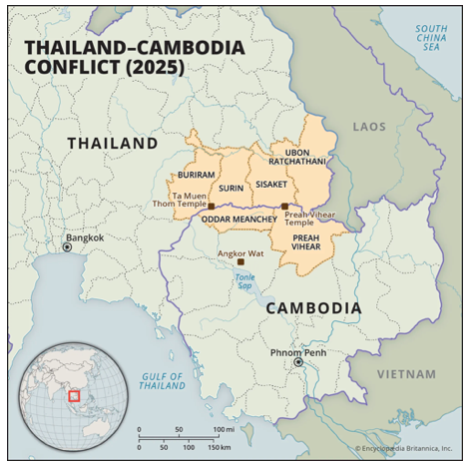
In News
- Recently, Thailand launched airstrikes on Cambodian military targets.
Background
- The conflict centers on a long-standing territorial dispute dating back to colonial-era border demarcations made by France in 1907.
- At the heart of the dispute is the Preah Vihear temple, a culturally significant 11th–12th century Khmer shrine claimed by both countries.
- Though the International Court of Justice affirmed Cambodian sovereignty in 1962 and again in 2013, Thailand has rejected the rulings, and the area remains heavily militarized.
UPI Recognized as World’s Largest Real-Time Payment System by IMF
Syllabus: GS3/Economy
In News
- The International Monetary Fund (IMF) report on ‘Growing Retail Digital Payments (The Value of Interoperability)’ dated June 2025 had recognized Unified Payments Interface (UPI) as the world’s largest retail fast-payment system (FPS) by transaction volume.
Unified Payments Interface (UPI)
- Launched by – UPI was designed and launched by the National Payments Corporation of India (NPCI) in 2016.
- Objective – It is a system that powers multiple bank accounts into a single mobile application (of any participating bank), merging several banking features, seamless fund routing & merchant payments into one hood.
- Countries with operational or planned interoperability include: Singapore (PayNow), UAE, France, Nepal, Bhutan, Mauritius, Sri Lanka, Indonesia, and others.
Additional Information – National Payments Corporation of India (NPCI)
- Established in – It serves as an umbrella body for the operation of retail payments in India.
- Established by – Reserve Bank of India along with the Indian Bank’s Association.
- Established under – It was set up under the provisions of the Payment and Settlement Systems Act, 2007.
Products of NPCI
- RuPay
- National Common Mobility Card
- Bharat Interface for Money (BHIM)
- Unified Payments Interface (UPI)
- Bharat Bill Payment System
International Big Cat Alliance (IBCA)
Syllabus: GS3/ Environment
In News
- The Union Minister for Environment, Forest and Climate Change addressed a high-level meeting of the Collaborative Initiative for Big Cat Conservation under the International Big Cat Alliance (IBCA) in New Delhi.
International Big Cat Alliance (IBCA)
- Headquarters – India,
- Objective – It is a multi-country, multi-agency coalition of 95 big cat range countries with an interest in big cat conservation.
- Genesis: IBCA was launched by the Prime Minister of India in 2023 during the event ‘Commemorating 50 years of Project Tiger’.
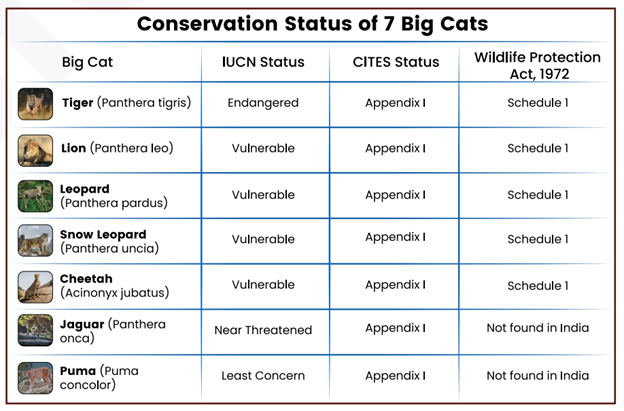
- Aim: Conserving seven big cats – Tiger, Lion, Leopard, Snow Leopard, Cheetah, Jaguar, and Puma.
- Members: Nicaragua, Eswatini, India, Somalia and Liberia have signed the Framework Agreement to formally become members of the IBCA.
C. Rajagopalachari
Syllabus: GS1/History
In News
- Prime Minister Narendra Modi paid tribute to C. Rajagopalachari popularly known as Rajaji on his birth anniversary (10th December).
- Rajagopalachari
Early Life and Education:
- He was a close associate of Mahatma Gandhi.
- Completed Bachelor of Law (1899) and began practicing law in Salem.
- Early political consciousness was shaped by Curzon’s Partition of Bengal (1905) and Tilak’s call for Swaraj.
Contributions to Freedom’s Struggle:
- He left his legal career in 1919 and went on to play a leading role in several major movements, including the protests against the Rowlatt Act, the Non-Cooperation Movement, the Vaikom Satyagraha, and the Civil Disobedience Movement.
- Led the Vedaranyam Salt Satyagraha (1930) in the Madras region, parallel to Gandhi’s Dandi March.
- After Quit India Movement, published “The Way Out”, proposing the C. R. Formula to resolve the constitutional deadlock with the Muslim League over Pakistan.
Post-Independence Contributions:
- Appointed Governor of West Bengal and later became the first Indian Governor-General of India (1947–1950) after independence.
- Worked to protect India’s secular fabric and integrate Muslims into the national mainstream.
- Served as Union Home Minister after Sardar Patel’s death; contributed to national integration & early planning processes, including the First Five-Year Plan.
- Legacy: He was awarded the Bharat Ratna in 1954 for his contributions to politics, literature and public service.
‘Your Money, Your Right’ Movement
Syllabus: GS2/Governance/GS3/Economy
In News
- Prime Minister Narendra Modi urged citizens to participate in the ‘Your Money, Your Right’ movement.
‘Your Money, Your Right’ movement
- It is an initiative, launched in October 2025
- It was designed to ensure citizens can reclaim their rightful assets.
- It aimed at helping people recover unclaimed deposits, insurance proceeds, dividends and other financial assets.
- Significance – It offers individuals a chance to convert forgotten financial assets into usable funds.
|
Do you know? ● Indian banks currently hold about ₹78,000 crore in unclaimed deposits. ● Insurance companies have nearly ₹14,000 crore lying unclaimed, mutual fund companies around ₹3,000 crore, and unclaimed dividends amount to roughly ₹9,000 crore. |
Various Steps
- Dedicated online portals have been created to enable easy tracking and claiming of funds:
- RBI UDGAM Portal for unclaimed bank deposits
- IRDAI Bima Bharosa Portal for unclaimed insurance proceeds
- SEBI MITRA Portal for unclaimed mutual fund amounts; and
- IEPFA Portal for unpaid dividends and unclaimed shares.
- Facilitation camps have been held in 477 districts across the country, with a focus on rural and remote areas.


Leave a Reply