
150 Years of Foundation of Arya Samaj
Syllabus: GS1/ Art & Culture
In News
- The Prime Minister addressed the International Arya Mahasammelan 2025 in New Delhi, praising Arya Samaj’s 150-year legacy in social reform, education, and Vedic thought.
- PM Modi urged Arya Samaj to support the Gyan Bharatam Mission – digitising ancient manuscripts and engaging youth in preserving India’s knowledge heritage.
Arya Samaj
- Founded by – Swami Dayanand Saraswati
- Established in – 1875 in Bombay, which was finalized in Lahore in 1877.
Major Reforms
- Religious – Rejected idol worship, ritualism, and priestly dominance
- Social – Opposed caste by birth, untouchability, child marriage, and forced widowhood. Advocated inter-caste marriage, widow remarriage, women’s education, and social service.
- Educational: Established DAV schools and Gurukul Kangri to blend Vedic knowledge with modern science, fostering social mobility and nationalism.
Role in Indian Nationalism and Social Change
- Arya Samaj members, including Lala Lajpat Rai, Bhagat Singh, and others, contributed significantly to India’s freedom movement, promoting Swadeshi and social awakening.
Relevance of Arya Samaj in Contemporary India
- Women Led Progress: Arya Samaj’s early advocacy for women’s empowerment aligns with national initiatives like Beti Bachao Beti Padhao, Nari Shakti Vandan Adhiniyam and “Drone Didis”.
- Preserving Gurukul Tradition & Educational Reform: Arya Samaj revived India’s Gurukul system, blending Vedic learning with modern education.
- Vedic Ideals & Global Relevance: The motto “Krinvanto Vishwam Aryam” mirrors India’s development philosophy — national progress for global welfare. Its ideals resonate in initiatives like Mission LiFE, One Sun One World One Grid, and International Yoga Day, spreading sustainable and spiritual living worldwide.
APEC Summit (2025)
Syllabus: GS2/International Relation; Global Grouping
Context
- Recently, the Asia-Pacific Economic Cooperation (APEC) Summit (2025), held in Gyeongju, South Korea, concluded with the adoption of APEC Leaders’ Gyeongju Declaration (2025)
APEC Summit (2025)
- Adoption of Leaders’ Declaration (Gyeongju Declaration): APEC leaders endorsed a joint declaration reaffirming their commitment to:
- Free and open trade across the Asia-Pacific region;
- Strengthening supply chain resilience;
- Promoting inclusive and sustainable economic growth;
- Advancing digital transformation and climate action.
Asia-Pacific Economic Cooperation (APEC)
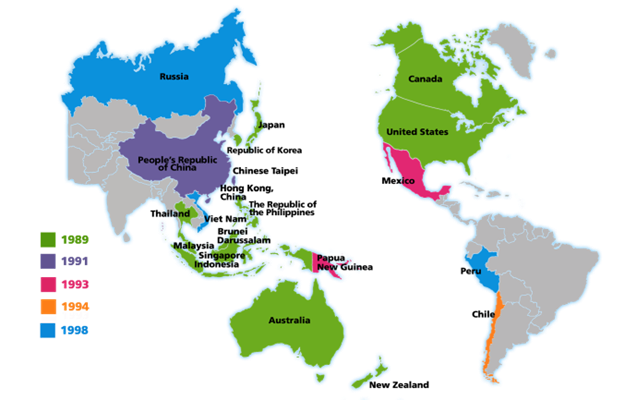
- It is a regional economic forum established in 1989
- Mandate – to strengthen the interdependence of economies across the Asia-Pacific region.
- Member Economies (21 Members): Australia; Brunei Darussalam; Canada; Chile; People’s Republic of China; Hong Kong, China; Indonesia; Japan; Republic of Korea; Malaysia; Mexico; New Zealand; Papua New Guinea; Peru; The Philippines; The Russian Federation; Singapore (APEC Secretariat & Headquarter); Chinese Taipei; Thailand; United States of America; and Viet Nam.
Carbon Capture for Net-Zero India
Syllabus: GS3/ Environment
Context
- Ocean-based carbon capture can help India reach net-zero by 2070, turning its seas into engines of carbon removal and blue growth.
What is Carbon Capture, Utilisation, and Storage (CCUS)?
- The International Energy Agency (IEA) defines CCUS as a group of technologies for capturing of CO2 from large and stationary CO2 emitting sources, such as fossil fuel based power plants and other industries.
India’s Emission Reductions Commitments
- India has launched the LiFE mission (Lifestyle for Environment) and updated its NDCs (Nationally Determined Contributions) under the Paris Agreement.
Under its updated NDC 2022, India pledges:
- 45% reduction in emissions intensity (amount of CO₂ per unit of GDP) by 2030, compared to 2005 levels.
- 50% of installed electricity capacity will come from non-fossil fuel sources by 2030.
- Creating a carbon sink of 2.5 to 3 billion tonnes of CO₂ equivalent (GtCO₂e) by increasing forests and tree cover.
Union Health Ministry sets 3 Guinness World Records
Syllabus: GS2/Health
Context
- The Union Health Ministry has achieved three Guinness World Record titles under the nationwide “Swasth Nari, Sashakt Parivar Abhiyaan” (SNSPA) campaign.
The Records Achieved are:
- Most people register for a health care platform in one month.
- Most people sign up for a breast cancer screening online in one week.
- Most people sign up for vital signs screening online in one week (at state level).
Swasth Nari, Sashakt Parivar Abhiyaan
- Launched from – It was launched from 17th September to 2nd October 2025, in conjunction with Poshan Maah.
- Objective -The campaign focuses on improving the health and nutrition of women, adolescent girls, and children.

Leave a Reply